
Main Article:
Ami Ayalon, the former head of the Israeli Shin Bet and of the Israeli navy, has argued for years that the Sunni Arab states could form a regional coalition only on one condition. In 2024 he said such a coalition "will not be created unless it is for the sake of two states," and that Israel should not be part of it [1].
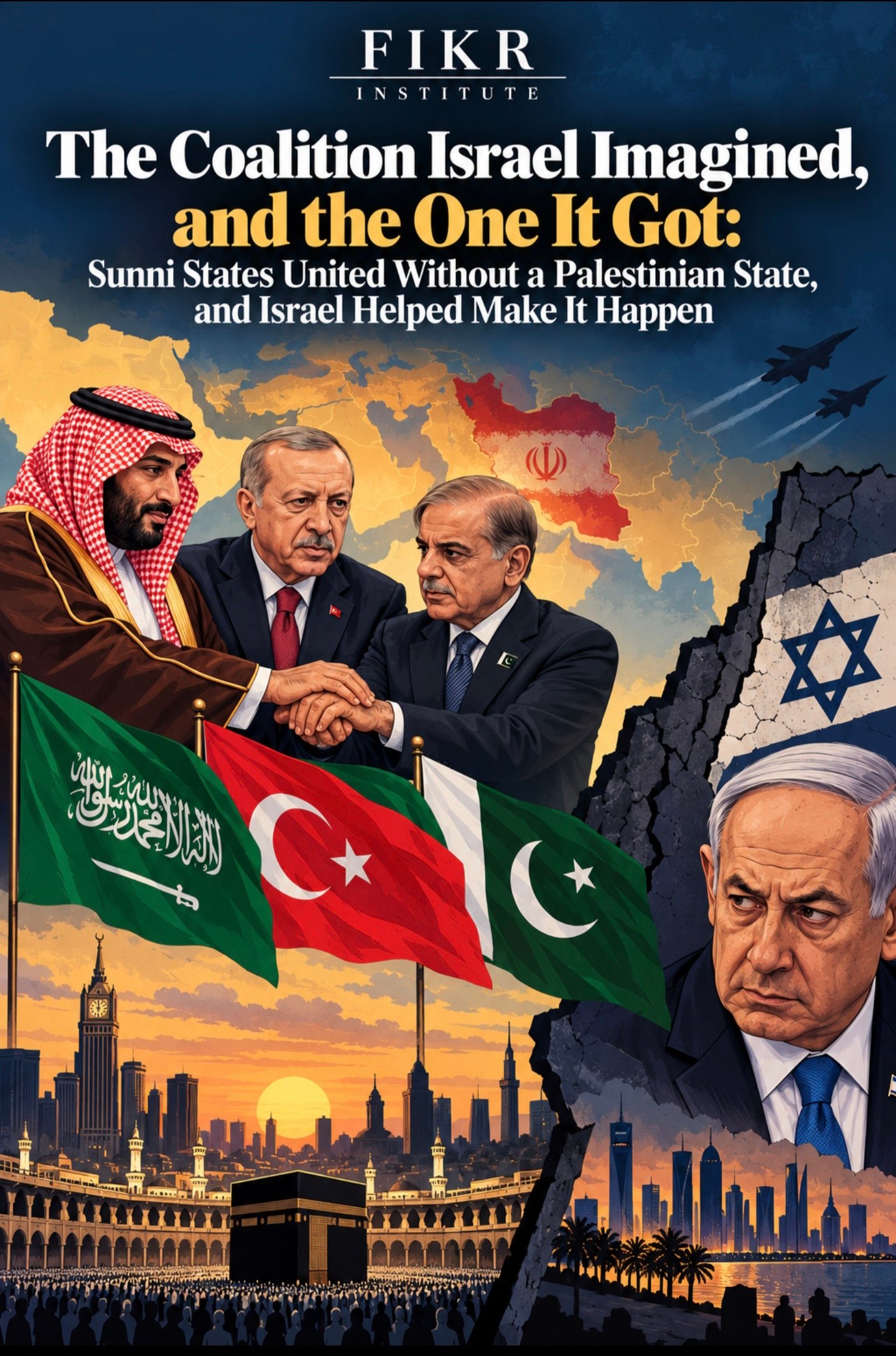
In August 2026, Saudi Arabia, Türkiye and Pakistan signed the Mecca Joint Defence Agreement, under which an armed attack on one is treated as an attack on all [2]. On October 26, Egypt approved military support for Saudi Arabia [3]. There is no Palestinian state. Israel is not part of the alliance.
So was Ayalon wrong? And does Israel, as some argue, now enjoy the benefit of a Sunni wall against Iran without paying the price of a Palestinian state? Fikr reads the record differently.
What Israeli strategists hoped the Sunni axis would be
The idea of a Sunni axis is not new in Israeli strategic writing. In 2013, two researchers at the Institute for National Security Studies in Tel Aviv described an emerging Sunni bloc of Gulf monarchies and Türkiye that counterbalanced Iran. They wrote that, from the Israeli perspective, "greater regional firmness toward Iran is a positive development," and that the change "offers an opportunity to further isolate Iran" [4]. They also warned that the same trend could hamper the Israeli "freedom of diplomatic and military action" [4].
That is the hope and the fear in one paragraph. A Sunni bloc that faces Iran serves Israel. A Sunni bloc that faces Israel does not.
What built the alliance
The record shows that the alliance did not form only against Iran. Talks between the three began after October 7, 2023 and the war on Gaza, and gathered pace during the US and Israeli war on Iran [5]. The bilateral pact between Saudi Arabia and Pakistan that preceded it was signed on September 17, 2025, eight days after Israeli jets struck a residential compound in Doha, the capital of a Gulf state [6]. Researchers at the Center for Strategic and International Studies wrote that the Doha strike created "a sense of urgency and political cover for Riyadh to formalize the pact" [6].
Iranian aligned attacks on Saudi Arabia are real, and analysts say the alliance keeps one eye on Iran [2]. But a Gulf capital struck by Israel, and a war on Gaza that no Arab government could defend to its people, were also in the foundations. Ayalon expected the Palestinian question to decide whether a coalition could form. In the end, the war on the Palestinians and the strike on Doha helped bring one into being.
How Israel reads it
Israel does not see the alliance as its buffer. When the pact was signed, a senior Israeli official told Ynet: "This alliance is aimed against Israel" [7]. Naftali Bennett, who hopes to lead the next Israeli government, called Türkiye "the new Iran" [5]. In February, Netanyahu announced a "hexagon" of alliances against what he called "the radical Shia axis" and "the emerging radical Sunni axis" [8], and in October he displayed a map placing Saudi Arabia, Türkiye, Egypt and Pakistan in a bloc of their own [9].
An alliance that the Israeli government lists among its enemies is not one from which it collects a free dividend.
Where Israel could still benefit
There is one path on which the earlier hope of Israeli strategists would come true: if the Mecca pact becomes an instrument of war against Iran. A Sunni bloc and a Shia state bleeding each other, with Saudi interceptors spent and Turkish and Pakistani forces drawn in, would weaken every Muslim power at once, while Israel keeps its occupation and pays nothing. Saudi Arabia had reportedly already used some 86 percent of its PAC 3 MSE interceptors by August [10]. Haaretz reported that Netanyahu sought Saudi approval to join the fight against the Houthis, and that the crown prince refused [11].
That is the outcome that would serve Israel. It is not the outcome the alliance has chosen so far.
The alliance members have drawn the line themselves. The Turkish foreign minister, Hakan Fidan, said: "This is a defence agreement," and "This is not an offensive agreement," and Türkiye has ruled out sending troops to attack the Houthis inside Yemen [12]. On October 26, the Saudi defence minister, the Pakistani army chief and the Turkish intelligence chief went to Tehran [13]. Iranian media said the four agreed to continue discussions to strengthen cooperation [14], and no security deal was announced [15].
Where Ayalon was right, and where he was not
Ayalon was right that a coalition of Muslim states would not include Israel, and right that the Palestinian question would shape it. He was not right that it would wait for a Palestinian state. It formed because of what happened in its absence.
Fikr tests the hypothesis in levels
The hypothesis: the Mecca alliance benefits Israel by containing Iran at no cost to Israel.
Formation: not supported. The alliance grew out of the Gaza war, the strike on Doha and the war on Iran together [5][6].
Israeli perception: contrary. Israeli officials and leaders call the alliance a threat [7][8][9].
The conditional benefit: real. Israel gains only if the alliance turns into a war against Iran [4][11].
The signs to watch: whether the Tehran talks continue to a second round; whether Houthi attacks on Saudi Arabia fall; whether Türkiye completes ratification; whether Egypt formally joins; and whether the next Israeli government seeks a role in any war on the Houthis or Iran.
The verdict
Fikr Institute judges that Israel is not the benefactor of the Mecca alliance as it stands. It would become one only if the alliance is turned into a Sunni wall in a war against Iran, the outcome Israeli strategists welcomed in 2013 and the one Netanyahu still frames with his two axes.
The alliance has so far refused that role. It defends Riyadh and talks to Tehran. The question for the Muslim world is whether it can hold that line. A pact that guards its members and keeps its neighbours at the table serves Muslims. A pact that is pushed into fighting them serves only those outside who have always gained when Muslims fight each other.