
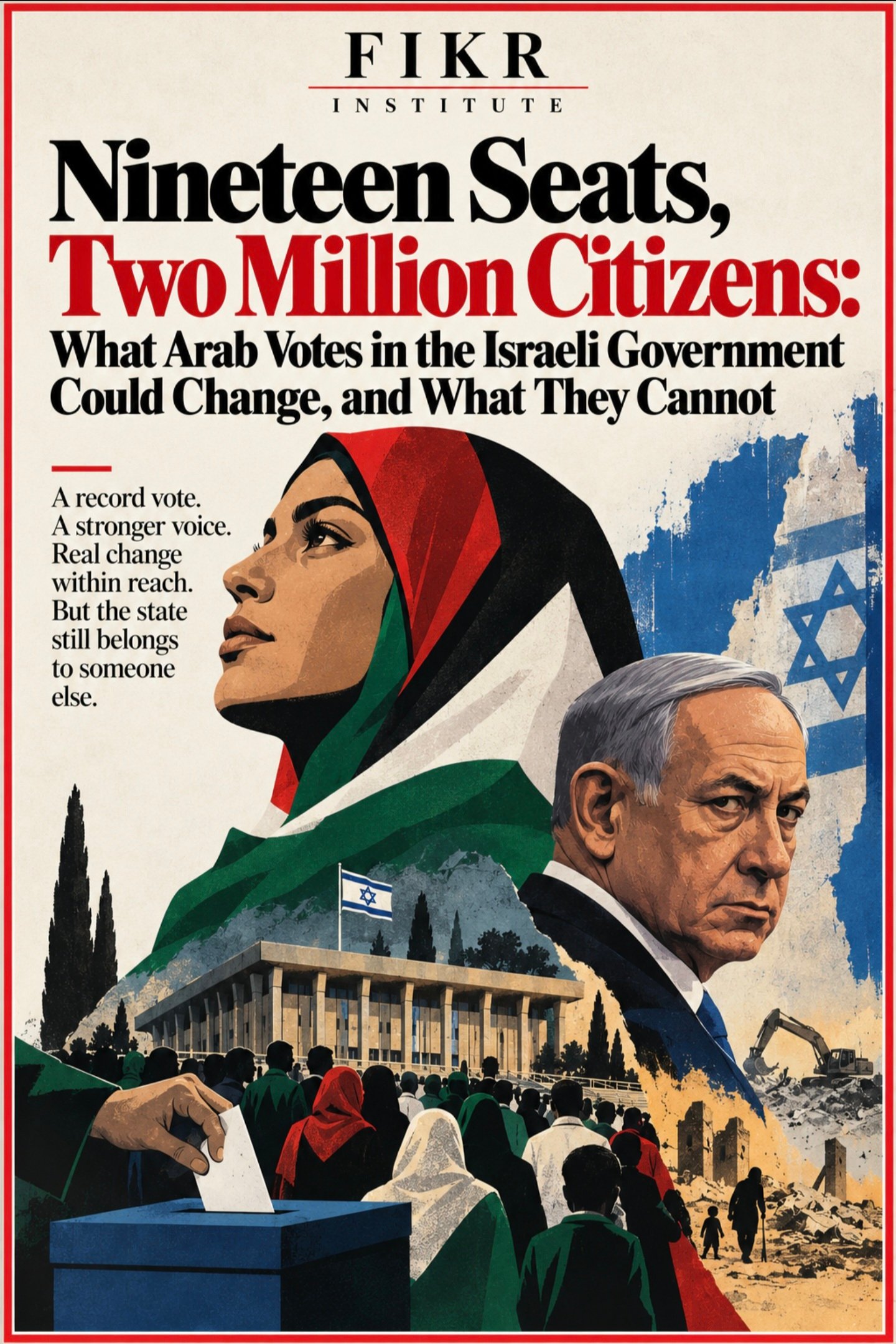
Whenever the word apartheid is used about Israel, the same answer comes back: two million Arabs live inside Israel, vote and sit in the Knesset. On October 27, they used that vote as never before. Around 80 percent turned out, according to polling cited by Channel 12, and Arab parties won a record 19 seats, 12 for the Joint List and 7 for Raam, against a previous record of 15 in 2020 [1][2]. Without them, no bloc reaches the 61 seats needed to govern [3][4].
So Fikr asks the question the answer avoids. If the vote is real, what does it buy? And if those 19 seats entered or supported the next Israeli government, what would change in the lives of the Arab citizens of Israel, and what would not?
What the citizen with a vote still lacks
Begin with the measurable gaps.
Poverty. In 2024, 37.6 percent of Arab families in Israel lived below the poverty line, against 20 percent of all families, according to the National Insurance Institute [5].
Safety. In 2025, 252 people were killed in Arab communities, up from 74 in 2018 [6]. Research by the Taub Center puts the homicide rate in Arab society at about 11.7 per 100,000, against roughly 0.74 among Jewish Israelis [6]. An Arab citizen is about fifteen times more likely to be murdered than a Jewish one. In the first 36 days of 2026 alone, 35 were killed [6].
Land and home. About 30 percent of the roughly 300,000 Bedouin of the Negev live in villages the state does not recognise [7]. On October 12, bulldozers destroyed about 80 homes and a mosque in one such village, Al Dahiya, leaving about 400 people, 250 of them school students, without shelter [7]. The rights group Adalah calls it "an unprecedented crisis of forced displacement, mass evictions and home demolitions" [7].
Status. In 2018, Israel passed the Nation State Law, which declares that the right to national self determination in the state of Israel is "unique to the Jewish people," and lowered Arabic from an official language to a "special status" [8]. The Supreme Court upheld it in 2021 [8].
A vote that elects members of parliament has not closed any of these gaps. The question is whether a vote that helps form a government could.
What participation has already shown
There is a precedent. In 2021, the Raam party of Mansour Abbas became the first independent Arab party to join an Israeli governing coalition [9]. What it obtained was concrete. In October 2021, the cabinet approved a five year plan of 29.5 billion shekels for Arab communities, covering education, welfare, employment of women and municipal services, and a separate plan of 2.4 billion shekels to fight crime [10]. The government also moved to recognise some unrecognised Bedouin villages and to connect thousands of homes built without permits to the electricity grid [9].
And there is the second half of the precedent. When that government fell and Netanyahu returned, his finance minister, Bezalel Smotrich, froze about 300 million shekels earmarked for Arab local authorities [11]. What a coalition partner wins in one government, the next government can withhold.
Even the plan itself was modest against the need. The Musawa policy centre said that closing decades of neglect would require up to 10 billion shekels a year [10].
What the Arab parties are asking for now
The two Arab lists have now made their offers. Mansour Abbas said Raam would join a government led by Eisenkot [12]. The Joint List will not join, but Ahmad Tibi said it is "ready" and "willing" to help form a minority government from outside, without ministers, on condition that it tackles crime in Arab towns and halts the demolition of Bedouin homes [13]. Before the vote, the list had also asked for diplomatic steps toward a Palestinian state, and said its support would come as a "safety net," not "a blank check" [14].
The first two are the kind of gains Raam won in 2021. The third is where the limit lies. Gadi Eisenkot, who leads the main opposition bloc, has vowed to prevent the creation of a Palestinian state [15], and said before the vote: "I will not align myself with any Arab party" [16]. After the count, Eisenkot did not answer the offer. He repeated that his priority is a "Zionist government committed to military conscription," and Tibi said Eisenkot had not contacted him [13]. Naftali Bennett and Avigdor Liberman have also pledged not to sit with Arab parties, though Bennett led the government that included Raam in 2021 [2]. Only Yair Golan of the Democrats has openly called for a government formed in partnership with the Arab citizens of Israel [17].
Meanwhile, Likud has declared that the election was "stolen" by Arab parties [12], a claim the police say they have no evidence for [18]. Any opposition leader who counts the Arab seats will do so under that accusation.
What 19 seats could change
If the Arab parties support or join the next government, the realistic gains are in the services of citizenship. Budgets for Arab towns can be restored and protected. A serious plan against crime can be funded and enforced. Demolitions in the Negev can be slowed, and some villages recognised and connected. These are not small things. For a family in Al Dahiya, or a mother in a town where shootings are weekly, they are the difference between a state that neglects them and one that serves them.
What 19 seats cannot change
But there is a ceiling, and it is written into law. No coalition deal can repeal a Basic Law that reserves national self determination to one people without a Knesset majority that does not exist. No partner in a government led by Eisenkot will be allowed to bring a Palestinian state onto the table [15]. And the policies toward Gaza, the West Bank and Iran will be decided by the same security consensus that Arab members are excluded from shaping.
The deepest limit is the one revealed this week. Both main blocs had ruled out governing with the Arab parties before a single vote was cast [4][16]. Arab citizens can vote, but their parties are treated as a reserve to be used only in an emergency, and quietly, from outside the cabinet.
Fikr tests the hypothesis in levels
The hypothesis: the Arab vote in Israel delivers representation without power, and power, when it comes, is limited to services rather than status.
Representation: real. Arab parties won a record 19 seats [1].
Power: conditional. Both main blocs refuse a formal coalition with them [4][16], Eisenkot has not answered their offer [13], and the largest Arab list offers only outside support [13].
Gains: possible but reversible. The 2021 plans were real [10][9], and the next government withheld funds [11].
Status: unchanged. The Nation State Law remains, and the main opposition rejects a Palestinian state [8][15].
The signs to watch: whether any government is formed with the Arab seats counted, inside or outside; whether the Joint List conditions on crime and demolitions enter a written agreement; whether the 2021 plans are restored and protected in law; and whether demolitions in the Negev slow in the months ahead.
The verdict
Fikr Institute judges that the two million Arab citizens of Israel are not proof that Israel is equal. They are the test of whether it is. Their votes can now decide who governs. If the 19 seats bring budgets, safety and an end to demolitions, that will matter in daily life. But they will not change what the state says about who it belongs to.
A citizen whose vote can win a road but not a place in the definition of the state has been given a voice in the house, but not a key to it.