
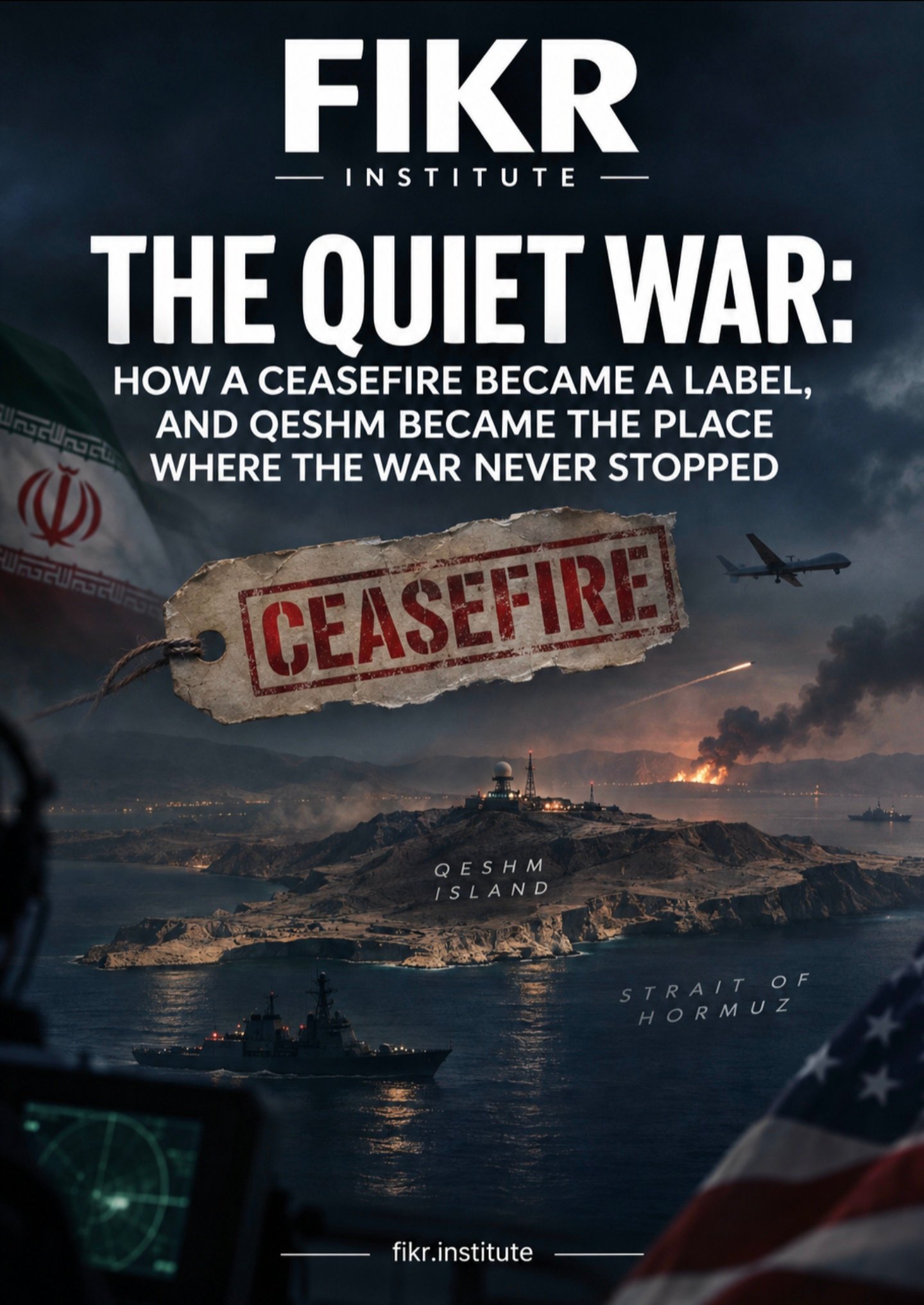
On Friday, November 6, American forces struck Qeshm Island in the Strait of Hormuz. Asked about it the next day, Trump said Iran had built a small anti aircraft device and that American forces knocked it out "in about 15 minutes" [1]. Iranian state media reported two missile strikes in the Suza area of the island, and the Iranian army said its air defences had shot down an American Reaper drone [1]. Central Command said the situation was "relatively calm" [1].
Most coverage asks whether this was defence or provocation. Fikr asks a different question. Why do Americans learn about these strikes, if at all, from the president in passing or from a newspaper days later, while officially there is a ceasefire?
The ceasefire is real on paper. In early April, Pakistan brokered a pause, and Trump announced that he agreed to suspend the bombing and attack of Iran for a period of two weeks [2]. Since then, the record shows something else. On March 7, before the pause, strikes put a desalination plant on Qeshm out of service; Iran blamed the United States and Israel [3]. On May 7, a month into the ceasefire, Iranian forces attacked three American destroyers in the strait, and the United States struck Qeshm, Bandar Abbas and a naval facility in Minab. Central Command described them as strikes in self defence, Trump described the response as a love tap, and he said the ceasefire was in effect [4]. On the night of November 2, the eve of the midterm elections, American forces struck Qeshm again [5]. The military did not announce it. The Wall Street Journal reported it, and reported that the administration had "purposefully" kept its recent smaller strikes quiet [5]. Then came November 6.
That is the part that needs adding up. The war that voters judged on November 3 was the visible war: the February attacks, the oil price, the blockade. The war still being fought is designed not to be seen. Each strike is small. Each is called defensive. Each is either left unannounced or described as a matter of minutes. And because none is large enough to count as a return to war, the ceasefire can be declared intact after every one of them [4][1].
This design does three things that a declared campaign cannot.
First, it needs no vote. In June, Congress voted to halt the war, and the White House called the measure not binding, as Fikr documented in Five Ballots, One Rule. A strike that is never announced is never put to anyone. It cannot be debated, because officially it did not happen.
Second, it turns the ceasefire into a label. A ceasefire is meant to describe a fact: the guns are silent. Here it describes a status that survives the guns. On May 7, the United States struck three locations and the president said the ceasefire was in effect [4]. A word that remains true whatever happens no longer describes anything. It protects.
Third, it denies the public a count. The Iranian side reports explosions and downed drones; the American side reports "relatively calm" conditions [1]. In the reporting Fikr reviewed, neither side has released a public tally of strikes since April. A war with no count cannot be judged by those who pay for it, and the voters who rejected the war on November 3 cannot weigh what they were not told was happening the night before [5].
The quiet runs deeper than Washington. In May, American officials told The New York Times that Saudi Arabia and the United Arab Emirates had separately carried out unannounced strikes on Iran, in retaliation for Iranian attacks on them during the war. It was the first known time either country had attacked Iran directly, and neither government has acknowledged it [6]. Iran had attacked the Gulf states after the American and Israeli attacks began on February 28 [6]. Muslim states and their Muslim neighbour are now striking each other in secret, inside a war that none of them started.
Who benefits from that? Not Riyadh, not Abu Dhabi and not Tehran, each of which has been struck and each of which has struck back. The war that pulled them in was begun by outside powers, and its quiet phase lets those powers keep the pressure on without the political cost of a declared war. Every Muslim capital drawn into the secret exchange carries risk that should belong to those who started it. And the publics of Saudi Arabia and the Emirates have been told nothing by their own governments, which have not acknowledged the strikes [6].
Meanwhile the diplomacy continues on its own track. On November 6, Trump said the United States was dealing with Iran and claimed a lot of progress [1]. The same day, Central Command posted an offer of up to 20 million dollars for information on the Iranian nuclear programme [1]. The Qatari foreign ministry spokesman, Majed al Ansari, rejected reports that the talks had failed, and said such claims serve those who want to prolong the war [1]. Talks in the open, strikes in the dark and a bounty on a social media feed: three tracks, run at once.
Coordination between the quiet strikes and the course of the talks is not the claim, and there is no evidence that the strikes are timed to sabotage them. Convergence is clear: each strike is framed as defence, each is kept small, and the result is a war that continues under the name of a ceasefire. Exploitation is documented: the administration chose to keep its smaller strikes quiet, according to The Wall Street Journal, and one of them fell on the eve of a national vote [5]. The precedent is the Gulf of Tonkin in 1964, when a series of naval incidents, one of them later found not to have happened, became the basis for a war that no single incident would have justified [7].
The signs to watch are whether the next strike on Iran is announced or discovered, whether the new Congress in January asks the Pentagon for a count of strikes since the April ceasefire, whether Riyadh or Abu Dhabi ever acknowledge their own, whether the Qatari proposal moves while the strikes continue, and whether a small strike is followed by an Iranian response large enough to be presented as the reason for a large one. That last sign is the one that turns a quiet war into a loud one, the window Fikr set out in its strategic forecast.
Fikr Institute judges that the question of whether the Qeshm strikes are defence or provocation misses the design. The strikes are built to be too small to be called a war, and too quiet to be counted. The ceasefire has become a label that protects the war from scrutiny rather than a fact that ends it. Voters punished the war they could see. The war they cannot see goes on.