
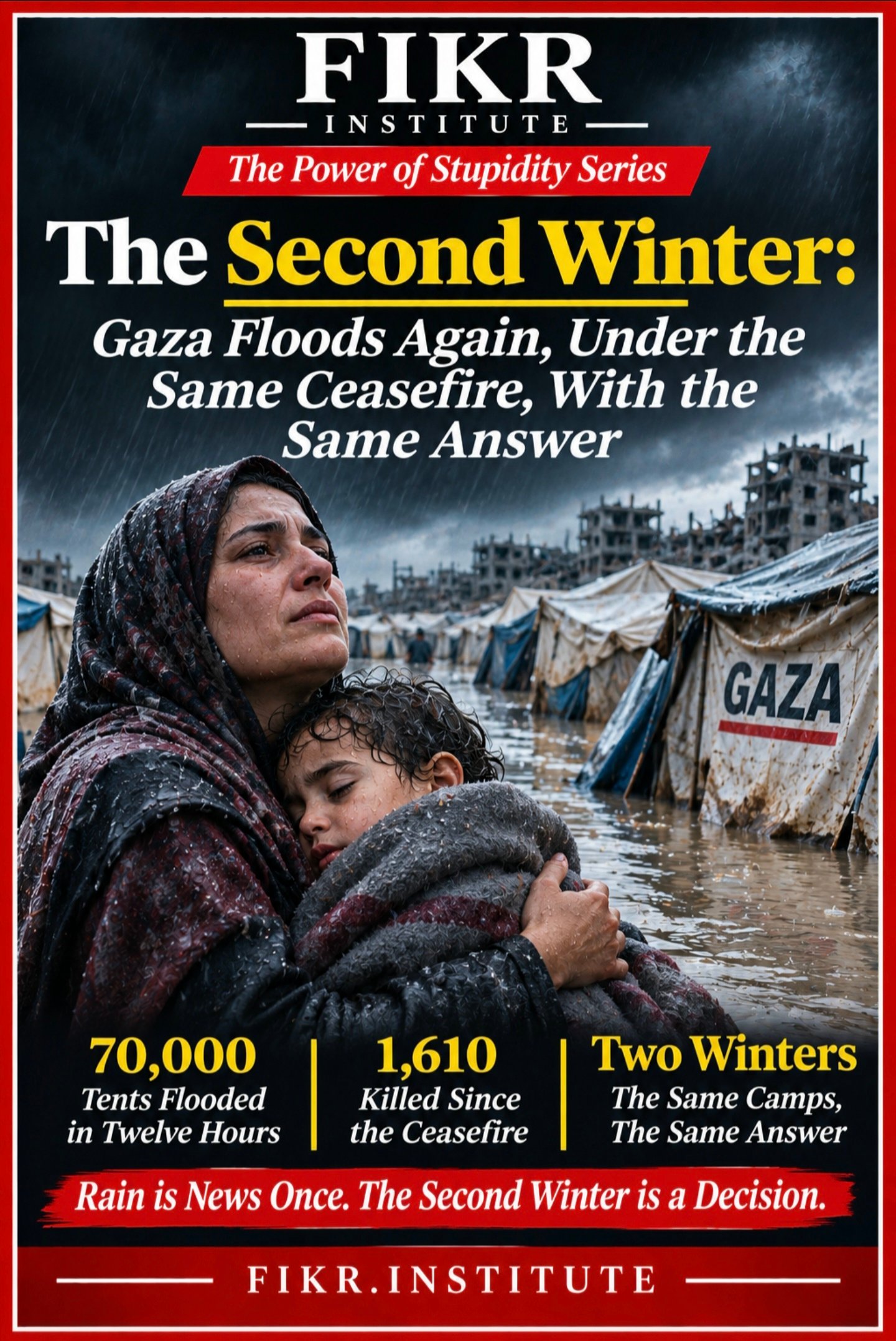
In the twelve hours to Saturday, November 7, heavy rain flooded at least 70,000 tents across the Gaza Strip, according to the Gaza government media office, and the civil defence received 1,500 distress calls [1]. "This is the first day of rain and of course we are already flooded," said Olfat Magdoub, a displaced woman [1]. Another resident, Rafiq Ghattas, said: "We have no resources, no tarpaulins, no tents and no one is checking on us" [1]. The government media office says more than 2,000 buildings are at risk of collapse, that at least 300,000 tents are needed, and that nearly 400,000 displaced people are sheltering in areas considered highly vulnerable to flooding [2].
The coverage treats this as a storm. Fikr looks at the calendar. This is the second winter.
One year ago, in mid November 2025, the first heavy rain of the season sent water through the tents of the Muwasi camp, where the United Nations had counted up to 425,000 displaced people that summer [3]. Then, the Israeli body that controls aid said it was allowing in winter materials, including blankets and heavy tarpaulins. Aid organisations answered that such efforts were "far from sufficient when temperatures plummet in the winter" [3]. This year, the same body said it had increased sanitation work before the rain and that four more vacuum trucks had entered through the Red Cross, joining eight brought in over the past month [1]. The civil defence and municipal officials said they could not cope, because of fuel shortages and because hundreds of their vehicles, including bulldozers and water pumps, had been destroyed by Israel [1].
Put the two winters side by side. The same tent camps. The same first rain. The same statement that materials are entering. The same reply that they are not enough. Rain is news the first time. When it floods the tent camps again a year later, after a year of warnings, it is no longer weather. It is the predictable result of decisions about what is allowed in and what is allowed to be rebuilt.
Those decisions are made inside a ceasefire. The American brokered ceasefire of October 2025 called for reconstruction, but little progress has been made, and Israel controls about two thirds of the territory [1]. Hamas blames Israel for blocking shelter and construction materials [1]; the Israeli aid body points to sanitation work and vacuum trucks [1]. Those are the claims of the two sides. What is not in dispute is the water in the tents and the reconstruction that has not begun [1]. The dead under the ceasefire number at least 1,610 by the count of the Gaza authorities [2].
This is the same pattern Fikr traced in The Quiet War, written about Iran this week. There, American strikes continue in small, quiet units while the White House says the ceasefire holds. In Gaza, the killing continues at a lower rate, and the shelter that would protect the survivors from winter does not arrive, while the word ceasefire stays in every headline. Two ceasefires, one function. The word no longer describes the guns. It describes the status of the story. Once a war is declared over, its continuing dead become an aftermath, and an aftermath does not lead the news.
Who benefits from that? Not the families in the tents, and not the Muslim world that watched the ceasefire announced as peace. The benefit runs to those who can claim credit for ending a war that has not ended, and who face less pressure for what continues under that claim. A flood that is reported as weather asks nothing of anyone. A flood that is reported as the second winter of a failed reconstruction asks who decided what could enter, and why the answer has not changed in a year.
Coordination is not the claim; there is no evidence of a plan to let the camps flood. Convergence is clear: restrictions on materials, destroyed equipment and stalled reconstruction produce the same result two winters running [1][3]. Exploitation is visible in the framing: each side offers its statement, the storm is reported, and the ceasefire label survives untouched. The precedent is the winter of 2025, when the tent camps flooded under the same answer [3].
The signs to watch are how many of the 300,000 tents needed enter before the next storm [2], whether caravans and construction materials are allowed in, whether the count of those killed since the ceasefire keeps rising, whether the equipment the civil defence says it lost is replaced, and whether the next flood is reported as weather again.
Fikr Institute judges that the floods in Gaza are not a natural disaster. They are the second winter of a ceasefire that stopped the war in the headlines but not on the ground. A storm that strikes the same tents twice, after a year of warnings and the same official answer, is a decision repeated. The ceasefire has become a label, in Gaza as over Iran, and the label is doing its work: it turns the living into an aftermath.