
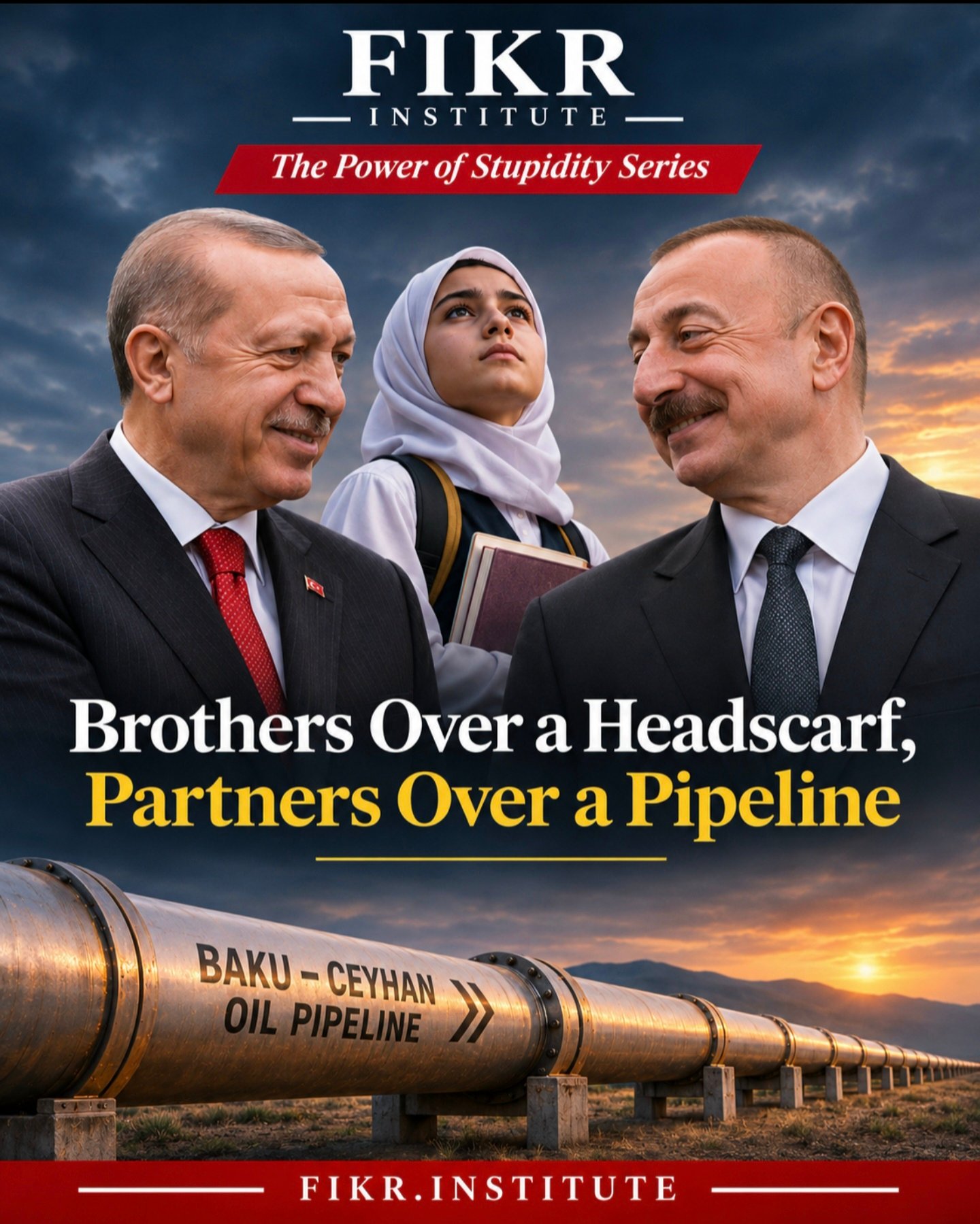
On November 8, Recep Tayyip Erdogan landed in the Fizuli district of Azerbaijan for the Victory Day celebrations, and Ilham Aliyev received him with a guard of honour [1]. In Shusha, Aliyev recalled the words Erdogan spoke in the first hours of the 2020 war: "Azerbaijan is not alone; Turkiye stands by its side." He said the two leaders "will not allow anyone to come between us," and called their unity eternal and unshakable [2]. Erdogan said Turkiye would always stand by Azerbaijan [2].
Five weeks earlier, the tone was different. On October 2, at his party congress, Aliyev said: "When we needed help, no one helped us." He said everything Azerbaijan acquired, including all its weapons, was bought with its own money at world market prices, down to the last bullet, and that the ideological space of the country must be free from foreign influences [3]. He did not name Turkiye [3]. Then the quarrel came into the open.
Some commentary reads Shusha as Baku backing down. Fikr Institute looks at what each side gave up, and the record points the other way.
The quarrel began with girls in school. On September 21, Azerbaijan amended its school uniform rules to ban clothing "inconsistent with the principle of secular education." The rules took effect on October 12, and schools across the country turned away girls who wear the hijab; separate rules adopted on October 6 cover teachers [4]. That evening the Interior Ministry said it had detained 37 people in Baku, independent media reported more than 200 detentions, and activists reported 88 in the village of Nardaran [4].
A presidential adviser in Ankara, Oktay Saral, demanded that Baku reverse the restrictions. The ruling party of Aliyev called it interference in the internal affairs of Azerbaijan, and Erdogan dismissed his adviser [1]. Baku declared 31 Turkish nationals persona non grata over critical posts on social media, among them an opposition lawmaker and party leaders [1]. Aliyev skipped the summit of Turkic leaders in Ankara on October 30, despite a personal invitation, and sent his foreign minister instead [1]. On November 8, Erdogan travelled to Azerbaijan.
Count the concessions. Ankara removed its own adviser. Ankara absorbed the expulsion of 31 of its citizens. Ankara made the journey. In the press statements in Shusha, there was no mention of the hijab [2]. The rule that started the quarrel is still in force. The presidential adviser who spoke for the girls lost his post. The brothers reconciled, and the girls stayed outside the classroom.
That is the first thing the celebrations covered. The second is larger.
Turkiye has reported zero trade with Israel since June 2024, a ban Ankara imposed over the war in Gaza [5]. Erdogan has accused Israel of genocide [1]. Yet in 2025, according to ship tracking data reported by Reuters, Israel imported about 94,000 barrels a day of Azerbaijani crude loaded at Ceyhan, on Turkish soil, up 31 percent on the year before. Azerbaijani oil made up 46.4 percent of all Israeli oil imports, the highest share this decade [5]. Ankara says it does not control where oil sold through the Baku Tbilisi Ceyhan pipeline ends up, and that its state operator is not involved in the sales [5]. Baku, for its part, has close military and economic ties with Israel, which supplied it with weapons in the 2020 war [1].
The brothers quarrelled in public over a headscarf, over who deserves credit for a victory, and over an adviser and some social media posts. They did not quarrel over the oil. Nearly half of the crude Israel imported in 2025, a year of war in Gaza, crossed Turkish territory from a Muslim ally, and none of it appeared in the dispute or in its settlement. The pipeline was never in question.
The third thing is the road. In Shusha, Aliyev listed the Zangezur Corridor among the subjects discussed [2]. The route across southern Armenia that would link mainland Azerbaijan to Nakhchivan, and onward to Turkiye, is being built under an American framework published in January. It is named the Trump Route for International Peace and Prosperity, and the United States is to hold 74 percent of the company that develops it and manages its transit fees for at least 49 years, with Armenia holding 26 percent [6]. The brotherhood that was renewed in Shusha will travel, when the road opens, on a corridor mostly owned by Washington.
Who benefits? Not the girls barred from school, and not the families who protested for them. The documented beneficiaries are outside. Israel keeps its main supplier of crude, through the territory of a state that accuses it of genocide [5][1]. The United States holds the majority of the new corridor through the Caucasus [6]. A dispute between two Muslim states was loud enough to dominate the news and narrow enough to leave both of those interests untouched.
Coordination between Ankara and Baku to protect the oil and the corridor is not the claim. Convergence is clear: two governments that disagreed in public about religion and sovereignty agreed, without saying so, to keep the energy flow and the transit plans out of the quarrel. Exploitation is documented: the headscarf dispute was settled by removing the voice that defended the girls, not by changing the rule. The precedent is Turkiye itself, which spent years dismantling its own headscarf ban and now accepts its return next door in the name of alliance.
The signs to watch are whether the girls and teachers excluded from schools are readmitted, what happens to those detained in October, whether Ankara mentions the hijab again in any official statement, whether 2026 shipping data show Azerbaijani crude still flowing from Ceyhan to Israel, and how much of the Zangezur route is built under American ownership.
Fikr Institute judges that Shusha did not show who backed down. It showed what was never on the table. Brotherhood was performed where it cost nothing: in speeches, in a guard of honour, in the memory of a war. Interest decided everywhere else: the rule against the hijab stayed, the adviser went, the oil kept flowing to Israel through Turkish soil, and the road was left to Washington. Brothers over a headscarf. Partners over a pipeline.