
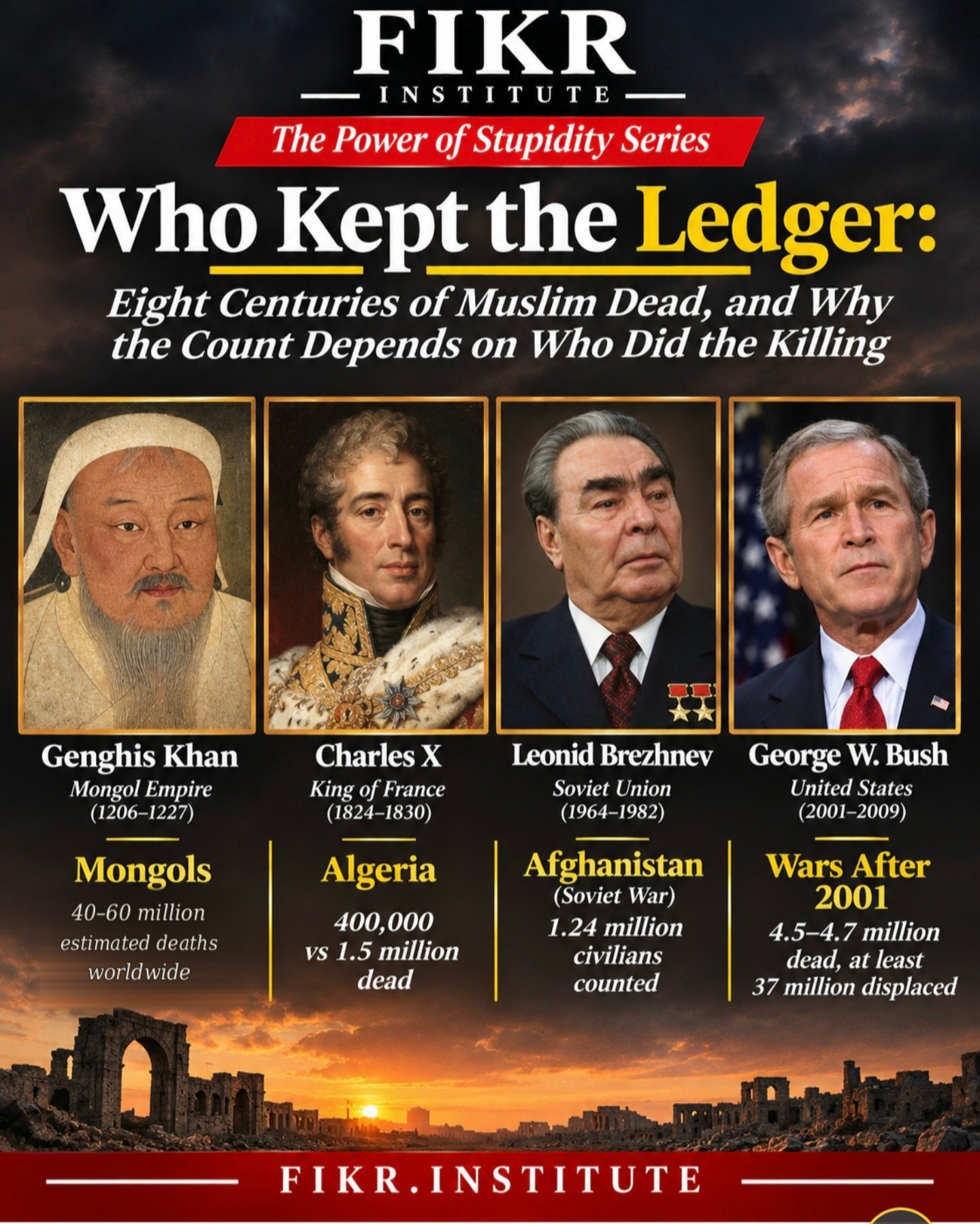
When the Soviet Union invaded Afghanistan, the dead were counted. A Swiss demographer, Marek Sliwinski, put the civilian toll at 1.24 million, out of a pre war population of 15.5 million [1]. The refugees were counted too: by the late 1980s about 6 million Afghans, roughly a third of the population, lived as refugees, about 3.5 million in Pakistan and 2 million in Iran [2]. Those numbers were published, repeated and taught. They served the side that was counting.
When the United States invaded Afghanistan and Iraq, the general who commanded the invasion said that American forces did not do body counts [3]. The military kept no count of the civilian dead. The counting was left to others.
That difference is the subject of this analysis. Fikr Institute set out to rank those who have killed the most Muslims across eight centuries. The ranking matters. But what the research shows most clearly is that the size of the Muslim dead depends on who did the killing, and on who kept the ledger.
Begin with scale. The Mongol conquests of the thirteenth century killed an estimated 40 to 60 million people across Asia and Europe, most of them in China, at a time when the world held roughly 360 to 400 million people [4]. That is about one person in every eight to ten alive. In the Muslim lands, the chroniclers recorded the destruction city by city. Ibn al Athir described the fall of Merv and of Khorasan as a catastrophe without equal [5]. Their figures run into the hundreds of thousands for single cities, and modern historians have reduced many of them. Here, unusually, it is the Muslim sources that give the higher count, and later Western scholarship that lowers it. Even at the lowest modern estimate, no campaign before or since destroyed so large a share of humanity.
The Crusades, which lasted two centuries, killed between 1 and 3 million people in the most cited totals, with some writers claiming far more; modern historians of the crusades tend not to make or trust such estimates [6]. Measured against a world of a few hundred million, it was well under one percent of humanity. Its weight in Muslim memory comes less from the count than from what it began: armies from Europe arriving to conquer in the name of faith.
Spain did something different. It did not kill on the scale of the Mongols. It erased. In 1502, the Muslims of Castile were given a choice between conversion and exile, and by the end of 1526 every Muslim in Spain was, in law, a Christian, and the open practice of Islam was banned [7]. Then the Inquisition policed what remained. Moriscos were fined, imprisoned and sometimes executed for eating couscous, refusing wine, bathing in their own homes and keeping texts from the Quran; the Arabic language, songs, clothing and the veil were treated as signs of a hidden faith [7]. Washing, the precondition of prayer, became evidence against the believer. From 1609, about 300,000 Moriscos were expelled, and many died of hunger, at the hands of pirates and crews, or in attacks after landing [7]. Eight centuries of Muslim life in the peninsula ended in a little over a century. The killing was limited. The disappearance was total.
The breakup of the Ottoman lands between 1821 and 1922, from the Balkans to the Caucasus, produced the largest losses of the modern era before the twentieth century wars. The highest figure comes from the American historian Justin McCarthy, who estimated about 5.5 million Muslim dead and millions more refugees [8]. His work is heavily contested, and his critics accuse him of minimising the Armenian genocide and inflating Muslim losses. Yet the sociologist Michael Mann, no ally of his, wrote that even if the figures were cut in half they would still horrify [9]. The record of that century, in Muslim memory, is of entire communities driven out of lands they had lived in for centuries.
Stalin killed Muslims by famine and by exile. The forced collectivisation of 1930 to 1933 caused a famine in which about a third of all Kazakhs died, between 1.3 and more than 2 million people [10]. In February 1944, almost the entire Chechen and Ingush nation, about 496,000 people from a 1939 population of some 500,000, was deported to Kazakhstan and Kyrgyzstan [11]. At least a quarter died; historians estimate between 123,000 and 146,000 deaths, and Chechen sources give far higher figures [11][12]. In May 1944, at least 191,000 Crimean Tatars were deported; estimates of the dead range from 18 percent in a demographic study to 46 percent in the count of the Tatars themselves [12]. In each case, the count kept by the deported peoples themselves is the highest.
France followed the same rule. The Algerian presidency says more than 5.6 million Algerians died under French rule from 1830 to 1962, including 1.5 million in the war of independence. French historians put the dead of that war at about 400,000 on both sides [13]. The difference between the two is not a rounding error. It is the difference between a count kept by those who were killed and a count kept by those who did the killing.
Then come the wars that followed September 2001. Brown University estimates between 905,000 and 940,000 direct deaths in the war zones of Afghanistan, Pakistan, Iraq, Syria, Yemen, Somalia and Libya, and a further 3.6 to 3.8 million indirect deaths from the collapse of health systems, economies and infrastructure, a total of 4.5 to 4.7 million [14]. In Yemen alone, the United Nations projected 377,000 deaths by the end of 2021, about 60 percent of them from hunger, disease and lack of care [15]. The displacement is larger still. At least 37 million people were driven from their homes by these wars, and the authors of the study say the true number may be 48 to 59 million, more than in any conflict since 1900 except the Second World War [16]. Most did not cross a border. They fled villages for cities. In Afghanistan, war drove people off the land, and Kabul is estimated to have doubled in size [2]. The war also destroyed what the dead would have needed to live.
These numbers were not produced by the governments that fought the wars. They come from a university project, from United Nations agencies and from survey researchers. The dead of the Soviet war became a Western cause. The dead of the Western wars were left to others to count.
Bosnia, in the 1990s, is the European case closest in memory. About 100,000 people were killed between 1992 and 1995, roughly 80 percent of the civilians among them Bosniaks, and as many as 8,000 men and boys were killed at Srebrenica in July 1995 [17].
Set side by side, the ranking by scale is as follows. The Mongols stand first, in absolute numbers in the Muslim lands and far beyond any other in their share of humanity. The breakup of the Ottoman Muslim world, led by the Russian Empire and the new Balkan states, comes next, on the highest and most contested estimate. The wars after 2001, under Bush and Obama and continued since, follow, with millions dead and tens of millions displaced. Stalin, the Soviet war in Afghanistan and France in Algeria form the next tier, each with a gap between the official and the community count. The Crusades and Spain follow, the first measured in lives and the second in a civilisation erased.
Coordination across eight centuries is not the claim. Convergence is clear: in each case, the power that did the killing produced the lowest count or none at all, and the people who were killed produced the highest. Exploitation is documented: the dead of the Soviet war were counted because they served a Cold War argument [1][2], and the dead of the American wars were not counted by the state because they did not [3]. The precedent is the oldest one in the record: the victors write the numbers, and the vanquished are left to remember them.
The signs to watch are whether any government that fought after 2001 ever publishes its own count of the dead, whether the next edition of the Brown estimates rises, whether France opens its archives on Algeria in full, and whether the dead of the current wars, in Gaza and in Iran, are counted by those who caused them or only by those who buried them.
Fikr Institute judges that the question of who killed the most Muslims cannot be separated from the question of who counted them. The Mongols killed on a scale the world has not seen since, and their own victims recorded it. Stalin, France and the empires that broke the Ottoman lands left the count to the communities they destroyed, and then disputed it. The wars of this century killed and displaced millions, and the governments that waged them chose not to count at all. A dead person not counted is a crime not recorded. The ledger is the first thing the powerful control.