
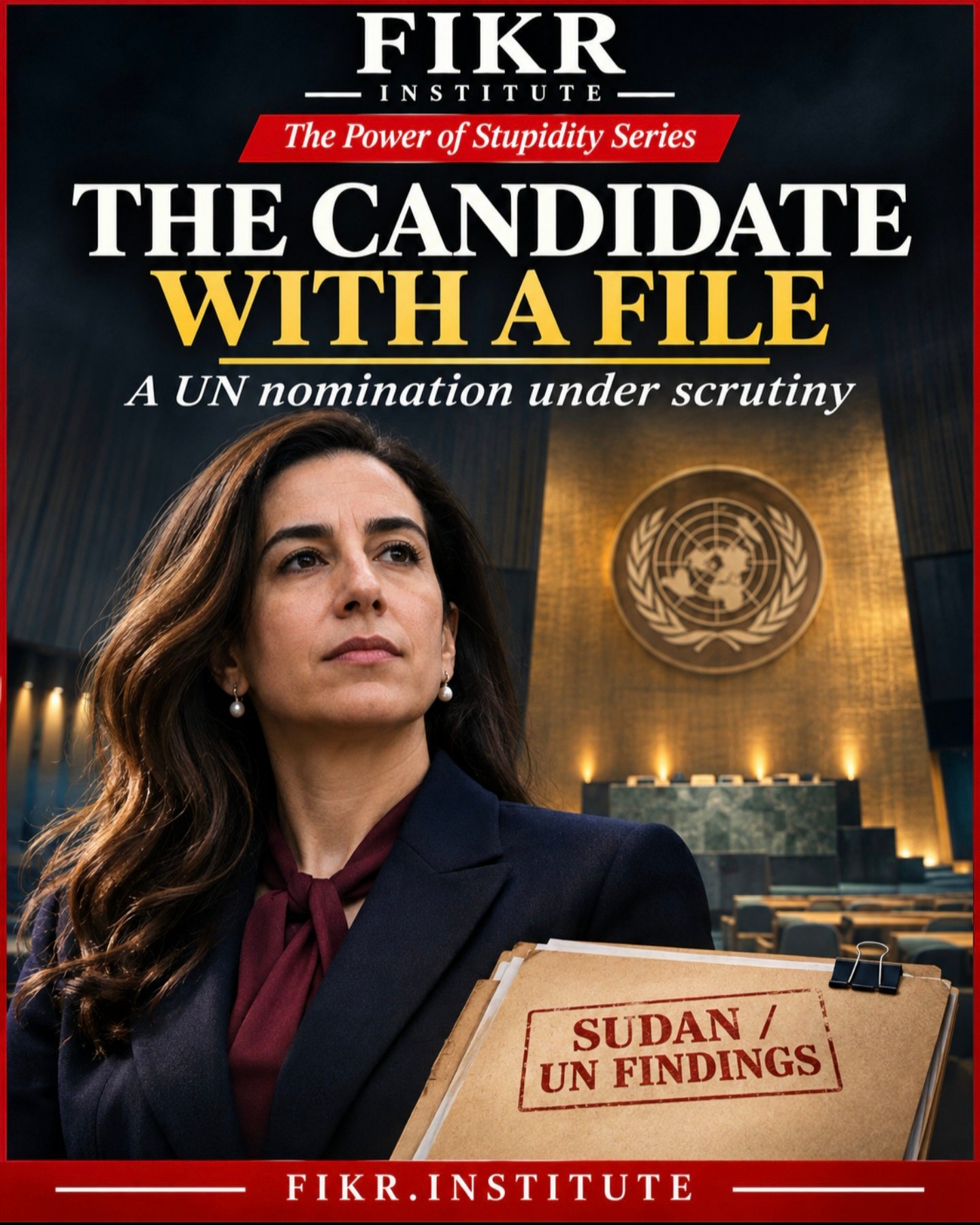
On October 21, the United Arab Emirates nominated Lana Nusseibeh, its former ambassador to the United Nations and now a minister of state on leave, to succeed Antonio Guterres as Secretary General [1]. She entered the race late, in a year that Latin America and the Caribbean expected to be its turn [1]. On November 5, in the eighth straw poll of the Security Council, she received 7 votes encouraging her, 6 discouraging and 2 with no opinion, placing fourth for the second time [2]. To be recommended, a candidate needs at least nine votes and no veto from the five permanent members [2].
Social media has attacked her for her Palestinian family roots and for the subject of her university degree. That is the wrong file. Her ancestry and her studies prove nothing about her conduct. Her conduct as a diplomat is on the record, and it is the record the United Nations itself has been building.
The record is Sudan. In April 2024, she called accusations that the UAE was arming the Rapid Support Forces baseless [3]. In July 2024, asked on CNN whether the UAE armed the RSF, she said: "No, those allegations are categorically untrue" [3]. In September 2024, she wrote that the UAE was not providing weapons or any other support to the RSF or to any of the warring parties [3]. Before those denials, the UN Panel of Experts on Sudan had already reported "credible allegations" that the UAE supplied the RSF through Chad [3].
Since then, the evidence has grown, and it has come from the organisation she seeks to lead. On September 3, the UN fact finding mission for Sudan reported that private entities, intermediaries and recruiters operating from countries including Colombia and the UAE moved personnel, training, weapons and logistics to the RSF through Chad, Libya and Somalia [4]. It documented up to 2,000 former Colombian military contractors operating drones, artillery and advanced weapons alongside RSF units [4]. It said external support fed the RSF assault on El Fasher, where the mission found conduct with the "hallmarks of genocide" [4]. The war has displaced more than 12 million people since 2023 [4]. The UAE rejects all allegations that it supported the RSF [4].
On October 27, at the candidate dialogue, she was asked whether she would continue to reject the findings of the organisation she sought to lead. She did not answer directly. She said she had taken leave from her ministerial post and would refer questions about the UAE to its government [3].
The record extends to Yemen. In 2016 and 2018, she said the UAE took its responsibility for protecting civilians very seriously, while Human Rights Watch had documented 58 unlawful coalition airstrikes that killed nearly 800 civilians [3]. In 2021, the UAE and Saudi Arabia led the campaign that ended the mandate of the UN Group of Eminent Experts on Yemen [3]. In November 2025, as a minister of state, she personally lobbied members of the European Parliament before a resolution on Sudan, and the adopted text did not mention the UAE [3].
Most commentary stops at the question of whether such a candidate can be independent. Fikr Institute asks the question the commentary avoids. Who gains from choosing her?
The Secretary General is chosen by the five permanent members of the Security Council, each holding a veto [2]. The Charter asks the Secretary General to take instructions from no government. But a candidate whose own government faces open UN findings, in a war the UN mission says bore the hallmarks of genocide, carries a file that every one of the five can open at any time. A Secretary General with no such file can say no to a great power. A Secretary General with one has to weigh what saying no would cost. For the powers that choose, an unresolved record is not a disqualification. It is a handle.
The dead of El Fasher, of Darfur and of Yemen are Muslims, killed in wars between Muslim forces, armed and funded from outside. The outside benefits are documented. Colombian contractors were paid to fight [4]. Weapons and fighters moved through Chad, Libya and Somalia to reach the RSF [4]. And the same file that the UN mission compiled on those networks becomes, if she is chosen, a source of quiet pressure on the head of the United Nations itself. The suffering of Sudan would then serve twice: once as a battlefield, and once as leverage over the office meant to stop it.
There is a second use. An Arab woman of Palestinian descent, from a Muslim country, would be the first woman to hold the post [1]. Those are real facts and powerful symbols. A symbol can carry a record into an office that the record alone could not reach. The attacks on her ancestry help this happen: by aiming at who she is, they leave untouched what her government did and what she said about it.
Coordination between the UAE and any permanent member over her candidacy is not the claim, and there is no evidence of a deal. Convergence is clear: a candidate with an unresolved UN file and a selection process controlled by five vetoes produce a Secretary General who would owe the powers more than she could refuse them. Exploitation is documented: recruiters, contractors and suppliers from outside Sudan profited from the war, according to the UN mission [4], while the candidate denied what the UN Panel of Experts had already reported [3]. The precedent is Yemen, where the UN body investigating the war lost its mandate in 2021 under pressure from the same government [3].
The signs to watch are whether she receives a veto in the colour coded polls, how the United States votes on a candidate from its close partner, whether she publicly accepts or rejects the September findings of the fact finding mission before the Council decides, whether the mission on Sudan keeps its mandate and funding in 2027, and whether the next straw poll moves her above the nine votes she needs.
Fikr Institute judges that the question is not who Lana Nusseibeh is, but what her file would do in the office. A Secretary General who has denied the findings of the United Nations, about a war the United Nations says bore the hallmarks of genocide, does not arrive independent. She arrives held. For the five powers that choose, that may be her most useful qualification. For the people of Sudan and Yemen, it would mean the office meant to speak for them is held by the voice that denied them.