
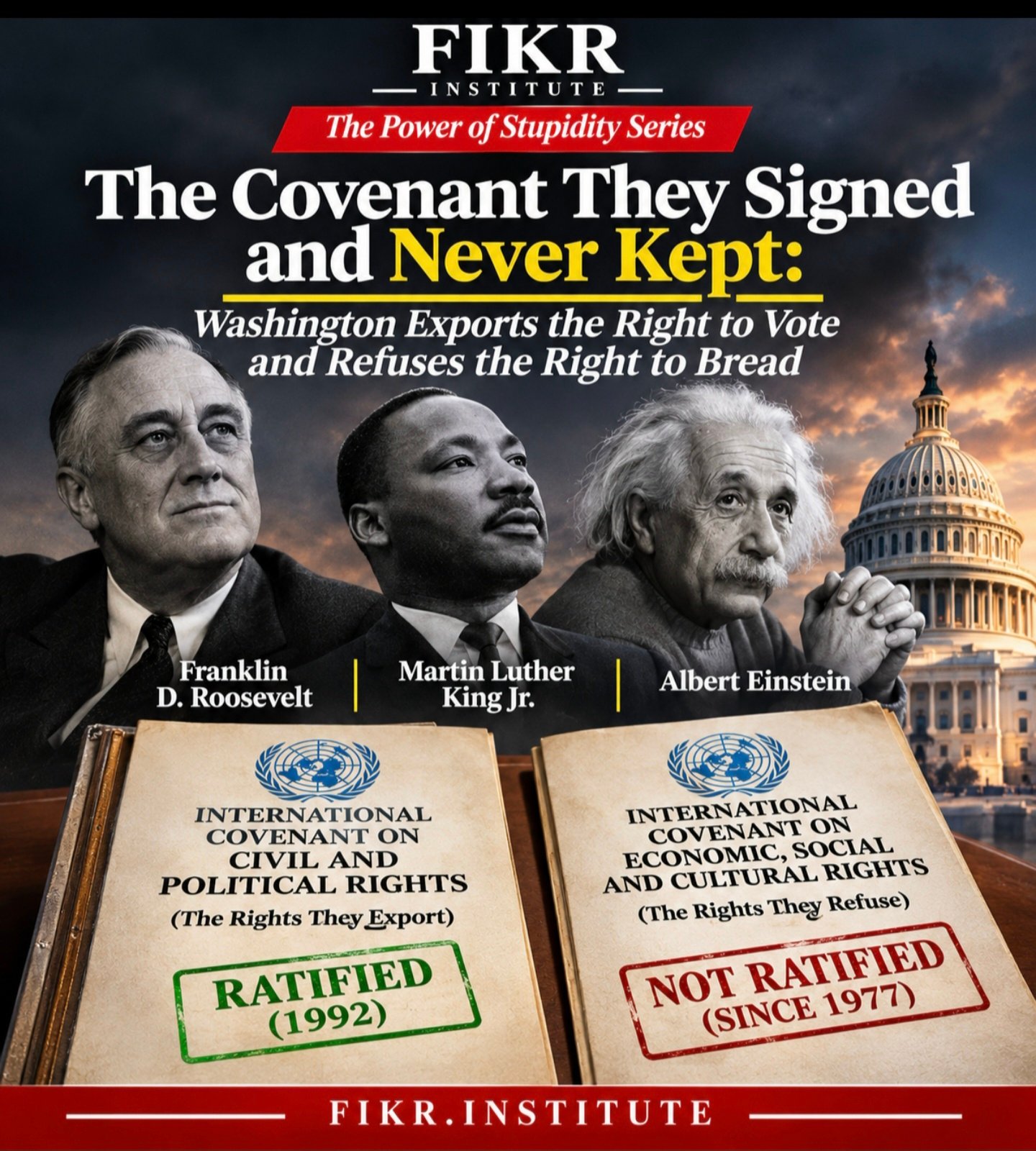
On October 5, 1977, President Jimmy Carter went to the United Nations and signed two treaties. One, he said, concerned "what governments must not do to their people." The other concerned what governments must do for their people [1]. The first is the International Covenant on Civil and Political Rights: the vote, speech, assembly and a fair trial. The second is the International Covenant on Economic, Social and Cultural Rights: work, food, housing, health and education.
In 1992, the Senate ratified the first. It has never ratified the second [2]. Nearly half a century after signing, the United States remains outside the treaty on what a government must do for its people.
That choice was not an oversight. It was a policy, and it was defended. The Reagan administration removed descriptions of economic and social rights from the human rights reports of the State Department, arguing that civil and political rights should take priority [2]. In 1986, the United States cast the only vote against the United Nations Declaration on the Right to Development, and it has generally opposed later resolutions on that right [2]. Opponents of ratification at home have called the covenant socialism [2].
Washington did not need to look abroad for the idea it rejected. Its own president had set it out. In January 1944, Franklin Roosevelt told Congress: "Necessitous men are not free men. People who are hungry and out of a job are the stuff of which dictatorships are made" [3]. He proposed a second bill of rights: the right to a useful and remunerative job, to earn enough for adequate food and clothing, to a decent home, to adequate medical care, to a good education, and to adequate protection from the economic fears of old age, sickness, accident and unemployment [3]. The rights were never written into law as rights.
In April 1967, Martin Luther King stood in Riverside Church and named what stood in the way. Unless the country changed course, he said, "the giant triplets of racism, extreme materialism, and militarism are incapable of being conquered" [4]. He called his own country "the greatest purveyor of violence in the world today: my own government" [4]. The state answered him. The FBI had monitored him since 1955, wiretapped his home and offices from 1963, sent him an anonymous letter his staff read as urging him to kill himself, and treated the Riverside speech as proof that he was under Communist influence [5]. A Senate committee concluded in 1976 that the impact of these efforts on the civil rights movement was "unquestionable" [5].
In 1949, Albert Einstein wrote that "private capital tends to become concentrated in few hands," producing "an oligarchy of private capital the enormous power of which cannot be effectively checked" [6]. Today the top 1 percent of American households hold 32.5 percent of the net worth of the country [7]. The bottom half hold 5 percent of its assets [8].
These men are now honoured. Roosevelt has his memorial, King his holiday, Einstein his place on every list of the greatest minds. What was honoured was the man. What was buried was the demand. A country can name a holiday after a critic of its militarism and still refuse the treaty that would oblige it to house, feed and heal its own people.
That is the part the celebrations leave out, and it reaches far beyond America. Fikr Institute sees in the two covenants a map of how rights are used. The covenant Washington ratified is the one that tells other governments what they must not do. It can be cited against a rival, written into sanctions and carried on the banners of an intervention. The covenant Washington refused is the one that would bind it to do something for its own people, at the expense of those who hold the 32.5 percent [7]. The rights that judge others were adopted. The rights that would cost the owners were declined.
The Muslim world has met the first set of rights at the end of a rifle. They claimed to bring freedom to Afghanistan and Iraq, and even then they did not act on it, as Fikr documented in its series on the democracy they claim. The second set of rights, the right to work, to bread and to a home, was never part of the export, because it was never accepted at home.
Coordination is not the claim; this is not a single plan. Convergence is clear: across administrations of both parties, the rights that restrain other governments were embraced and the rights that would oblige this one were refused [2]. Exploitation is documented: the language of political rights has been used to judge and pressure rivals, while a lone vote was cast against the right to development [2]. The precedent is 1944, when a president named economic security as the foundation of freedom and his country declined to make it law [3].
The signs to watch are whether any administration sends the economic covenant back to the Senate, whether the State Department ever restores economic and social rights to its human rights reports, how the United States votes the next time the right to development comes before the United Nations, and whether the share of wealth held by the top 1 percent keeps rising in the Federal Reserve data [7].
Fikr Institute judges that the United States did not forget the economic demands of Roosevelt, King and Einstein. It weighed them and chose. It ratified the covenant of what governments must not do and refused the covenant of what they must do. It celebrates the men and declines their programme. It exports the right to vote and refuses at home the right to bread. They claim freedom is the vote. Their own president said necessitous men are not free men, and even then they did not act on it.