
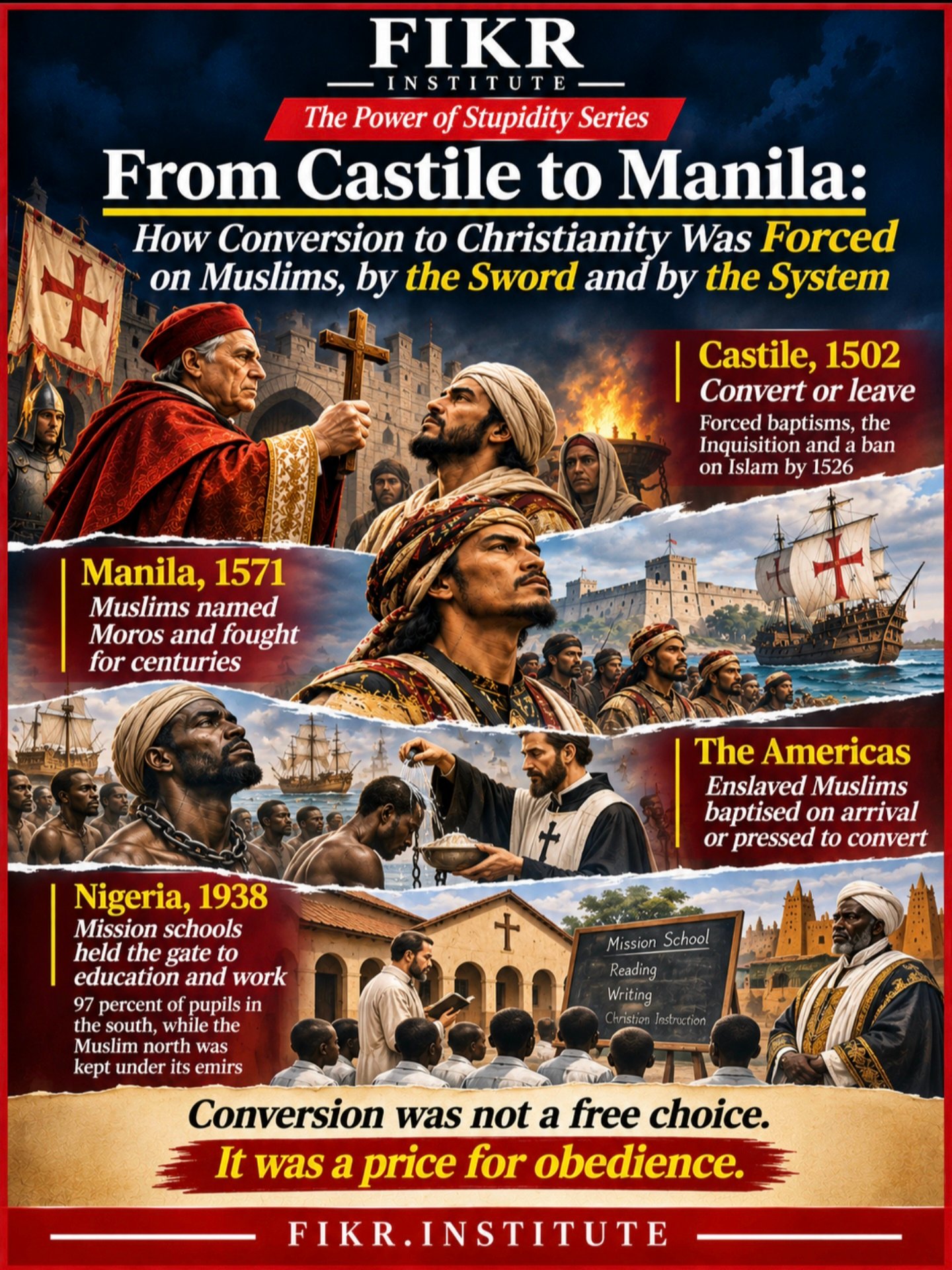
In 1502, the Muslims of Castile were given a choice: become Christians or leave [1]. In Valencia, during the revolt of the Germanias in 1521, rebels baptised Muslims by force; the Church then investigated those baptisms, decided to hold the baptised to the faith, and Charles V gave all the remaining Muslims of his kingdoms the alternative of exile or baptism [2]. By the end of 1526, every Muslim in Spain was, in law, a Christian, and the open practice of Islam was banned [1]. Then the Inquisition watched what remained. Moriscos were fined, imprisoned and sometimes executed for eating couscous, refusing wine, bathing in their own homes and keeping texts from the Quran [1]. From 1609, about 300,000 were expelled [1].
That is the direct form of the pressure: the decree, the forced baptism and the tribunal that punished the baptised for staying Muslim. Fikr Institute followed it across the world, and found it in two forms. Where conquerors had the power, conversion was imposed directly. Where they ruled through institutions, it was imposed indirectly, by making a Christian life the only road to safety, status and a livelihood. The forms differed. The pressure on Muslims did not.
It crossed an ocean almost at once. When Spain reached the Philippines, it found Muslim rulers there, and it gave them the name it had used for the Muslims of Iberia: Moros, the Moors [3]. Manila itself was a Muslim polity tied to the Sultanate of Brunei, ruled at the Spanish arrival by Rajah Sulayman [4]. Spain took it in 1571. The Muslims of Mindanao and Sulu, to whom Spain applied the name Moro [3], did not submit, and later fought the United States [5]. In March 1906, American troops attacked Moros who had taken refuge in the crater of Bud Dajo on Jolo, and killed by one estimate more than 1,200 men, women and children; soldiers machine gunned women and children who tried to surrender [5]. Mark Twain called it a slaughter and the soldiers "Christian butchers" [5]. The war that began in Castile against the Moors was still being fought, under that name, in the twentieth century.
Russia ran the same campaign in the same century as Spain. When Ivan IV took Kazan in 1552, many of its Muslims were forcibly converted, others were drowned or driven from the city, and mosques were destroyed and later banned until the reign of Catherine II [6].
The Atlantic slave trade carried Muslims as cargo. About a third of the enslaved Africans in America may have been Muslim, and up to 40 percent of those captured came from largely Muslim regions of West Africa [7]. Spanish Catholics baptised enslaved people in mass ceremonies on arrival, without instruction [8]. In the English colonies, the pressure was less formal but constant: conversion could bring slightly better standing, and those who kept Islam could practise it only in secret, with no mosque and no community [8]. Some converted, and some pretended to, in order to satisfy their captors [7]. Omar ibn Said, a scholar seized in what is now Senegal in 1807, lived out his life enslaved in the American South and left an autobiography in Arabic, now held by the Library of Congress [7].
In colonial Africa, the pressure took its indirect form. There was no need for a decree. Around 1938, mission schools enrolled 97 percent of pupils in southern Nigeria and about 95 percent across the British colonies [9]. The colonial state left schooling to the missions, and the school was the door to literacy in the language of the ruler, to a clerk post, to a court and to a wage. For a Muslim family, the price of that door was a Christian classroom. A child did not need to be threatened. The road out of the village ran through the church.
That is the thread from Castile to Manila. Directly, through the decree in Castile, the forced baptisms of Valencia, the Inquisition, the conquest of Kazan and the baptism on the slave dock. Indirectly, through the name Moro carried across the Pacific to mark Muslims as the enemy, through the pressure that made conversion the price of better standing in slavery, and through the mission school that held the key to every office. Muslims were pressed to abandon Islam because their faith gave them a law, a language and a loyalty that the conqueror did not control.
Coordination across four centuries and four continents is not the claim. Convergence is clear: the same pressure on Muslims to become Christians, by force where possible and by institutions where not, appears in Spain, the Philippines, Russia, the Americas and Africa. Exploitation is documented: Islam was banned in Spain [1], mosques were destroyed in Kazan [6], Muslims were baptised on arrival as slaves [8], and schooling under colonial rule ran through the missions [9]. The precedent is Castile in 1502, the first written ultimatum of the age [1].
The signs to watch are how that inheritance shapes the present: the long war in Mindanao, the memory of al Andalus in Spain and North Africa, and whether the descendants of the enslaved Muslims of America are ever counted in the history of the country.
Fikr Institute judges that conversion to Christianity was imposed on Muslims across four centuries and four continents, directly and indirectly. Directly, by decree, forced baptism, the Inquisition and conquest. Indirectly, by naming Muslims the enemy, by tying survival and standing under slavery to the faith of the master, and by making the church the only gate to education and work. The sword and the system served the same end. From Castile to Manila, Muslims were not offered a free choice of faith. They were offered a price for keeping it.