
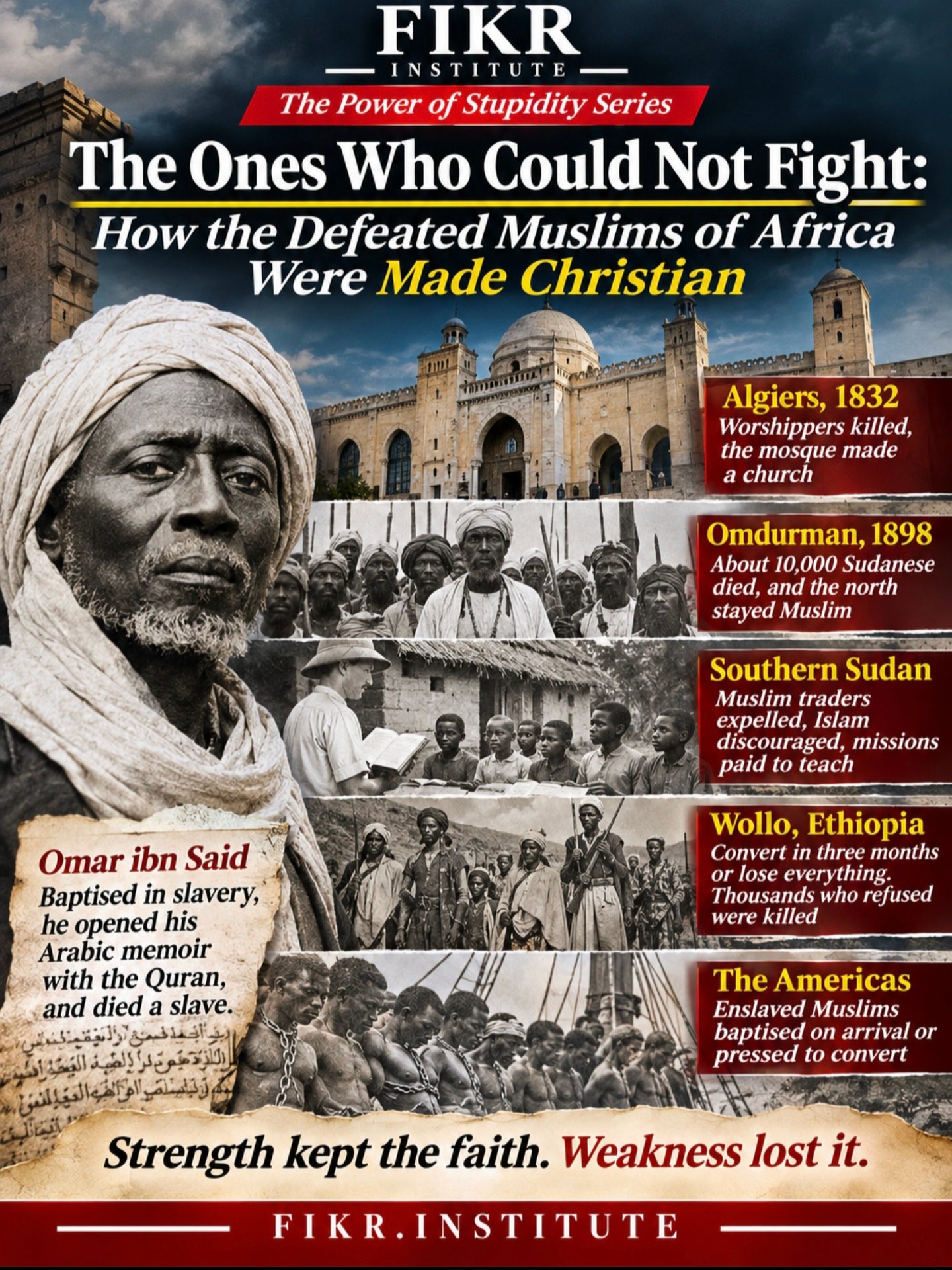
In Africa, the faith of a Muslim community under European and Christian power was decided less by sermons than by strength. Where Muslims could stand and fight, they kept their religion, even in defeat. Where they were broken, enslaved, orphaned or taken as children, they were made Christian: by the sword, by hunger, by the school and by the price of survival. Fikr Institute follows that line across the continent.
Begin with those who fought. In 1898, at Omdurman, the Mahdist state of Sudan met the British and Egyptian army. About 10,000 Sudanese were killed, with countless wounded, against 48 British and Egyptian dead; spears, swords and single shot rifles faced machine guns, rapid fire artillery and armoured gunboats [1]. The Sudanese lost the battle, but the north of Sudan had shown what it would cost to touch its faith. It remained Muslim, and it was governed as Muslim. In northern Nigeria, the Sokoto Caliphate resisted the British conquest before falling in 1903, and Britain then governed the region through its Muslim emirs [2]. In Algeria, after decades of resistance, the French governor general, Marshal MacMahon, opposed missionary work among Muslims, warning that they would see it as a breach of the religious peace [3].
Now look at those who could not fight.
The clearest case is the same country, divided in two. In the north of Sudan, the Muslims had fought. In the south, they had not. From the 1920s, the British closed the south to northerners, expelled the Arab Muslim merchants who had carried its trade, and discouraged the spread of Islam, Arab customs and even Arab dress [4]. In their place, the government subsidised the schools and clinics of Catholic, Presbyterian and Anglican missions, each given its own territory, and the graduates of those schools took the posts in the provincial civil service [4]. A directive of 1930 declared the people of the south to be "a people distinct from northern Muslims" [4]. Islam was pushed out, and the mission became the only door to an office.
In Ethiopia, the order was given in its plainest form. At the Council of Boru Meda, Emperor Yohannes IV commanded the Muslim nobility of Wollo to convert to Christianity within three months or lose their positions [5]. Their leader, Mohammed Ali, was baptised as Mikael, with the emperor as his godfather, and the historian Harold Marcus records that he judged Wollo "worth a mass" [5]. Most of the Muslims of Wollo refused. They rose in revolt, the emperor campaigned across the province, thousands of Muslims were killed, and many fled to Metemma, to the Kingdom of Jimma and to the Emirate of Harar [5]. Those who would not be baptised were killed or driven from their land.
In Algeria, the weapon was hunger. In 1868, as famine swept the country, the new Archbishop of Algiers, Charles Lavigerie, began gathering orphaned Muslim children into villages of his own, in the hope of a widespread conversion [3]. The adults of Algeria had fought France for decades. The children whose parents had died of hunger could not fight anyone. They were taken in, and raised in the faith of those who fed them.
In Algiers itself, the conquest had already marked its claim on Islam with the sword. In 1832, French forces stormed the Ketchaoua mosque, killing some of the several hundred worshippers who resisted the takeover, according to Aicha Hanafi, a professor of archaeology at the University of Algiers. The mosque was turned into a church, and the first Christmas Mass was held there on December 24 of that year [6].
On the Swahili coast, the Portuguese took a child. Around 1614, after the Portuguese killed Sultan Hasan of Mombasa, his son Yusuf, about seven years old, was taken to Goa, baptised as Dom Jeronimo Chingulia and raised as a Christian. In 1627, the Portuguese crowned him ruler of Mombasa, Malindi and Pemba [7]. A Muslim dynasty had been converted through its youngest heir, and returned to the throne as a Portuguese instrument. But the boy grew into a man who began to pray in the Muslim way. On August 15, 1631, he killed the Portuguese captain of Fort Jesus, his followers killed more than 100 Portuguese, and he openly returned to Islam [7]. Writing to seek a pardon in 1637, he explained himself in four words: "necessity knows no law" [7]. The conversion had lasted only as long as he had no power to refuse it.
In Buganda, on the shores of Lake Victoria, the question was settled by war. Between 1888 and 1892, the kingdom was torn apart by armed converts. The Muslims at first prevailed and proclaimed an Islamic state, but they were defeated and could not renew their effort [8]. The victorious Protestant and Catholic factions divided the kingdom between them, ruling through a figurehead king who depended on their weapons. When the two Christian factions fought each other in 1892, Captain Frederick Lugard brought a Maxim gun, and "the Maxim decided the issue in favor of the pro British Protestants" [8]. The Muslims of Buganda had lost the state, and with it the power to decide the faith of the kingdom.
Then there are those who were taken out of Africa altogether. Omar ibn Said was a scholar from Futa Toro, in what is now Senegal, who had studied, prayed five times a day, given alms and made the pilgrimage to Mecca [9]. In 1807 he was captured, shipped to Charleston and sold into slavery [9]. He escaped a cruel first master, was caught in Fayetteville, North Carolina, and jailed for sixteen days, until he was bought by the Owen family, one of whom, John Owen, later became governor of North Carolina [9][10]. In 1821 he was baptised in the local Presbyterian church, and journals of the time celebrated his conversion [10][9].
Ten years later, in 1831, still enslaved, he wrote the story of his life in Arabic. He opened it not with a hymn, but with Surat al Mulk, the chapter of the Quran on the sovereignty of God over all things [10]. He hid verses of the Quran in his Bible and among his belongings, and his own minister suggested that his inner belief differed from the Christianity he showed the world [10]. His autobiography is the only known surviving work of its kind, an account of enslavement written in Arabic by an enslaved man in the United States [9]. He was allowed to write, to teach Arabic to visitors and to receive an Arabic Bible [10]. He was never allowed to be free. Baptised in 1821, he died enslaved in 1863 [9]. The conversion changed the name his captors used for him. It did not change his chains.
Set the cases side by side. The Mahdists of the Sudan and the Caliphate of Sokoto fought, and their faith was left in place, even under foreign rule. The south of Sudan could not fight, and Islam was expelled from it while the missions were paid to teach. The Muslims of Wollo were given three months to convert. The orphans of the Algerian famine were gathered into Christian villages. The worshippers of the Ketchaoua mosque were killed and their mosque made a cathedral. The boy of Mombasa was baptised in Goa and crowned as a Christian. The Muslims of Buganda were defeated and lost the kingdom. And Omar ibn Said, baptised in captivity, died a slave. The line runs through all of them: strength kept the faith, and weakness lost it.
The conversion of the weak served the strong in a second way. A baptised prince on a Portuguese throne, a famous convert on an American estate, a mission graduate in a colonial office: each became a display. Each told the people around them that the road to rank, to learning or simply to safety ran through the church. For the many who were converted and remained as poor, as ruled and as unfree as before, the change of faith brought nothing at all.
Coordination across the continent is not the claim; these were different powers in different centuries. Convergence is clear: wherever Muslims were defeated, enslaved or orphaned, the faith of their conquerors was pressed on them, and wherever they kept the strength to resist, it was not. Exploitation is documented: in the south of Sudan, Islam was discouraged while missions were subsidised [4]; in Wollo, conversion was the price of rank and of life [5]; in Algeria, famine made orphans into converts [3]; in Mombasa, a child was converted to make a client king [7]. The precedent is Castile in 1502, where the Muslims of Spain were first told to convert or leave, as Fikr documented in From Castile to Manila.
The signs to watch are how this history is remembered now: whether the descendants of the Muslims of southern Sudan, Wollo and Buganda recover their own record, whether the Ketchaoua mosque, restored and reopened, is remembered for what was done there in 1832, and whether the autobiography of Omar ibn Said, held today by the Library of Congress, is taught as the testimony it is.
Fikr Institute judges that in Africa, the faith of Muslims under foreign and Christian power was decided by their ability to resist. Those who fought kept Islam. Those who could not were made Christian: by decree in Wollo, by the sword in Algiers, by hunger among the orphans of Algeria, by kidnapping in Mombasa, by war in Buganda, by policy in the south of Sudan, and by slavery in the Americas. And for most of them, the new faith changed nothing but their name. Omar ibn Said began his life story with the Quran and ended his life a slave. That is the whole history in one man.