
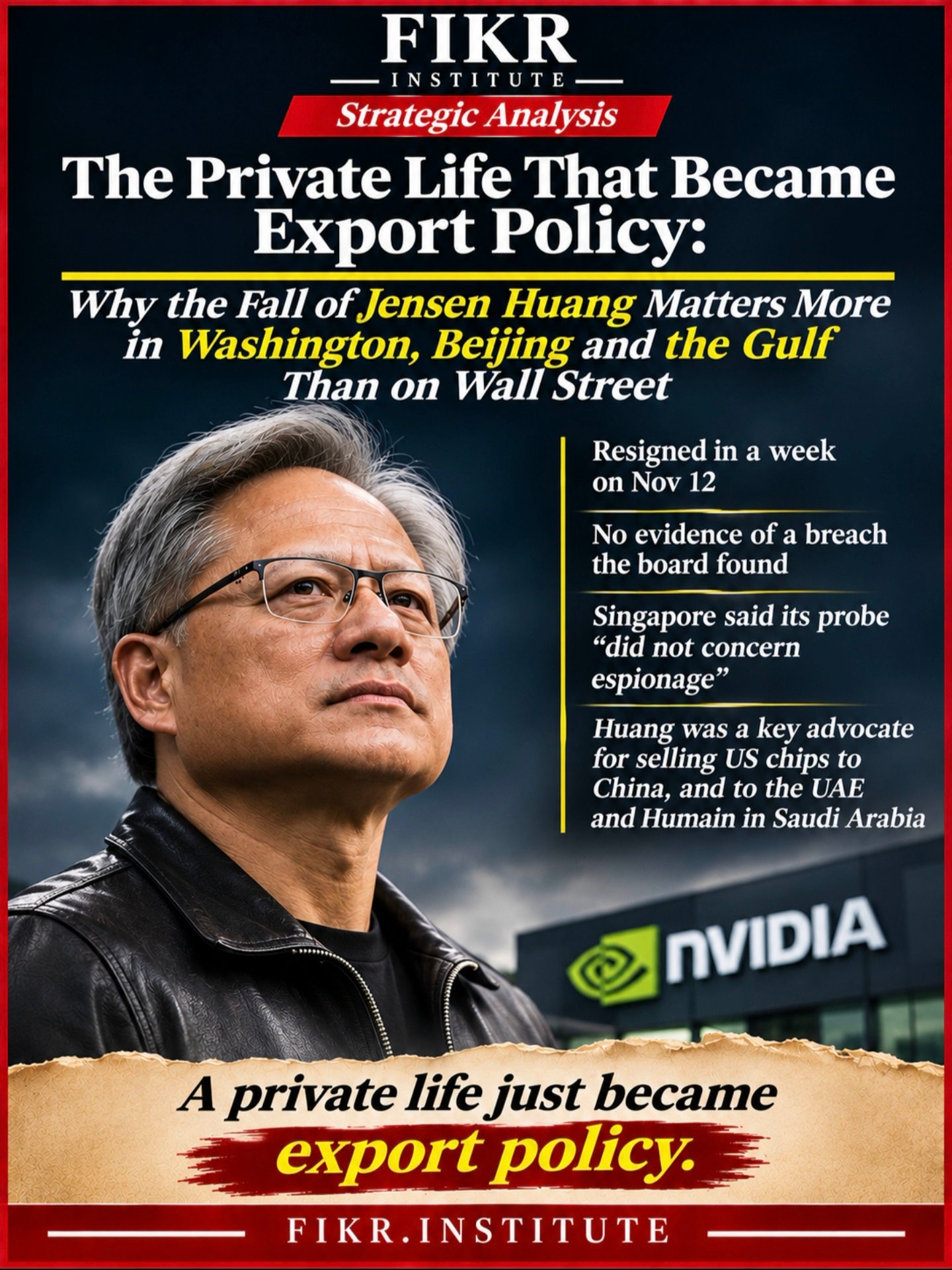
On November 12, Nvidia announced that Jensen Huang, who had led the company since he co founded it in 1993, had resigned as president, chief executive and director, effective immediately [1][2]. The filing with the Securities and Exchange Commission gives no reason [2]. The chief financial officer, Colette Kress, became interim chief executive, and Harvey Jones became the first chair of the board in the history of the company [1]. Nvidia shares fell as much as 14 percent that morning, and losses this month passed one trillion dollars [3].
The sequence that led there was fast. The New York Times reported that Huang had a relationship with Alice Huang, a senior executive at the Singapore data company Megaspeed, whom American authorities suspect of working for Chinese intelligence [4][5]. China called the allegations baseless and slanderous [4]. Huang acknowledged being unfaithful to his wife, and on November 8 the board opened an inquiry into reports that he had been the target of a foreign intelligence effort [6]. The board said it had "no reason to believe that either national security or NVIDIA secrets were compromised" [6]. The Times then reported a second relationship, with a senior Nvidia executive [6]. The chairs of the House Foreign Affairs, Intelligence and China committees demanded a closed door briefing, and the Foreign Affairs chair, Brian Mast, said he would "absolutely" subpoena him [4]. President Trump said Huang told him he had no idea the woman was a spy [4]. Four days after the inquiry opened, Huang was gone.
What the public record does not contain matters as much. On November 12, Singapore said it had barred Alice Huang from returning after an investigation into servers bought there and exported to Malaysia, and issued her a stern warning for giving police information "which she knew to be inaccurate." It also found insufficient evidence that she had committed any offence, and said its investigation "did not concern espionage" [5]. Nvidia says it has no reason to think secrets were lost [6]. No charge against anyone in connection with Huang has been reported. A founder worth trillions to his shareholders fell not on proof of a breach but on the suspicion of one.
Most coverage asks what this means for the share price. Fikr Institute asks what it means for policy.
Huang was not only the head of a company. He was one of the most effective advocates in Washington for selling American chips abroad. In July 2025, shortly after he met Trump, the administration reversed its curbs on the sale of Nvidia H20 chips to China; the chair of the House China committee, John Moolenaar, protested that large volumes "could give China the computer power it needs" [7]. In November 2025, the Commerce Department approved exports of the equivalent of up to 35,000 of the most advanced Nvidia chips to G42 in Abu Dhabi and to Humain, the artificial intelligence company of the Saudi Public Investment Fund, under strict security conditions [8]. The man who opened those doors is the man who has now been removed.
That is the part no share price shows. Among the chairs who demanded the briefing is John Moolenaar, the same lawmaker who protested the chip sales to China [7][4]. The Republican chairs lose control of those committees in January, when the new Congress sits, and any subpoena would then expire [4]. The suspicion did in a week what years of argument over export controls had not: it removed the voice that argued for selling.
The Gulf has the most to watch. Riyadh and Abu Dhabi have tied their ambitions in artificial intelligence to chips from one American company, delivered under licences issued in Washington [8]. Those licences were won in an era when the chief executive of that company could call the president. The new leadership of Nvidia starts under a congressional inquiry into foreign influence, and the first test of every licence will be whether it can survive that scrutiny. The question for the Gulf is no longer only what it can buy. It is whether it can rely on a supply that one private scandal can shake.
Coordination is not the claim, and there is no evidence that the scandal was engineered by anyone in Washington, Beijing or the industry. Convergence is clear: a personal scandal, a suspicion that Singapore says did not concern espionage, and congressional committees opposed to chip sales combined to remove one of the most powerful advocates of those sales [5][7][4]. Exploitation is visible: lawmakers moved to subpoena within days, and the matter is being framed as national security before any breach has been shown [4][6]. The precedent is the Profumo affair of 1963, when a minister fell over a relationship linked to a Soviet officer, and the inquiry that followed found no evidence of a security breach of the kind that had been feared [9].
The signs to watch are whether Huang appears before the House committees, whether the Nvidia results on November 17 show the business intact [1], whether the next export licence decisions for China and the Gulf tighten, whether the board inquiry finds any compromise of secrets, and whether any government brings a charge.
Fikr Institute judges that the fall of Jensen Huang was decided by suspicion, not by proof, and that its consequences will be felt in export policy more than in the stock market. The most powerful voice for selling American chips to the world is gone, removed in a week, while the evidence of espionage remains unshown. For Beijing, it means a harder road to American chips. For the Gulf, it means its future in artificial intelligence rests on licences from a Washington that has just shown how quickly it can turn. For everyone else, it is a lesson in how a private life can become public policy.