
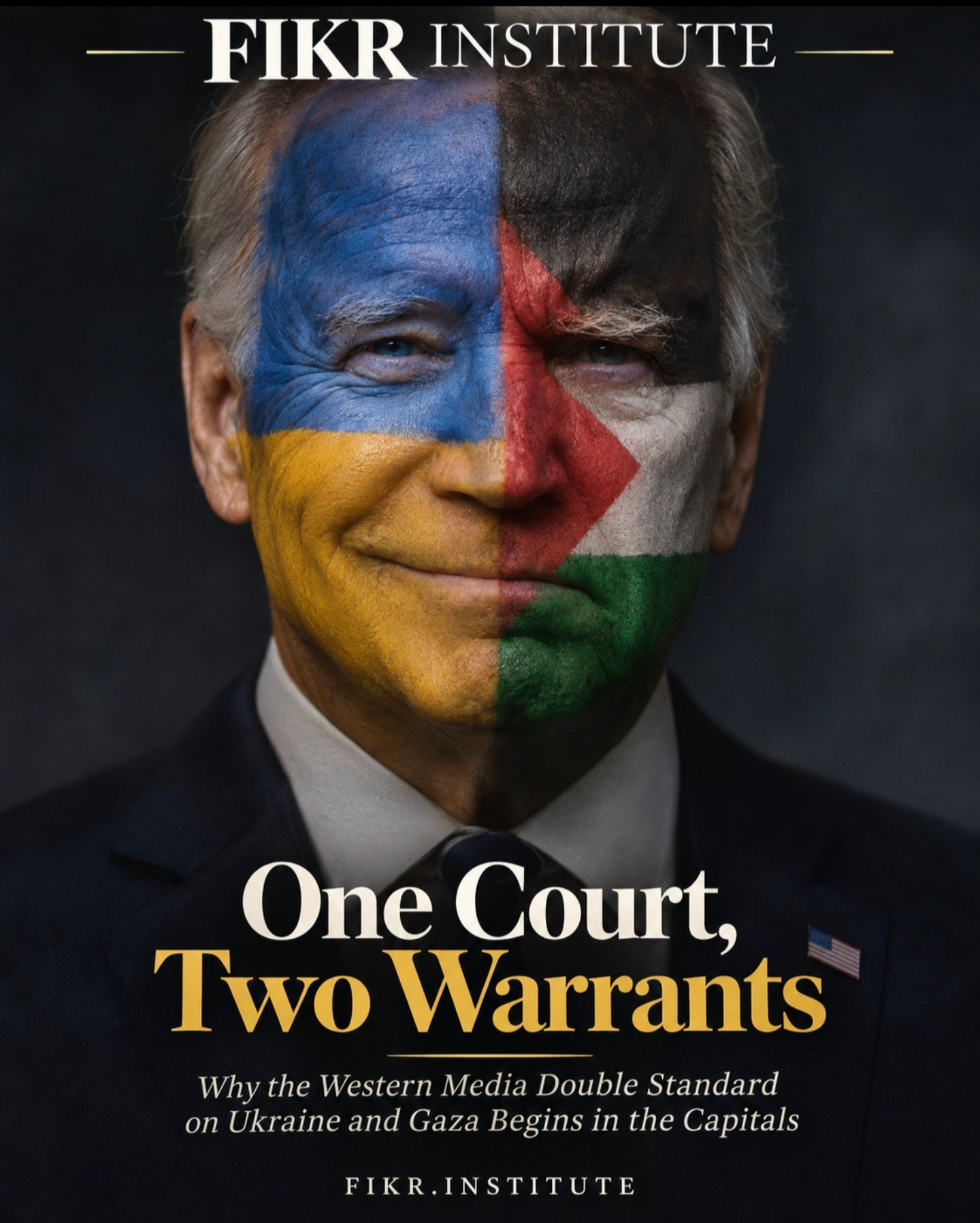
On March 17, 2023, the International Criminal Court issued an arrest warrant for Vladimir Putin over the deportation of Ukrainian children. President Biden called it justified and said it "makes a very strong point" [1]. On November 21, 2024, the same court issued warrants for Benjamin Netanyahu and his former defence minister over Gaza. Biden called them "outrageous" [2]. One court. One statute. Two answers from the same president.
The study of Western news coverage of Ukraine and Gaza usually stops at the newsroom: which words are used, whose dead are named, who is quoted. Those differences are real and they have been measured. But Fikr Institute looks one step higher. Before any editor chooses a word, the governments that newsrooms report on have already decided which warrant is law and which is politics. The media double standard is the double standard of the capitals, carried into print.
Look at how Washington treated the court when it pointed at Moscow. In December 2022, Congress changed the law so that the United States could fund the court and assist its Ukraine investigations, and so that the court could investigate on American soil [3]. In July 2023, Biden ordered his administration to share evidence of Russian war crimes with the court, over the objections of the Pentagon; the National Security Council said there must be accountability for "the perpetrators and enablers of war crimes" [4].
Now look at how it treated the court when it pointed at Israel. In February 2025, Trump authorised sanctions on the court over its investigations of Israel and the United States, and named its prosecutor the first target [5]. In March 2025, the Justice Department withdrew from the multinational investigation of Russian aggression and wound down its war crimes team for Ukraine [6]. On October 9, 2026, the United States sanctioned the court itself, freezing its American property and barring Americans from funding or supplying it. The reasons it gave were the Afghanistan inquiry and the warrants for Netanyahu and Gallant. The Secretary of State, Marco Rubio, said: "Either the ICC will end its threats, or we will end the ICC." Netanyahu thanked the administration for its "leadership" [7]. Washington walked away from the case against Putin before it would accept the case against Netanyahu.
Europe drew the same line in its own way. When Putin visited Mongolia in September 2024, the European Union said Mongolia had failed to comply with its obligation "to execute the arrest warrant" [8]. When the warrant for Putin was issued, France said that no one, whatever their status, should escape justice. When the warrant for Netanyahu was issued, France said immunities applied to him, because Israel is not a party to the court. William Schabas, a leading scholar of the court, called the contrast a double standard [9]. In February 2025, Friedrich Merz, who went on to become chancellor, promised Netanyahu that he would find a way for him to visit Germany and leave without being arrested [10]. The court replied that it is not for states to decide for themselves whether its decisions are sound [11]. In April 2025, Hungary received Netanyahu with military honours and announced that it would leave the court [12]. Mongolia was rebuked by name for hosting one man wanted by the court [8]. Hungary, a member of the European Union, hosted another.
This is the frame journalists inherit. When the official sources a reporter relies on call one warrant justice and the other an outrage, the story writes itself before it is written. The measurements show the result. A study of the BBC by the Centre for Media Monitoring, covering October 2023 to October 2024, found that Israeli deaths received 33 times more coverage per death than Palestinian deaths in written reports, and that the word massacre was applied 18 times more often to Israeli victims [13][14]. Comparing more than 7,700 BBC articles on Ukraine, it concluded the broadcaster was "more willing to cover the full facts in Ukraine than Gaza" [14]. The BBC questioned the use of artificial intelligence in the analysis and said impartiality cannot be measured by counting words [13]. In Australia, a University of Technology Sydney study found that Western and Ukrainian narratives dominated Ukraine coverage across four major outlets, while Russian narratives had little authority; on Gaza, coverage shifted over time, and one outlet, The Australian, consistently favoured Israeli perspectives [15]. In the first days of the Russian invasion, a CBS correspondent described Ukraine as "relatively civilized, relatively European," in contrast to Iraq and Afghanistan, and apologised [16]. The hierarchy was spoken aloud once. It has been written into the numbers ever since.
Coordination between governments and newsrooms is not the claim. Convergence is clear: in Washington, Paris, Berlin and Budapest, the same warrant regime was treated as binding against an adversary and negotiable for an ally, and the coverage measured in London and Sydney follows the same line [9][10][12][13][15]. Exploitation is documented: the warrant against Putin was used to build a case in public, with evidence shared and allies rebuked, while the warrant against Netanyahu was answered with sanctions, immunity claims and an exit from the court [4][8][7][12]. The precedent is 2020, when the first Trump administration sanctioned the then prosecutor after she sought an inquiry that could reach Americans in Afghanistan, sanctions the Biden administration later lifted [5]. The court is welcomed while it pursues others, and punished when it turns toward Washington or its allies.
The signs to watch are whether any European state that rebuked Mongolia arrests or turns away Netanyahu when he travels, whether the European Union answers the sanctions on the court with its blocking statute, whether the court can keep operating under American sanctions, and whether major broadcasters describe the sanctioned court with the same respect they gave it when it charged Putin.
Fikr Institute judges that the Western media double standard on Ukraine and Gaza is not a failure of individual reporters but the faithful reflection of a double standard in the capitals. The same court issued both warrants. One was called justice and armed with evidence. The other was called an outrage and answered with sanctions. A newsroom that takes its frame from those governments will name one perpetrator and leave the other in the passive voice. They claim universal law. And even then, they apply it only to their adversaries.