
On November 13, 2001, the Taliban left Kabul and the forces of the Northern Alliance, backed by American air power, entered the capital [1]. Twenty five years later, the anniversary is remembered in the West as a liberation. Fikr Institute marks it with what followed: a defeated movement that offered to surrender and was refused, and a victory handed to armed factions that turned on civilians.
Begin with the surrender. On December 5, 2001, as Kandahar was falling, Mullah Obaidullah, the Taliban defence minister, delivered a letter to Hamid Karzai near the Dahla Dam. The letter accepted the choice of Karzai at the Bonn conference as interim leader, acknowledged that the Islamic Emirate had no chance of survival, and said the signatories had permission from Mullah Omar to surrender. Its signatories included Mullah Beradar and Tayeb Agha. Their main request was immunity from arrest, in exchange for staying out of political life [2]. The next day, the American defence secretary, Donald Rumsfeld, ruled out any deal that would let Mullah Omar live in dignity, and the White House said those who harboured terrorists must face justice [3]. The overtures were largely ignored, under pressure from the United States and the Northern Alliance. The men who had offered to surrender were harassed and fled to Pakistan. Beradar went on to become the day to day leader of the insurgency, and others became its strategists and financiers [2]. When disarmament programmes began under the Bonn settlement, a later American government review found, "These programs did not include defeated Taliban forces" [4]. The movement was not offered a way home. It was offered a war.
Then came the reprisals. In April 2002, Human Rights Watch documented abuses against Pashtun civilians in northern Afghanistan since November 2001 by three factions of the victorious alliance: Junbish i Milli, Jamiat e Islami and Hizb i Wahdat [5]. In early December, in Bargah e Afghani in Balkh province, gunmen killed 37 Pashtun men after tying them up, beating them in front of their families and demanding money. In Balkh city, a Pashtun woman and her 14 year old daughter were raped by soldiers. In Samangan and Baghlan, Pashtun men were held and beaten with cables until they paid. Militias looted Pashtun homes and villages, and some regional commanders responsible held high office in the new interim government [5]. Afghans who lived through those months told Fikr Institute, in accounts given on condition that they not be named, that gunmen entered Pashtun homes and took vehicles and property from families accused of supporting the Taliban. Their accounts match the pattern that Human Rights Watch recorded: the accusation was the weapon, and the property was the prize [5].
The prisoners fared worse. In November 2001, after the surrender at Kunduz, prisoners were packed into container trucks by the forces of General Abdul Rashid Dostum. Physicians for Human Rights said American government documents it obtained showed that as many as 2,000 suffocated and were buried in the desert at Dasht e Leili [6]. The New York Times reported in 2009 that the Bush administration discouraged efforts by the FBI, the State Department and the Red Cross to investigate, in part because the CIA was paying Dostum at the time [6]. The families of foreign fighters were also abandoned. In December 2001, Human Rights Watch warned that hundreds of foreign women and children were stranded and in grave danger from cold, hunger, bombing and bandits. "These women and children had no choice but to go with their male relatives to Afghanistan," it said [7].
This is the order the war created in its first months. The men who offered to lay down their arms were refused. The men who killed and robbed in the name of the new order were paid, protected and promoted.
Coordination is documented at the level of policy: Washington refused the surrender terms, paid Dostum, and discouraged the inquiry into the containers [3][6]. Convergence is clear: the factions that profited from the accusation of Taliban support were the factions Washington had armed, and the community that paid the price was the Pashtun community from which the insurgency would later recruit [5][2]. Exploitation followed: the refusal left the Taliban leadership no road but Pakistan and rearmament, and the reprisals gave it a grievance to recruit with [2][5]. The precedent set in those months held for twenty years: loyalty to Washington outranked accountability, as the fate of the Dasht e Leili inquiry showed [6].
The signs to watch, twenty five years on, are whether any inquiry into Dasht e Leili is ever completed, whether the documents on the 2001 surrender are released, and whether the survivors of the northern reprisals are ever heard.
Fikr Institute judges that the war in Afghanistan could have ended in December 2001, on terms the defeated movement itself proposed. Washington refused, and handed the victory to factions that robbed, raped and killed in its name. The liberation that began on November 13, 2001 was, for the Pashtun families of the north, the start of a punishment. And the men refused a surrender came back, twenty years later, to take the country.
They Came as Liberators and Returned the Warlords: Twenty Five Years After Kabul Fell, the Surrender That Was Refused
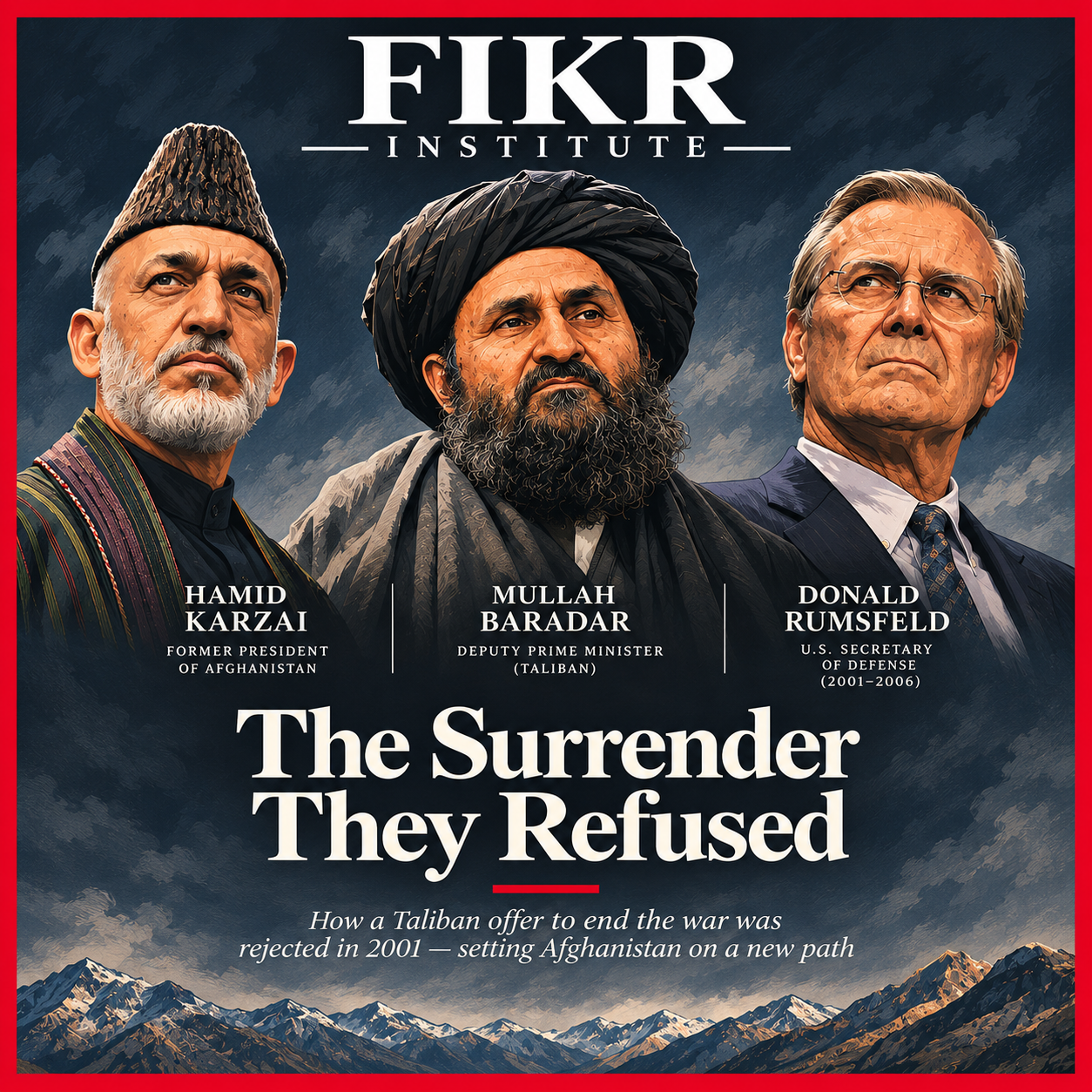
Twenty five years ago Kabul fell. Weeks later Taliban leaders offered to surrender and accept Karzai; Washington refused. Its allies killed 37 Pashtun men in one village and up to 2,000 prisoners died in containers. The war that could have ended...
On November 13, 2001, the Northern Alliance entered Kabul with American air support. Fikr Institute marks the anniversary with what followed. On December 5, senior Taliban leaders, including Beradar, sent Hamid Karzai a letter accepting his interim leadership and asking only for immunity in return for leaving politics. Rumsfeld ruled out a deal, the offer was ignored under American pressure, and the men fled to Pakistan to lead the insurgency. Human Rights Watch documented abuses against northern Pashtuns by the victorious factions, including the killing of 37 men in Bargah e Afghani, rape and looting, while some responsible commanders held office. Physicians for Human Rights said up to 2,000 prisoners suffocated in containers under Dostum, whom the CIA was paying, and the Bush administration discouraged an inquiry. Afghans who lived through those months told Fikr Institute of gunmen seizing the vehicles and property of families accused of Taliban ties. Fikr Institute judges that the war could have ended in December 2001, and that Washington chose to continue it.
Voice of America. Northern Alliance troops enter Kabul as Taliban flee. November 13, 2001.
Afghanistan Analysts Network, Anand Gopal. Flash from the past: missed opportunities for reconciliation, first published by Foreign Policy. November 15, 2010.
RTE News, with agencies. US rules out Taliban surrender deal for Mullah Omar. December 6, 2001.
Special Inspector General for Afghanistan Reconstruction. Reintegration of Ex Combatants: Lessons from the US Experience in Afghanistan, SIGAR 19 58 LL. September 2019, accessed November 13, 2026.
Human Rights Watch. Paying for the Taliban Crimes: abuses against ethnic Pashtuns in northern Afghanistan. April 9, 2002.
Voice of America, citing The New York Times. Bush team discouraged probe of mass Taliban deaths. July 11, 2009.
Human Rights Watch. Afghanistan: families of foreign fighters at risk. December 4, 2001.