
By the end of 2001, the Taliban government had collapsed. Twenty years later, its fighters walked back into Kabul. What happened in between is usually explained by sanctuaries in Pakistan and the corruption of the Afghan government. Those were real. But Fikr Institute looks at the part of the story that foreign forces wrote themselves: the raids, the strikes and the men they hired, which turned families who had not fought into families that would.
It began with the wrong names. In July 2002, an American aircraft struck a wedding party in Deh Rawud in Uruzgan. Afghan investigators counted 48 dead and 117 wounded, and the American military investigation counted 34 dead. Afghan officials said the only gunfire had been celebratory rifle shots; the American military blamed the wedding party for firing on its aircraft [1][2]. In Khost, The Christian Science Monitor reported in 2005, American officials admitted that more than three years into the mission they still could not always separate truth from vendetta; the head of the local council of mullahs said an allied militia was "giving wrong information to the coalition forces" to settle old scores [3]. In 2008, Radio Free Europe reported that some translators sent with international forces did not know the Pashto dialects of the places they worked. One translator told NATO troops that a camp of Kochi nomads was a Taliban position, and only another translator stopped the air strike. A Pashto translator for NATO said, "There are some translators who are working for their own political, personal and tribal interests" [4].
Afghan interpreters who worked with foreign forces told Fikr Institute the same story from the inside. Their accounts were given on condition that they not be named. They described interpreters from other communities, who did not understand Pashto, telling soldiers that a villager had admitted to being Taliban, after which the man was arrested or shot. One interpreter described witnessing soldiers, after an attack, firing in every direction without distinguishing between attackers and passers by. Others described colleagues who came home at night and wept at what they had seen.
The record contains such a day. On March 4, 2007, after a suicide bomber hit a Marine convoy in Nangarhar, Marines opened fire as they drove away. As many as 19 civilians were killed and 50 injured. The Afghanistan Independent Human Rights Commission found that the soldiers used indiscriminate and excessive force in violation of international humanitarian law. No one was charged [5].
The strikes continued. On July 6, 2008, aircraft bombed a convoy carrying a bride to her new husband in Nangarhar. An Afghan official said 47 civilians were killed, 39 of them women and children. The American military first said the area held no civilians and that all the dead were militants [6]. In May 2009, in Farah, Afghan officials put the dead at 140, and the Afghan rights commission counted 97 civilians; the chairman of the Joint Chiefs of Staff said he saw nothing in the American review that might lead to disciplinary action [7]. On October 3, 2015, American aircraft destroyed the Medecins Sans Frontieres trauma hospital in Kunduz, and 42 people were killed [8].
Then came the night raids. By 2011, an estimated 12 to 20 raids were carried out every night, with thousands of detentions a year, many of them of noncombatants. A man from Nangarhar told the researchers: "They claim to be against terrorists, but what they are doing is terrorism." The researchers found that insurgent attacks rose as the raids increased [9]. For a Pashtun household, a night raid meant foreign men inside the home, among the women, in the dark. In November 2010, President Hamid Karzai, the leader Washington backed, said of the raids: "They were a problem then, they are a problem now. They have to go away" [10]. They did not go away.
The worst were the forces that answered to no army. Since 2001, the CIA ran its own war in Afghanistan, recruiting, training and deploying Afghan paramilitary units outside the normal chain of command [11]. In Kandahar, the brother of the president was reported to help the CIA run one of them, the Kandahar Strike Force, which on at least one occasion mounted an unauthorised operation against an Afghan official [12]. Afghans came to know these units by their numbers, the Zero units. In 2019, Human Rights Watch documented 14 cases of killings and other abuses by CIA backed strike forces, some amounting to war crimes, including the killing of eight men visiting their families for Eid in Paktia [11]. "In ramping up operations against the Taliban, the CIA has enabled abusive Afghan forces to commit atrocities," it said [11]. The Intercept documented ten raids by the unit known as 01 in Wardak that killed at least 51 civilians, many at close range [13]. Afghans told Fikr Institute that raids by these units seldom ended without a death, and that they understood the killing as a way to spread fear.
In August 2021, the same units guarded the Kabul airport for the evacuation. They fired warning shots and searched the crowds, and a former American interpreter said commandos demanded 5,000 dollars to let her through and beat her when she could not pay. The CIA flew out as many as 7,000 Zero unit members and their relatives, while thousands of former American employees and activists were left behind [13]. In the last days, Eagle Base, their compound outside Kabul, was destroyed with controlled explosions, along with its armouries, vehicles and records, so that nothing would be left for the Taliban [13][14].
Coordination is not needed to explain it; the policies were deliberate. Convergence is clear: wrong names from vendettas and bad translation, strikes on weddings and a hospital, nightly raids into homes and units that answered only to the CIA all fell on the same rural Pashtun communities [3][4][9][11]. Exploitation is documented: the insurgency grew as the raids grew, and the people the raids humiliated became its recruiting ground [9]. The precedent is 2002, when the first wedding was bombed and the first wrong name was believed [1][3].
The signs to watch are whether any member of the Zero units who was flown to the United States ever faces trial, whether the records of the units are ever opened, and whether the families of Nangarhar, Farah and Wardak ever receive an accounting.
Fikr Institute judges that the war rebuilt its enemy with its own hands. Every false name believed, every wedding bombed and every door kicked in at night made a new family into a party to the war. The men the CIA paid to raid villages were the last to leave with the Americans, and the evidence of their work was blown up behind them. The Taliban did not win the war by themselves. The raids recruited for them.
The Raids That Rebuilt the Resistance: Interpreters, Weddings, Night Raids and the CIA Zero Units
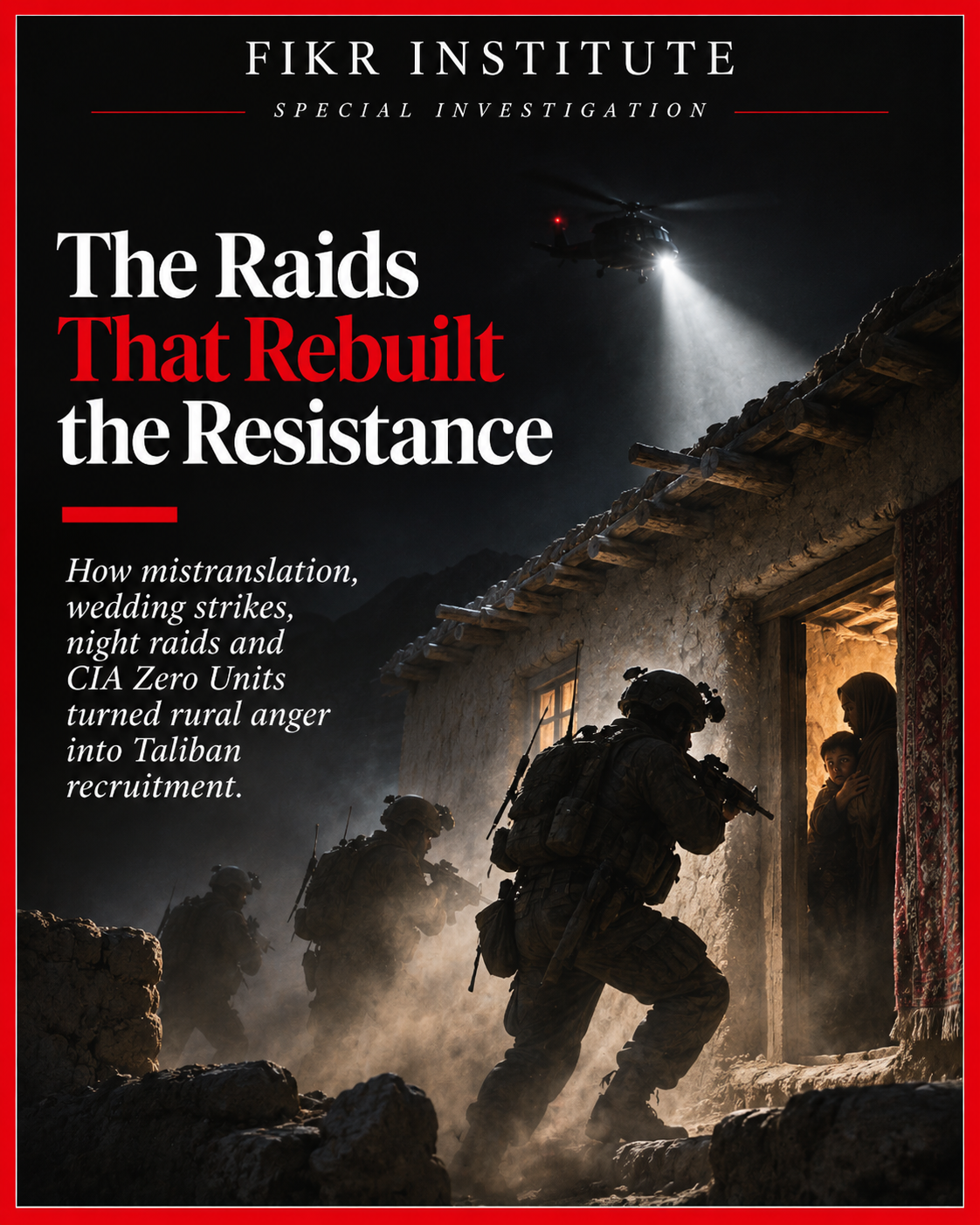
Wrong names from vendettas and interpreters who did not know Pashto. Weddings and a hospital bombed. Up to 20 night raids a night. CIA Zero units that killed and then left with the Americans. The war rebuilt its own enemy...
The Taliban government collapsed in 2001 and its fighters returned to Kabul in 2021. Fikr Institute examines what foreign forces did in between. American officials admitted they could not separate intelligence from vendetta, and Radio Free Europe reported translators who did not know local Pashto and one who nearly called a strike on nomads. Interpreters told Fikr Institute of false identifications and of soldiers firing in every direction after attacks; in 2007, Marines killed up to 19 civilians in Nangarhar and no one was charged. Strikes hit weddings in Uruzgan and Nangarhar, killed civilians in Farah, and destroyed a hospital in Kunduz. By 2011, 12 to 20 night raids took place every night, and insurgent attacks rose with them. CIA backed Zero units killed civilians in documented raids, guarded the airport in 2021, and were flown out while their base was destroyed. Fikr Institute judges that the war rebuilt its enemy, and that the raids recruited for the Taliban.
AFP and Reuters, as carried by Dawn. 48 killed in bombing, admits US. July 7, 2002.
Association for Diplomatic Studies and Training. The fog of war: investigating a US airstrike on an Afghan wedding party. June 2014, accessed November 13, 2026.
The Christian Science Monitor, Lane Hartill. Sifting intelligence tips from vendettas in Afghanistan. January 26, 2005.
Radio Free Europe Radio Liberty, Ron Synovitz. Mistakes by translators hamper Afghan antiterrorism campaign. September 2, 2008.
Jurist, University of Pittsburgh School of Law. US Marines will not be charged in 2007 Afghan civilian shooting. May 23, 2008.
Radio Free Europe Radio Liberty. Afghan official says US air strike killed 47 civilians. July 11, 2008.
Al Jazeera. US failures caused Afghan deaths. June 19, 2009.
Medecins Sans Frontieres. Kunduz: updated death toll, 42 people killed in US airstrikes on Kunduz hospital. December 12, 2015.
Open Society Foundations and The Liaison Office. Surge in night raids fuels Afghan anger, on The Cost of Kill or Capture. September 18, 2011.
Al Jazeera. Karzai calls for fewer US raids. November 14, 2010.
Human Rights Watch. Afghanistan: CIA backed forces commit atrocities, on the report They Have Shot Many Like This. October 31, 2019.
Al Jazeera. Karzai brother on CIA payroll. October 28, 2009.
The Intercept, Andrew Quilty and Matthew Cole. The CIA Afghan proxies, accused of war crimes, will get a fresh start in the US. October 5, 2021.
Business Insider, citing The New York Times. US destroys CIA outpost outside Kabul airport to keep sensitive information away from the Taliban. August 27, 2021.