
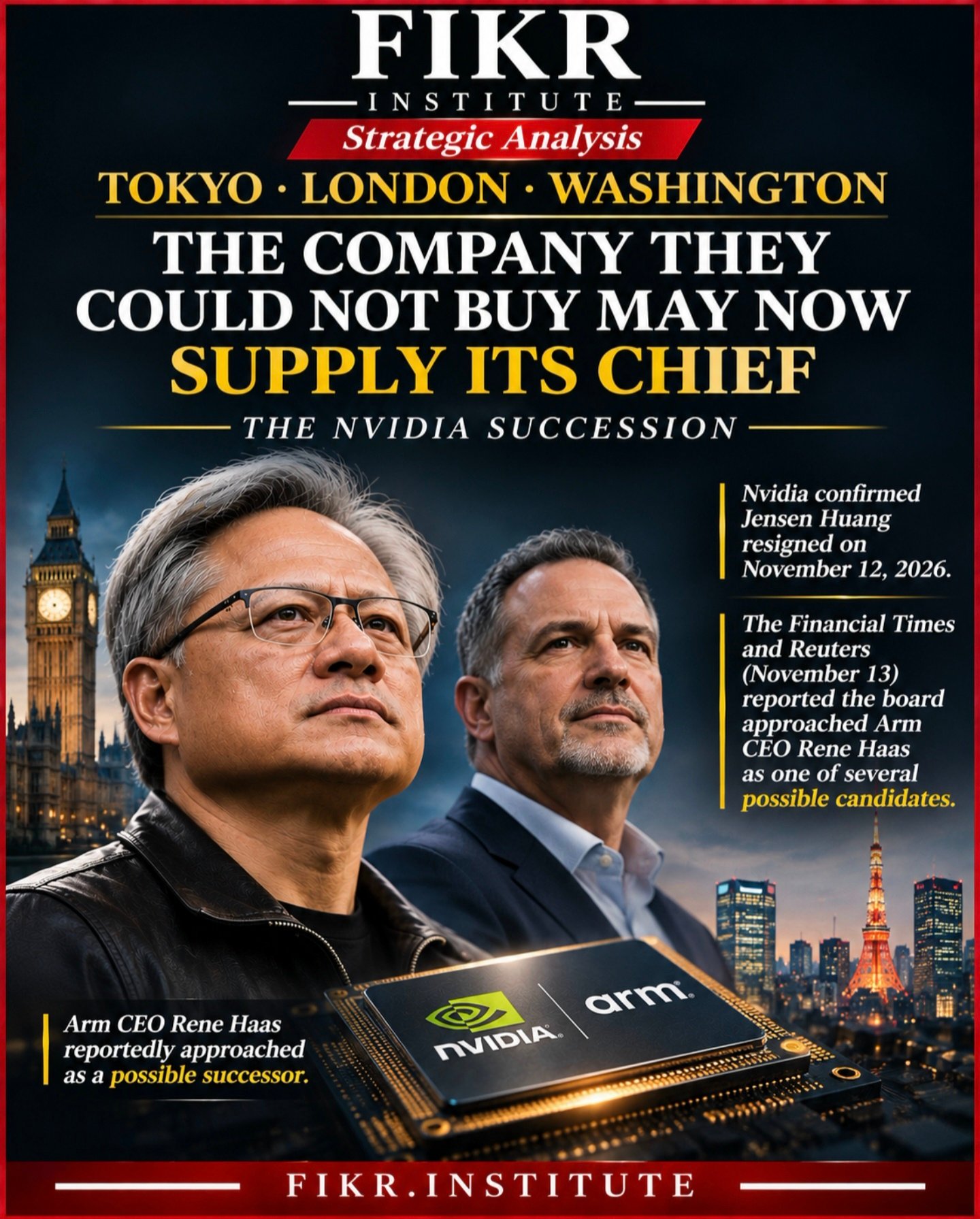
Since Jensen Huang resigned on November 12 [1], the question everyone has asked is who pushed him out: the China hawks in Washington, the people inside Nvidia who spoke to reporters, or the rivals who gain from its turmoil. Fikr Institute asks a different question. Who decides what Nvidia becomes next? Follow the succession, and it does not run only through Washington. It runs through Tokyo and London.
On November 13, the Financial Times reported that the Nvidia board had approached Rene Haas, the chief executive of Arm, as a possible successor. He is one of several candidates and has not been offered the job. Haas spent more than seven years at Nvidia before taking over Arm in 2022, and he keeps close ties with Huang and with several Nvidia directors. Arm shares fell 6.5 percent that day [2].
Arm is not just another chip company. It is headquartered in Britain and majority owned by SoftBank Group of Tokyo [3]. Its designs sit inside Nvidia processors: the Nvidia Grace CPU Superchip "packs 144 Arm Neoverse V2 cores into a single module" [4]. And since March 2026, Arm is no longer only a licensor. It released the first chip of its own in its 35 year history, an AI data centre processor built with Meta as its first customer, and with that step it began to compete with the partners that license its designs [3].
The history makes the approach remarkable. In 2020, Nvidia agreed to buy Arm from SoftBank for 40 billion dollars [5]. In April 2021, the British government intervened on national security grounds [6]. In December 2021, the US Federal Trade Commission sued to block the deal [7]. The European Union also opposed it, and on February 8, 2022, SoftBank and Nvidia called it off, citing significant regulatory challenges [5]. Washington and London would not let Nvidia own Arm. Four years later, Nvidia is talking to the man who runs it.
Tokyo has its own history with Nvidia. Masayoshi Son, the founder of SoftBank, once held about five percent of Nvidia and sold it. After buying Arm in 2016, he offered to lend Huang the money to buy all of Nvidia. Huang said in Tokyo in 2024: "Now I regret not taking it" [8]. In November 2025, SoftBank sold its entire remaining Nvidia stake, about 5.83 billion dollars, to fund its investment in OpenAI [9]. Its finance chief said the sale had "nothing to do with Nvidia itself," and that the OpenAI investment that year would exceed 30 billion dollars [10]. Son had stood at the unveiling of Stargate, the planned 500 billion dollar AI infrastructure project in the United States [10]. SoftBank has left Nvidia as a shareholder and returned as a rival chip owner, a customer through OpenAI and now a possible source of its leadership.
The markets in Tokyo read the week in their own way. On November 13, SoftBank Group fell 5.1 percent, while Tokyo Electron, a chip equipment maker, rose 1.7 percent [11].
Washington, meanwhile, treated the succession as a matter of state. President Trump named Tim Cook, the former head of Apple, as the one man to replace Huang [12]. Huang has agreed to testify under oath before the House Foreign Affairs Committee, the Justice Department is reported to be investigating whether Alice Huang helped smuggle servers containing Nvidia chips, and Commerce Secretary Howard Lutnick is due before the Senate Banking Committee on December 10 [13]. Elon Musk wrote that hiring Huang "would be an honor" [13]. The chief executive of a private company has become a question for the president, the Congress and the richest man in the world.
Coordination among Tokyo, London and Washington is not the claim, and there is no evidence that any of them arranged the scandal. Convergence is clear: the company Washington and London would not let Nvidia buy is now a rival that sells its own chips, the designer inside Nvidia processors, and the employer of a leading candidate to run Nvidia, while its Japanese owner has sold Nvidia shares to back a major Nvidia customer [5][3][4][2][9]. Exploitation is visible: the week of the scandal turned a board decision into a contest of presidents, committees and billionaires [12][13]. The precedent is February 2022, when regulators on two continents decided that Nvidia and Arm should not be joined under one owner [5].
The signs to watch are whether Haas is offered the job, whether regulators in Washington, London or Brussels examine the links that would follow between Arm and Nvidia, what Nvidia says when it reports on November 17, and how SoftBank positions Arm as a seller of chips against its own customers.
Fikr Institute judges that the fall of Jensen Huang will be decided less by who started it than by who fills the chair. If Nvidia turns to the head of Arm, a company that regulators refused to let it own would supply its leadership instead, and SoftBank would sit closer to the centre of the AI economy than at any time since Son offered to buy Nvidia outright. The scandal began in Washington. The succession may be settled between Tokyo and London.