
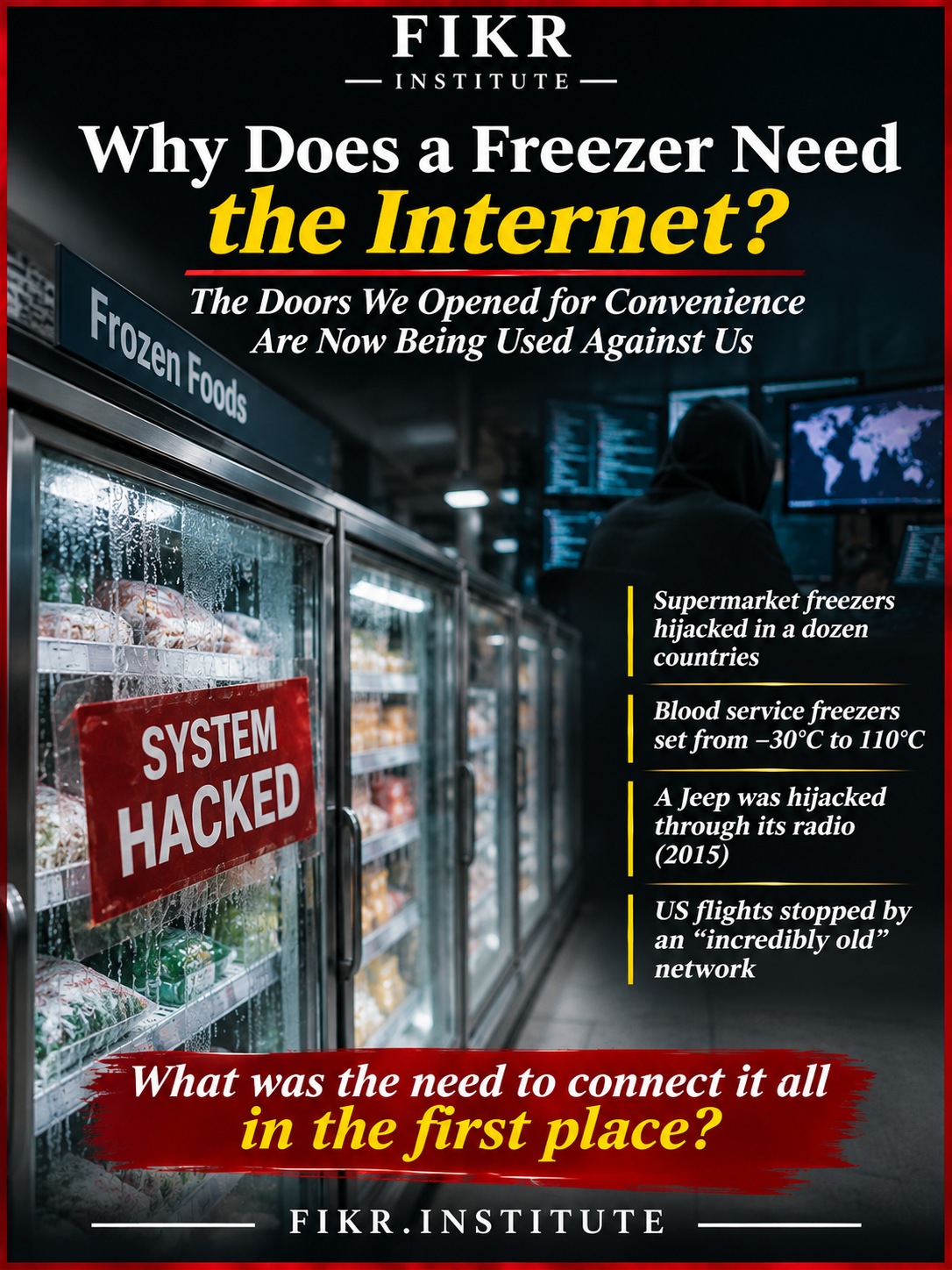
A freezer has one job: to stay cold. For most of its history it needed a plug and a thermostat. This autumn, freezers in at least a dozen countries were switched off, heated up or set on fire by people who never came near them. They could do it for one reason. Someone had connected the freezers to the internet.
The campaign began quietly. From late August, freezers failed at about six commissaries on United States military bases, and officials, speaking anonymously, said they suspected hackers linked to Iran [1]. In October, attackers took control of refrigeration systems at more than 700 supermarkets in France, and the damage ran to tens of millions of euros, with at least 15 fires [2][3]. On November 1, the temperature settings of freezers at three sites of the French national blood service were changed from minus 30 degrees to as high as 110 degrees; technicians caught it in time [4]. On November 2, stores in Sweden, Belgium, Luxembourg and Estonia were hit [5]. On November 5, American federal agencies warned that every organisation that depends on refrigeration should assume it could be a target [2][6]. On November 9, the French foreign ministry blamed a cyber unit of the Iranian Revolutionary Guard; that remains the assessment of one government [3].
The method was not advanced. The attackers did not need to break into a hospital or a supermarket. They reached controllers that their owners had exposed to the internet, and changed a setting [2][6]. The freezer did what it was told.
Canada has not been spared the wider danger. In August, a ransomware attack on the Health Sciences Centre in Winnipeg reached the systems that run its heating, ventilation and cooling [7]. Officials said patient care was not affected. The lesson stands: the building systems of a hospital are now a target.
The same logic runs through the car in your driveway. In July 2015, two researchers took remote control of a Jeep Cherokee through its entertainment system, reaching its speed, brakes, wipers and transmission. Fiat Chrysler recalled 1.4 million vehicles [8]. In June 2026, a Public Safety Canada memo, obtained by The Canadian Press, warned that data from connected vehicles "can have intelligence value" and could be used to "establish patterns of life or conduct surveillance on sensitive sites." Canada still relies on voluntary cyber security guidance for vehicles, written by Transport Canada in March 2020 [9]. The memo closed with advice that puts the burden on the buyer: "Each Canadian must also consider the cybersecurity, privacy implications, and trustworthiness of the devices they purchase and use" [9].
And when the systems are not attacked, they break on their own. On October 16, the data network behind air traffic control in Italy failed overnight, cutting capacity by half; the operator ruled out a cyberattack [10]. On November 12 and 13, Microsoft email and Teams went down for more than a day after a large number of servers became unavailable; the company said it had no evidence of malicious activity [11]. On November 13, every departure in the United States was stopped for hours. The transport secretary blamed overloaded routers on an "incredibly old" system [12]. Whether attacked or simply worn out, the same centralised, connected systems fail all at once.
Fikr Institute has put written questions to ten Canadian organisations, including health authorities, the Canadian Centre for Cyber Security, Transport Canada, the carmakers association, Canadian Blood Services and a Saskatchewan grocery cooperative, asking whether their cold storage or connected systems have been affected and whether they can be disconnected. Their answers, and any silence, will be reported.
Coordination between the attacks and the outages is not the claim, and no public evidence links them. Convergence is clear: in the same weeks, connected freezers were sabotaged in a dozen countries, and connected networks behind flights and email failed on their own [2][12][11][10]. Exploitation is documented: attackers turned a convenience into a weapon without advanced tools [2][6]. The precedent is 2015, when a car on the road was taken over through its radio and the industry answered with a recall rather than a rethink [8].
The signs to watch are whether Canada makes vehicle cyber security mandatory, whether hospitals and blood services disconnect their cold storage from the internet, whether any Canadian organisation confirms an attack on its refrigeration, and whether the causes of the November outages are made public.
Fikr Institute judges that the danger was not created by the attackers. It was created by the decision to connect what never needed connecting. A freezer that can be adjusted from a phone can be adjusted by anyone who steals the password. A car that receives updates over the air can receive orders too. The question no one asked before plugging everything in is the one that matters now: what was the need for it in the first place?