
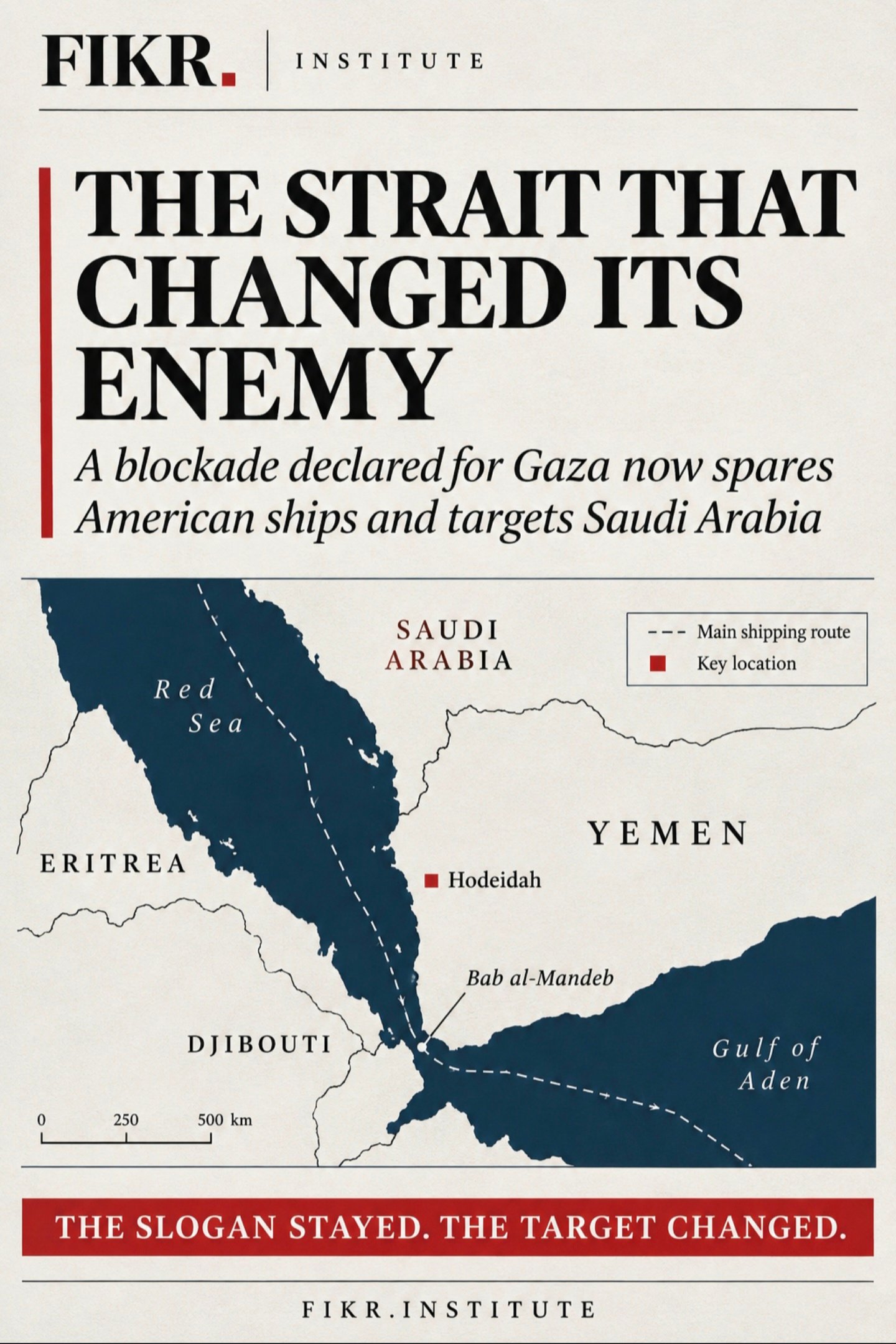
In October 2023, as the war on Gaza began, the Houthis started attacking ships in the Red Sea and declared that they were acting for the Palestinians [1]. For two years, the Bab al Mandeb strait was presented to the world as a front of the war for Gaza.
On November 15, 2026, the Houthis took control of the coast overlooking that strait once more, as Saudi backed government forces withdrew from Dhubab to defend Aden [2][3]. By the next day, Houthi forces were about 80 kilometres from Aden [2]. Saudi Arabia replaced the commander of its joint forces, a change two Western diplomats linked directly to the Houthi advance [4].
Most coverage asks whether the Houthis won the battle or whether Riyadh let them. Fikr Institute asks a different question: who is the strait closed to now?
The answer has changed. In May 2025, Oman announced a truce between the United States and the Houthis under which "neither side will target the other, including American vessels, in the Red Sea and Bab al Mandab Strait." The US State Department said the deal did not cover the conflict between the Houthis and Israel, and a Houthi leader said their operations "were and still are a support for Gaza" [1].
In September 2026, as the Houthis seized the western coast, American officials met Houthi representatives at the US embassy in Muscat. American officials said they had no plans to attack American shipping; the Houthis said their restrictions would apply only to vessels linked to Saudi Arabia [5]. A Yemeni source told Reuters that the Houthis had also pledged not to attack Israeli ships or other commercial vessels, except Saudi ones. That claim rests on one source and The National could not confirm it [6]. When the Saudi crown prince called President Trump twice to ask for American strikes, Trump refused, according to Axios, and Washington gave no explicit guarantee to defend Saudi energy sites or shipping [5].
Meanwhile, Saudi Arabia itself has come under fire. In November, missiles and drones were reported launched toward Riyadh, the Eastern Province and the Mecca region [2], and the Saudi led coalition said it intercepted two drones aimed at the Mecca region [3]. Who launched the strikes toward Mecca has not been independently established; the attribution rests on the statements of the parties to the war.
So the strait that was closed in the name of Gaza is now, by the account of the parties themselves, open to American ships and closed to Saudi ones. The slogan stayed the same. The target changed.
Was there a deal with Riyadh? One report, in Israel Hayom on October 26, citing unnamed Gulf diplomats, claimed that Saudi Arabia would pay the Houthis one billion dollars through Iran for a ceasefire. Riyadh, by the same report, rejected a new ceasefire and refused to pay before the Houthis returned the territory they had seized [7]. With strikes still reported on Saudi territory, the evidence points to a battle won on the ground, against government forces that analysts describe as fragmented and divided [4]. The deal that can be documented was not made in Riyadh. It was made in Muscat, between the Houthis and Washington [5][1].
The human cost falls on Yemen. Nearly 330,000 people have been displaced since fighting escalated in August, and Taiz has been surrounded for more than a month, with aid blocked [3].
Coordination between Washington and the Houthis against Riyadh is not the claim. Convergence is clear: the United States secured its own ships and stayed out, the Houthis secured freedom from American strikes, and Saudi Arabia was left alone to absorb the advance and the missiles [5][2]. Exploitation is visible: Yemenis fight Yemenis for the strait, and Saudi territory comes under fire, while the outside powers whose ships pass through it are spared [2][3][6]. The precedent is May 2025, when Washington first made its separate peace with the Houthis and left others outside the agreement [1].
The signs to watch are whether Houthi strikes on Saudi Arabia stop while the advance continues, whether Aden is besieged, whether any second named source confirms a Saudi payment, and whether any vessel linked to the United States or Israel is targeted in the strait again.
Fikr Institute judges that the most important change in Yemen is not on the map but in the target. A campaign declared for Gaza now spares American shipping by agreement and restricts only Saudi linked ships, while Washington watches from the sidelines. The outside power made its own peace [5]. Yemenis and Saudis are left to pay for it.