
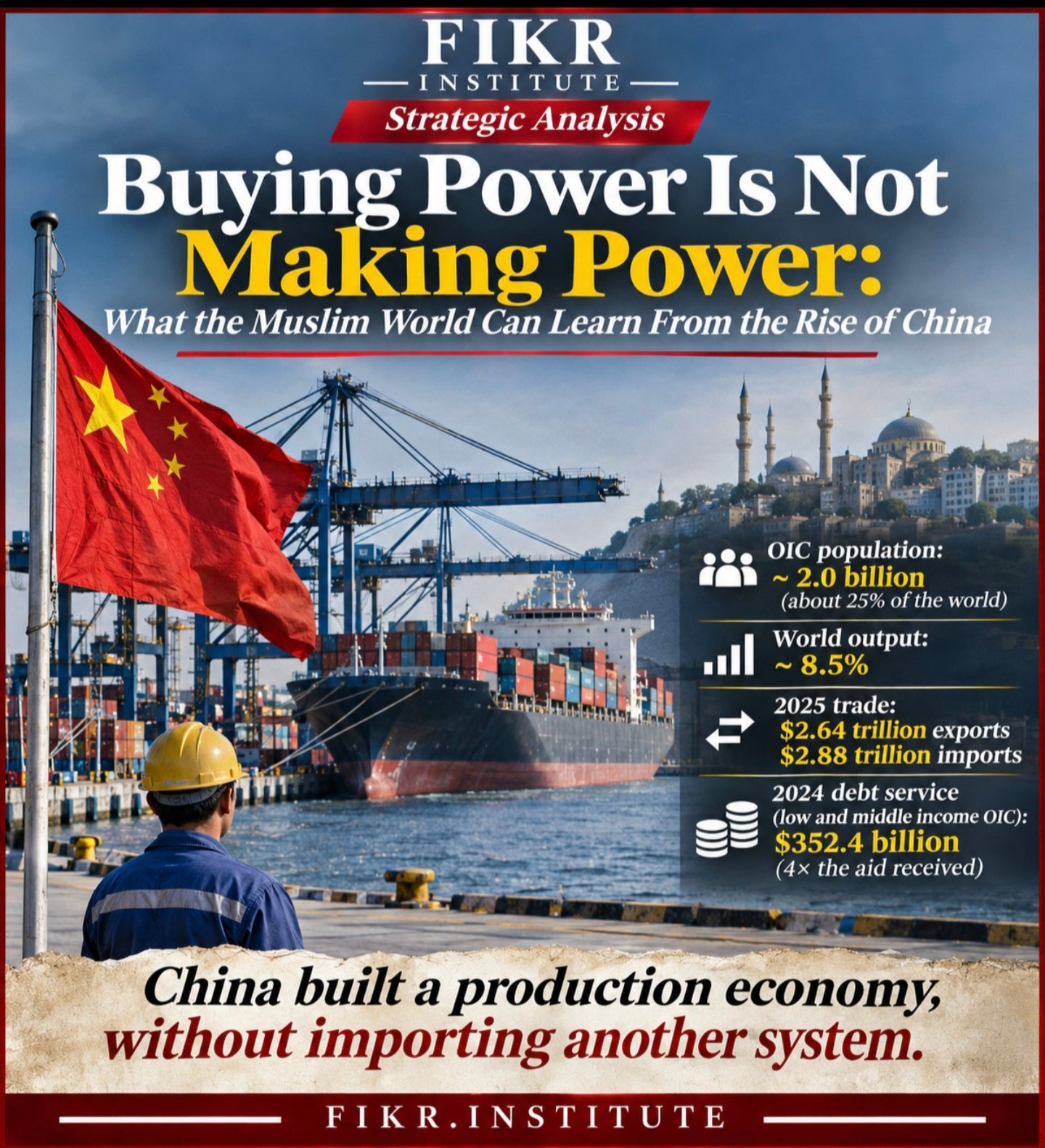
In 2025, the 57 member states of the Organisation of Islamic Cooperation were home to more than two billion people, about a quarter of humanity. Together they produced about 8.5 percent of world output [1]. They sold 2.64 trillion dollars of goods to the world, and they bought 2.88 trillion dollars [1]. Taken together, the Muslim world buys more than it sells.
In the same report, the research centre of the OIC records that its low and middle income members paid 352.4 billion dollars in debt service on their external debt in 2024, up from 270.5 billion in 2020. In the same year, all OIC countries together received 87.5 billion dollars in development aid [1]. More money left these countries to pay their creditors than arrived as aid, by four times.
The usual debate about China asks whether one party rule or elections produce prosperity. Fikr Institute sets that debate aside, because it makes the political system of others the measure of everything. The question here is simpler. China began its rise in the villages [2]. The Muslim world has villages too, and vast reserves of oil and gas besides. Why did one become the factory of the world, while the other remains its customer?
What China did is well documented. Close to 800 million people in China rose above the extreme poverty line in 40 years, close to three quarters of the global decline, according to the World Bank, which credits agricultural productivity, gradual industrialization, infrastructure and education [3]. A July 2026 study for the IZA Institute of Labor Economics traces the turn to 1978, when land was returned to farming households to work for their own gain. Farm output then grew by about 7 to 8 percent a year until 1984, and village enterprises absorbed the labour that the fields no longer needed [2]. China made basic schooling compulsory in its 1982 constitution, and by the 1990s, 40 to 50 percent of its upper secondary students were in vocational tracks [2]. The same study cites a former member of the Indian Planning Commission, who observed that the planners of China were mostly engineers, and those of India mostly economists [2]. Today China produces an estimated 26 to 30 percent of the manufactured value of the world, and UNIDO projects 45 percent by 2030 [4].
China imported machines, money and methods from countries whose ideology it rejected. It did not import their system. This is where Islamic economic thought has something to say that most development advice does not. It distinguishes between the science of production, which belongs to no civilisation and may be learned from anyone, and the economic system, which governs who owns, who earns and whose needs come first. A Muslim society can learn to build turbines from China, as China learned from others, without taking its ownership rules from Beijing or from Washington.
The second lesson concerns land. China began by giving land to those who would farm it [2]. The Islamic tradition reached a similar rule fourteen centuries ago. Abu Yusuf, chief judge under the Abbasids, records the ruling attributed to the Caliph Umar that a man who fences off land and leaves it idle for three years loses his right to it, so that it can go to someone who will work it [5]. Land is held to be used, not to be hoarded.
The third lesson concerns resources. The Prophet, peace be upon him, said, according to the collection of Abu Dawud, that Muslims are partners in three things: water, pasture and fire [6]. In Islamic economic thought, this is read as placing resources of collective need, such as energy, outside private ownership and outside sale to the favoured few. The Muslim world holds those resources. The question is what becomes of the revenue. When the revenue of oil is spent on imported machinery, imported services and the interest on foreign loans, the wealth of the ground leaves almost as fast as it arrives.
None of this means the Muslim world has no industry. In 2024, manufacturing made up 15.9 percent of value added in OIC economies, against 15.5 percent worldwide [1]. But the capacity is concentrated. In the most recent SESRIC study devoted to industry, Indonesia alone accounted for almost a quarter of all manufacturing in OIC countries, Türkiye for 15.6 percent, and the top five for 62.8 percent [7]. In 2025, the five largest OIC exporters accounted for 63.4 percent of all OIC exports, and trade among OIC members was only 20.1 percent of their total trade [1]. Those who produce and those who hold capital and energy are rarely the same countries, and they mostly trade with others rather than with each other.
Coordination is not claimed here. No state admits that it prefers its customers to remain customers. Convergence is visible: the countries that sell machinery and the lenders who are repaid each year gain from a Muslim world that buys more than it makes [1]. Exploitation is measurable: 352.4 billion dollars in debt service in one year is a flow of wealth outward, and the interest within it is riba, which Islam forbids [1]. The precedent is China itself, which also depended on foreign capital and foreign machines at the start, and used them to build its own [3][2].
The signs to watch are whether OIC imports keep rising faster than exports, as they did in 2025 [1], whether debt service keeps rising, whether trade among Muslim countries moves beyond one fifth of their total, and whether resource revenue is spent on machines that make machines, or on machines that only consume.
Fikr Institute judges that the Muslim world does not lack money. It lacks the conversion of money into productive power. Buying power can be spent in a year. Making power accumulates for generations. China showed that the science of production can be taken from anyone without surrendering the system that governs a society. The Islamic tradition already holds the rest: land that is used, resources held in common, and an economy measured by whether every person has what they need, not by the wealth of a few. The question for the Muslim world is not whether to learn from China. It is why it has not yet done what its own principles already ask.