
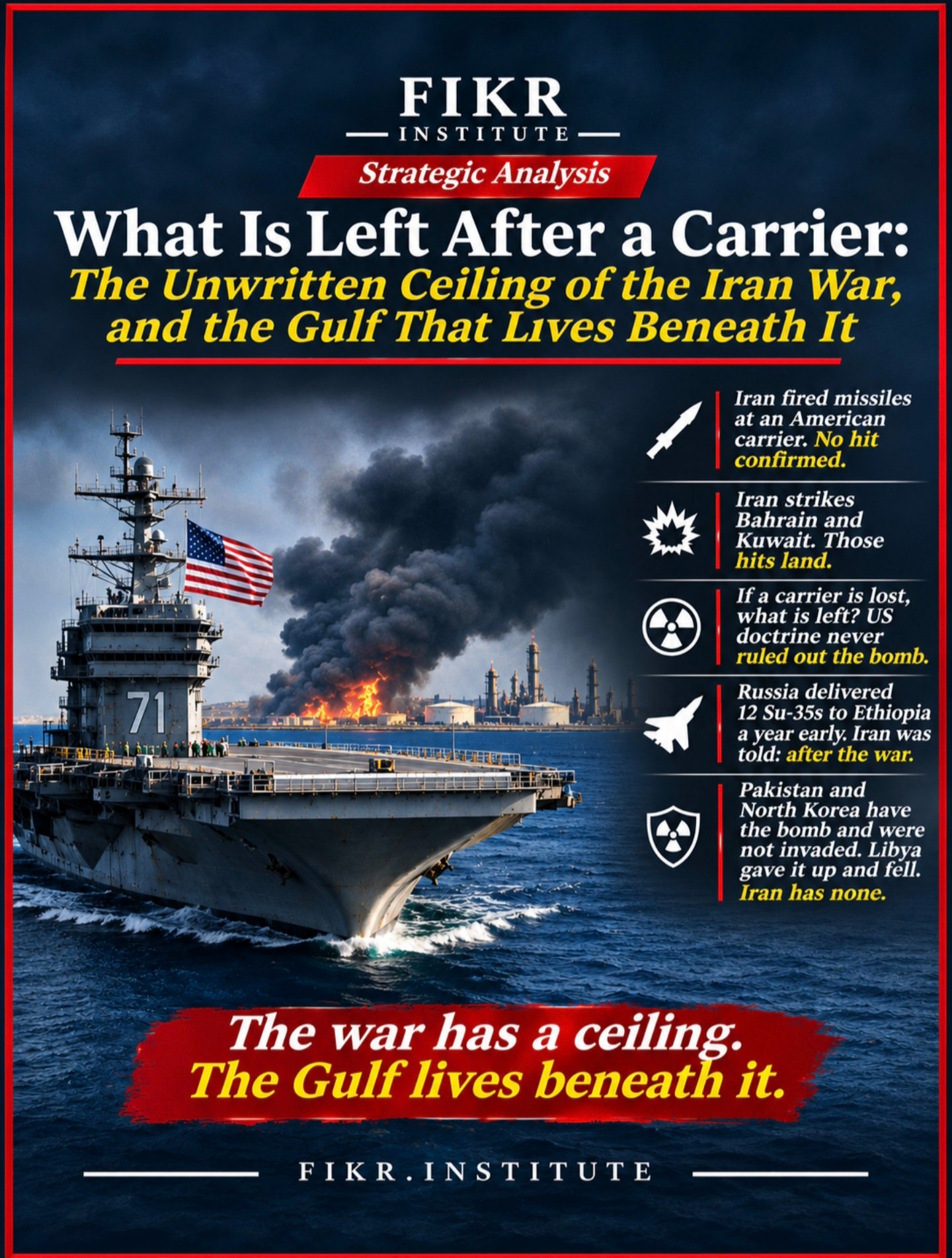
On November 15, the USS Theodore Roosevelt entered the area of US Central Command and joined the USS George Washington and the USS George H.W. Bush, putting three American carrier groups in the Middle East at once [1]. On the same day, Iran sent six drones toward the Riffa base in Bahrain [1]. By November 18, Iran had struck at Bahrain three times in one week and at Kuwait for the first time since September, and the United States had answered by striking a missile launch site on Qeshm Island [2][3].
The pattern of this war is now visible. Iranian fire falls on bases inside Gulf countries. It does not, by any confirmed account, fall on an American carrier. Fikr Institute asks why, and what that line tells us about the war and about those who live beneath it.
What Is Left After a Carrier
Iran has tried. On September 5, Central Command said ballistic missiles were fired at an American carrier and a destroyer, that both ships evaded them, and that no one was hurt. The Revolutionary Guard claimed both ships were damaged; Washington denied it [4]. The bases tell a different story. Early in the war, according to a New York Times report cited by Al Jazeera, Iranian attacks heavily damaged the American naval base in Bahrain, and the Navy moved its main supply hub to Diego Garcia, about 3,540 kilometres away [5].
So the question is not whether Iran can hit American forces. It is why the carrier remains the one target no one has confirmed hitting, and what would follow if it were.
A carrier is not just a ship. It is the symbol of American power at sea and the instrument of its deterrence. If it is sunk, a symbol is lost, and a symbol cannot be restored with a smaller weapon than the one that destroyed it. A president who has lost a carrier and thousands of sailors will look for what is left that can restore deterrence at once. That is the nuclear weapon.
This is not speculation about American intentions. It is written into American doctrine. The 2022 Nuclear Posture Review rejected both a no first use pledge and a policy limiting nuclear weapons to deterring nuclear attack, and the Congressional Research Service noted that its language on high consequence, strategic attacks could cover advanced conventional strikes [6]. The current Pentagon policy chief, Elbridge Colby, told the Senate in March 2026 that there would be no new review, and called the declaratory policy of the first Trump term "very good"; that policy reserves nuclear use for "extreme circumstances" to defend vital interests [7]. Washington wrote its doctrine so that the nuclear option stays on the table after a conventional attack of strategic weight. The loss of a carrier would be exactly that.
The precedent shows how steep the ladder is. On April 14, 1988, the frigate USS Samuel B. Roberts struck an Iranian mine in the Gulf. Four days later, the US Navy destroyed two Iranian platforms, sank two ships and badly damaged another, in what the Navy calls the largest of its surface actions since the Second World War [8]. That was the answer to a damaged frigate. A destroyed carrier is not on the same ladder.
The Agreement No One Signed
A limit does not need a signature. In 1960, the strategist Thomas Schelling described how enemies who refuse to talk still reach limits through what each side does, threatens and avoids [9]. The limit is kept because both sides read it, not because they wrote it.
The behaviour of this war reads that way. After Iran fired at two American warships on September 5, the commander of Central Command, Admiral Brad Cooper, did not strike Tehran. He struck three oil tankers, and said so in the language of a ledger: "If you shoot at two of our ships, we will impose an even higher economic cost," he said, "taking out three of yours" [4]. In November, after Iranian drones flew at a radar in Bahrain, the American answer hit a missile launch site on Qeshm, and Iranian officials said no residential or infrastructure areas were damaged [2][3]. Each side answers the other in measured units. Neither crosses the line that would make the other abandon measurement.
Fikr Institute does not claim a written deal. It observes a ceiling that both sides behave as if they see. Above the ceiling is the carrier, and with it the nuclear threshold. Below it is everything else.
The Gulf Below the Ceiling
Everything else is the Gulf. In June, a drone struck a passenger terminal at Kuwait International Airport, wounding several people [10]. In July, Iranian attacks set fire to a Kuwaiti power and water plant, the second such plant hit in two days [11]. In November, Bahrain intercepted Iranian attacks three times in a single week, and Kuwait shot down drones over its own territory [2][3].
The countries that host American forces carry the cost of a war fought below the ceiling, while the assets that symbolise American power sail above it. Muslims in Kuwait and Bahrain take the fire. Washington keeps its carriers, its doctrine and its freedom to choose when to answer. Who benefits from a war in which Muslim states absorb the blows, and the outside power decides the rules?
Coordination in the form of a written agreement is not claimed. Convergence is clear: Iranian fire lands on bases while no strike on a carrier has been confirmed, and Washington answers in measured strikes on tankers and launch sites rather than at the scale its doctrine allows [4][2][6]. Exploitation is visible: the war is fought on Gulf territory, against Gulf infrastructure, while the outside power keeps its carriers above the line [11][10][1]. The precedent is 1988, when a damaged frigate brought the sinking of Iranian ships within four days, an answer that never needed a nuclear weapon because the loss never reached the ceiling [8].
The signs to watch begin on Thursday, November 19, when President Trump, President Xi and President Putin meet in Shenzhen, with nuclear arms and Iran on the agenda; the Kremlin has already said that any agreement cannot be imposed on other nations [12]. Watch whether the Gulf strikes stop after the meeting, while the carriers stay. Watch whether any American warship is struck, and how Washington answers if one is. And watch whether anyone at that table speaks for Kuwait and Bahrain.
Fikr Institute judges that this war has a ceiling, and that the ceiling is the carrier. Above it sits the one weapon Washington has refused to rule out, and both sides behave as if they know it. Below it, the Gulf takes the fire. The rules of this war were not written in Kuwait or Manama, yet Kuwait and Manama are where they are enforced. That is the arrangement no one signed, and the Muslim states beneath the ceiling are the ones paying for it.