
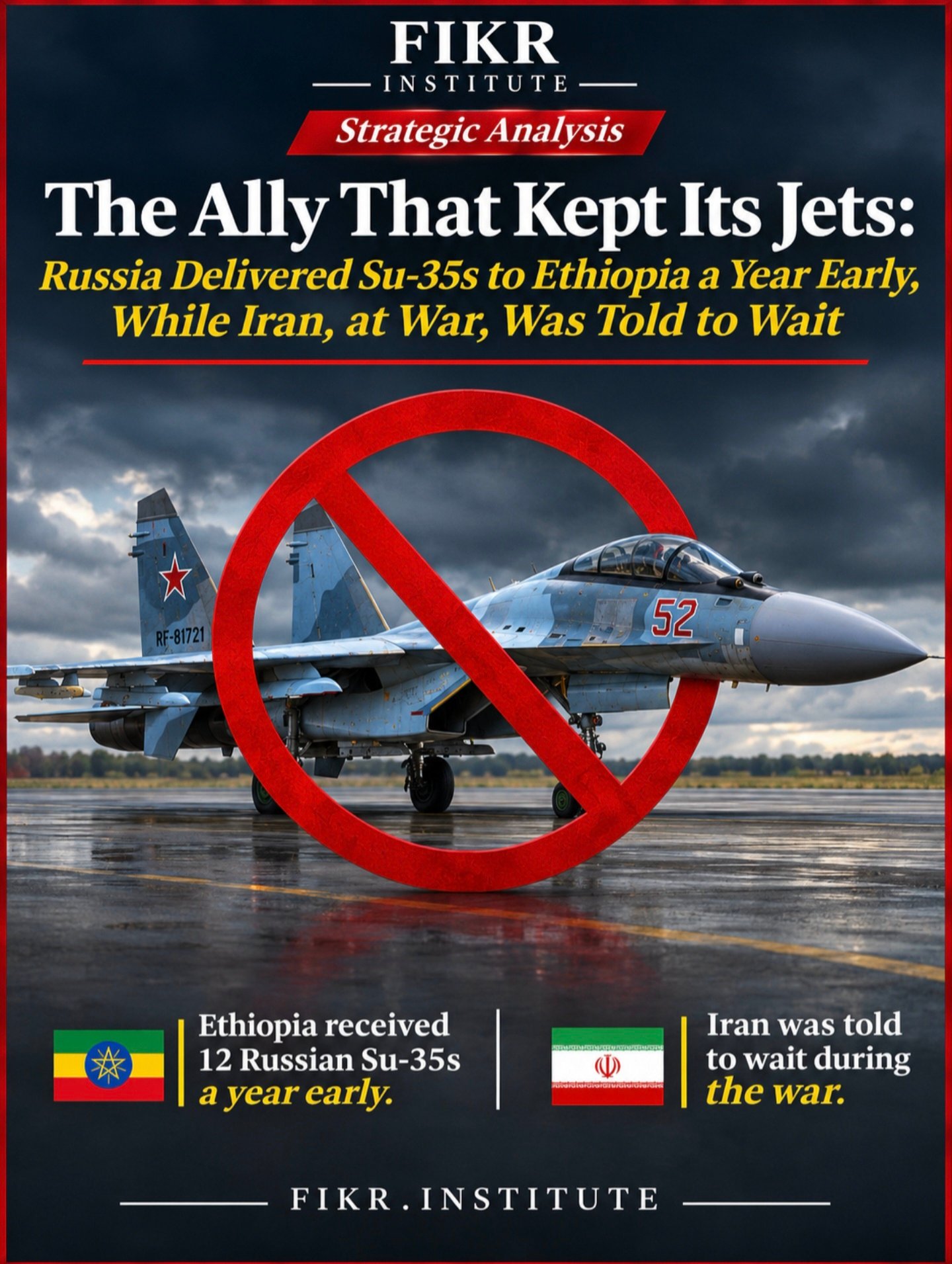
On October 28, Ethiopian Prime Minister Abiy Ahmed announced that his country had received 12 Russian Su 35 fighter jets. The agreement, he said, had set delivery for the next year, and he thanked President Putin for speeding it up [1]. He added that Ethiopia now planned to acquire the S 400 air defence system [1].
Four days later, a spokesman for the Revolutionary Guard, Brigadier General Mohammad Akraminia, told Iranian media that Iran had also completed the purchase of Su 35s and signed the contracts before the war. "In fact, these aircraft were supposed to arrive before the war," he said, adding that Iran would receive them after it [2].
Ethiopia is not at war with the United States. Iran has been at war with the United States and Israel since February 28 [3]. The country that needed the jets was told to wait. The country at peace with Washington received them a year early.
Most coverage treats Russia as the patron of Iran in this war. Fikr Institute asks what the patron has delivered, and who has gained more from the partnership.
What Iran Gave
The record on one side is long. Chatham House reported on November 2 that Iran supplied Russia with thousands of drones, including the Shahed 131 and Shahed 136, for its war in Ukraine. Leaked contracts indicate Russia agreed to pay about 290,000 dollars per drone for 2,000 of them, though how much was paid is unclear. Iran also helped Russia set up its own factories, so that Moscow now builds a modified version of the drone at home [4].
That last point matters most. A buyer who learns to build the product no longer needs the seller.
What Iran Received
The record on the other side is thinner. According to several reports cited by Chatham House, Russia gave Iran intelligence on American military positions, satellite imagery for targeting and weapons components, though their effect on the battlefield is hard to assess [4]. The advanced weapons Iran said it bought before the war, the Su 35s among them, did not come [4].
The two countries signed a comprehensive strategic partnership in January 2025. Iranian policymakers, Chatham House notes, remain wary of the absence of a binding security guarantee [4]. Tehran felt that Russia did not significantly come to its aid in the twelve day war of June 2025 either, and critics in Iran have argued that Russia gained far more from the partnership than it gave [4]. A former naval commander of the Revolutionary Guard put it more sharply: "There is a view that Russia sought to drag Iran into that war," he said of Ukraine [4].
And China? What Beijing has given Iran in this war has not been established. American officials told The Wall Street Journal that Iran used high resolution images from Chinese sources before its July attack in Jordan, but they did not name the source, and Chinese officials denied any involvement [5]. Until more is shown, it remains a single party claim.
The Table in Shenzhen
On November 19, President Putin sits down with President Trump and President Xi in Shenzhen, with nuclear arms and Iran on the agenda [3]. Iran will not be at that table.
In February 2025, Iranian commentators warned that Moscow might use Iran as a bargaining chip in its talks with Washington over Ukraine [4]. The meeting in Shenzhen is where that warning will be tested. A partner who delays your jets while you are at war, and then meets your enemy without you, has interests of its own.
Coordination between Moscow and Washington against Tehran is not claimed. Convergence is clear: Russia received thousands of Iranian drones and the means to build them, and the jets Iran paid for stayed in Russia while the war that Washington is fighting went on [4][2]. Exploitation is visible: Russia supplied a country at peace before a country at war, and sits at the table with the enemy of its partner [1][3]. The precedent is the twelve day war of 2025, when, by the account of Iranians themselves, Russia did not come to the aid of Iran in any significant way [4].
The signs to watch are whether the Su 35s reach Iran while the war continues or only after it ends, whether Russia delivers the S 400 to Ethiopia before anything comparable reaches Iran, what Putin says about Iran after Shenzhen, and whether Iran receives any new security guarantee from Moscow.
Fikr Institute judges that the partnership between Russia and Iran has been measured by what Iran gave, not by what it received. Iran gave Russia drones, contracts and the knowledge to build them. Russia gave Ethiopia its jets early, and told Iran to wait until the war is over, when it will need them least. For any Muslim state that places its security in the hands of a great power, the lesson is the same whether the power is in Washington or in Moscow: a patron delivers when it serves the patron.