
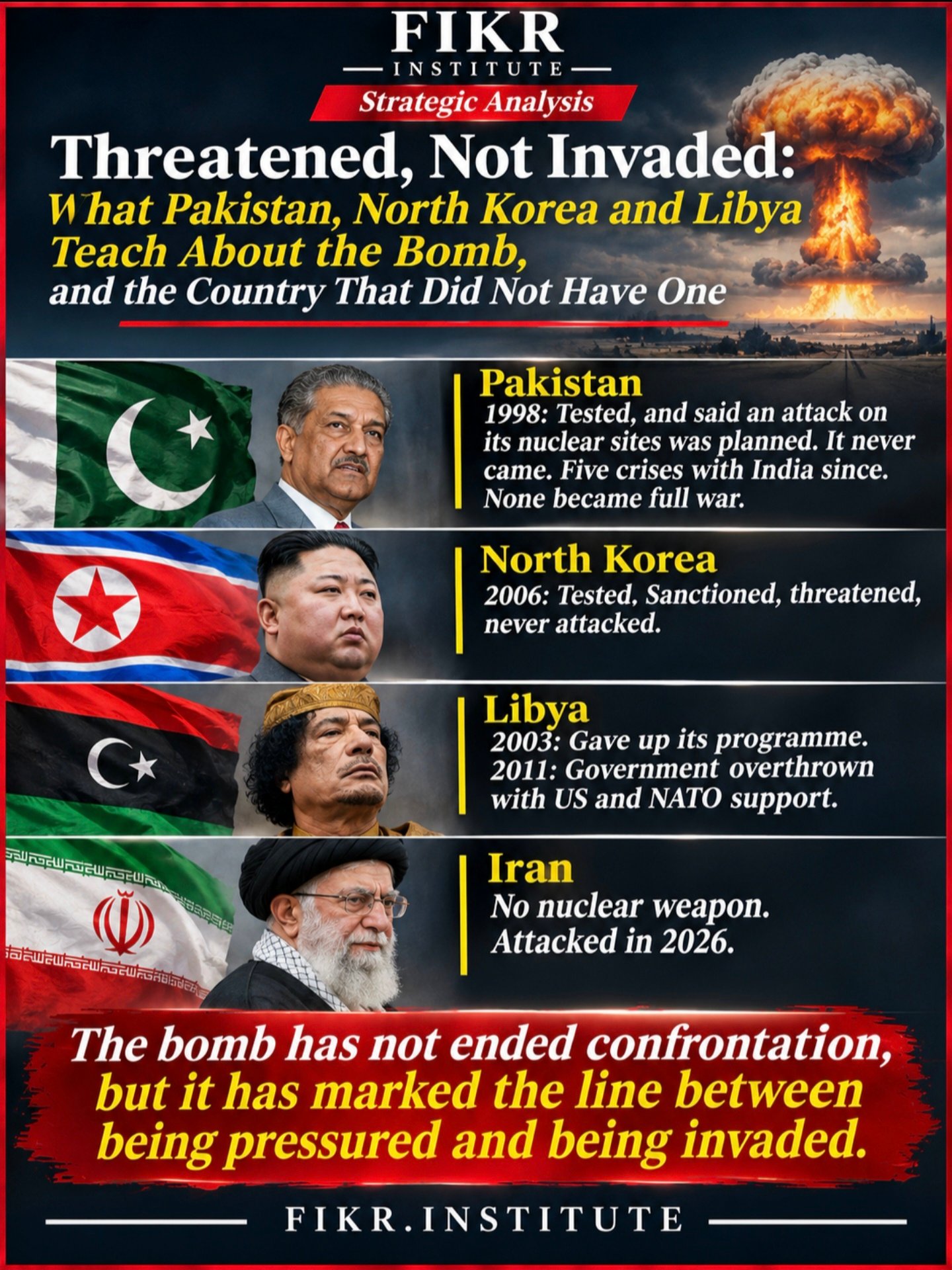
Four states have stood at the centre of the argument over nuclear weapons in the past three decades: Pakistan, North Korea, Libya and Iran. Two built the bomb. One gave up its programme. One never crossed the line. Their fates are a matter of record.
Most debate about the bomb asks whether it makes the world more dangerous. Fikr Institute asks a narrower question, one the record can answer: what happened to each of these states after the choice it made?
Pakistan
On May 28, 1998, as Pakistan conducted its nuclear tests, its representative told the Conference on Disarmament in Geneva that Pakistan had received information of a planned attack on its nuclear installations, and warned of "swift and massive retaliation" [1]. Israel denied any such plan, and the US State Department said it had no information that the danger was real [2]. Whatever was planned, the attack Pakistan warned of did not come.
Crises have followed. From 2001 to 2025, India and Pakistan went to the brink five times, after attacks in Delhi, Mumbai, Uri, Pulwama and Pahalgam, and in several of them they exchanged fire [3]. None of those crises became a full war. A February 2026 study for the Carnegie Endowment cites analysts who concluded that the spectre of nuclear retaliation held India back after the Mumbai attacks of 2008, and that the Pakistani doctrine of full spectrum deterrence stopped India from widening the conflict in 2019 [3]. The study describes these as crises in a nuclearised environment rather than nuclear crises as such [3]. The bomb did not end confrontation. It set a limit on how far confrontation could go.
North Korea
North Korea tested its first nuclear device on October 9, 2006. The Congressional Research Service wrote at the time that its planners "may believe that developing and demonstrating a nuclear capability will deter a U.S. attack" [4]. Twenty years later, North Korea has been sanctioned, isolated and threatened. It has not been attacked.
Libya
Libya chose the other path. On December 19, 2003, it announced that it was dismantling its weapons programme [5]. In 2011, insurgents with the direct support of the United States and NATO overthrew its government and killed its leader [5]. North Korea drew its own conclusion, describing the Libyan case as an invasion tactic to disarm a country, and its state news agency later wrote that the governments of Saddam Hussein and Muammar Gaddafi could not escape destruction after giving up their programmes [5].
Iran
Iran has no nuclear weapon. On February 28, 2026, the United States and Israel went to war against it [6].
Set side by side, the four cases tell one story. Pakistan and North Korea have been threatened, sanctioned and pressured, and they have not been invaded. Libya disarmed and its government fell. Iran did not have the bomb, and it was attacked.
Coordination is not the claim here, and no state announces that it chooses its targets by whether they can retaliate. Convergence is clear: in each case, the decisive difference between threat and invasion was whether the target could answer with a nuclear weapon [1][4][5][6]. Exploitation is visible in what the great powers ask of others: Libya was asked to give up its programme, and it was destroyed after it did [5]. The precedents are 1998 and 2006, when two states crossed the threshold and were never invaded afterward [1][4].
The signs to watch begin on November 19, when the leaders of the three largest nuclear powers meet in Shenzhen, with nuclear arms and Iran on the agenda [6]. Watch whether any agreement they reach on nuclear weapons asks restraint of themselves, or only of others. Watch whether Iran is asked to give up what it has, in the way Libya was. And watch which states, after this war, decide that the lesson of Libya and Pakistan is too clear to ignore.
Fikr Institute judges that nuclear weapons have not ended confrontation, but they have marked the line between being pressured and being invaded. The states that crossed that line have been threatened and left standing. The state that gave up its programme was destroyed, and the state that never had one was attacked. The great powers that keep thousands of these weapons for themselves have taught this lesson to the Muslim world more clearly than any argument could.