
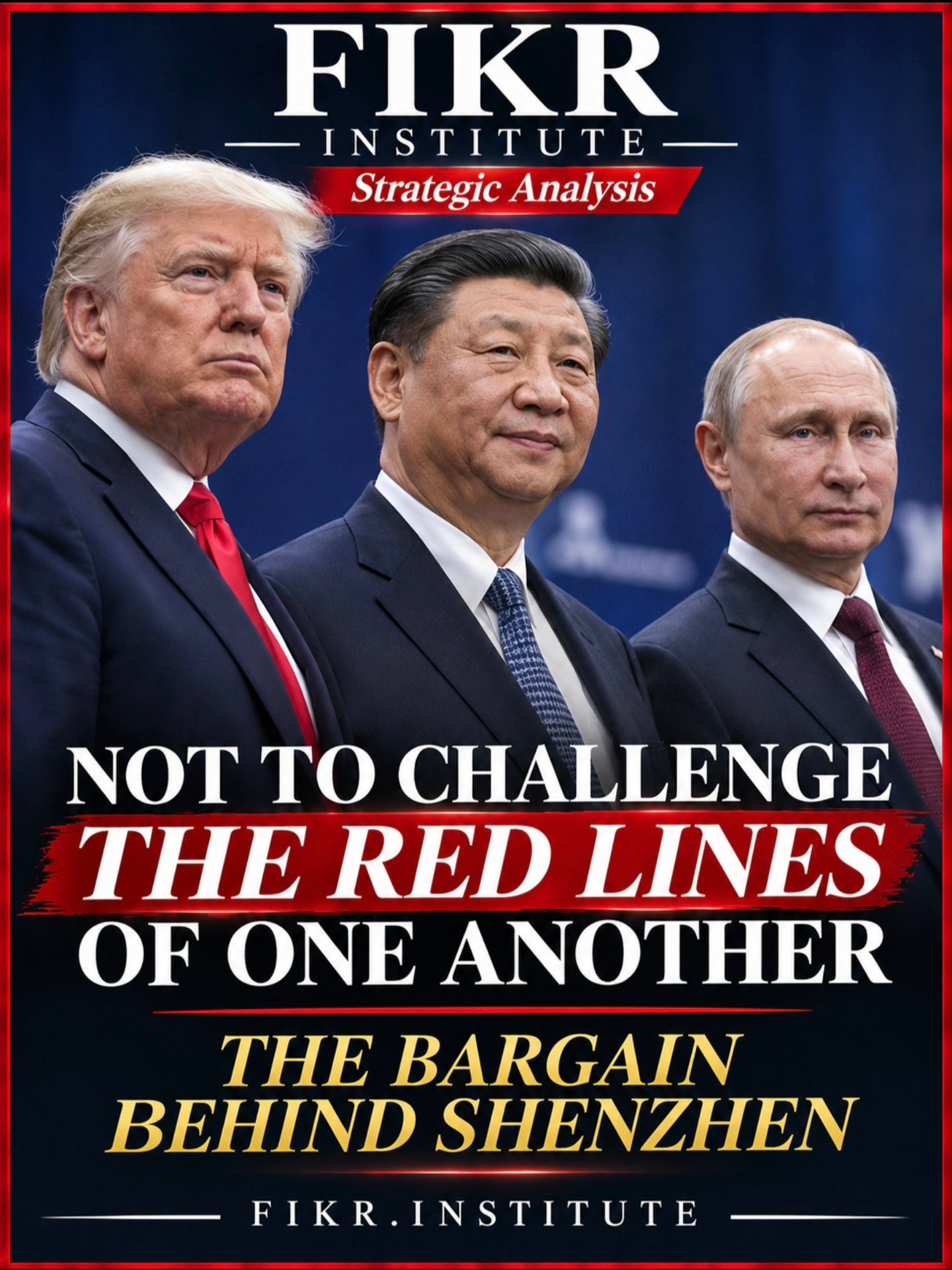
On November 19, in a villa in Shenzhen, the presidents of the United States, China and Russia sat at one table. It was the first time the three had met together [1]. Xi Jinping called the meeting "of groundbreaking significance," and set out its first rule: the three powers should respect the core interests and major concerns of one another, and take care "not to challenge the red lines of one another" [2]. A Korean daily rendered his words more directly: major powers must not touch the red lines of each other on sensitive issues [3].
After about 70 minutes, the three agreed on a narrow declaration: reform of the United Nations, more refined fuel, dialogue on nuclear risk, and a curb on the International Criminal Court [4]. Iran, the war Trump said he expected to discuss, was not among the points they agreed [5][4].
Most coverage concludes that the summit achieved little. Fikr Institute reads it the other way. When three powers on opposite sides of two wars agree on almost nothing in writing, but agree on the rule that each must respect the red lines of the others, the agreement is the rule. The question is what the red lines are, and who lives on the wrong side of them.
The Red Lines, by Their Actions
States do not publish their bargains. They act on them. The record of 2026 shows each power stepping back from what the others call a red line, and each being paid in kind.
China and Iran. In May, after a three day visit to Beijing, President Trump said Xi had promised him that he was not sending any weapons to Iran. He called it "a beautiful promise," and added: "I take him at his word" [6]. China has long been among the largest buyers of Iranian oil [5]. At Shenzhen, Trump said he and Xi shared an interest in keeping oil flowing through the Strait of Hormuz [4]. Iran needs air defence. China needs oil. On the record, Beijing promised to withhold the first and Washington spoke of securing the second.
The United States and Taiwan. Within days of the same visit, the acting US Navy secretary told the Senate that foreign military sales were on pause to preserve munitions for the Iran war, and Taiwan was waiting on a 14 billion dollar package. On his way home from Beijing, Trump called arms sales to Taiwan "a very good negotiating chip" [7]. At Shenzhen, according to the Chinese account, Trump told Xi that the United States "does not support Taiwan independence"; the White House did not release its own account [8]. Taiwan is the first of what China calls its red lines [9].
Russia and Iran. On October 28, Ethiopia received 12 Russian Su 35 fighters a year ahead of schedule and announced plans for the S 400 [10]. Iran, which said it bought the same jets before the war, was told they would come after it [11]. Russia has not delivered the advanced weapons Iran paid for [12]. Fikr Institute judges that jets and air defences of that class would matter in the air war over Iran. Moscow has kept them out of it.
The United States and Ukraine. On the day of the summit, Trump rejected new sanctions on Russia, while Kyiv suffered from disruptions to the satellite support its drones rely on [4]. Putin said afterward that he intended to lead a settlement of the Ukraine war [3].
Put the record together and a pattern appears. China does not arm Iran. Russia does not arm Iran with what would matter. The United States slows weapons to Taiwan and pressure on Moscow. Each power keeps its hands off the war the other two consider their own. Fikr Institute cannot prove that this was agreed in words. States do not admit such things. But it is what each has done.
What Each Receives
The returns are as visible as the restraint. Russia receives a seat beside Washington while it fights in Ukraine, and relief from new sanctions [4]. China receives a pause on Taiwan arms, a Chinese account of American words on Taiwan independence, and the role of host to the first meeting of the three [7][8][1]. The United States receives a war against Iran in which neither Beijing nor Moscow arms its enemy with what would change the outcome [6][11].
One more question deserves to be asked, even though no document answers it. If the United States accepts the red lines of China in its own neighbourhood, will China ask, in time, that Washington stop building up the rivals of China in Asia, India among them? Nothing in the public record says so. Fikr Institute puts the question to readers, and will watch what Washington does next in Asia.
The Clause That Protects the Accused
The only concrete protection in the Shenzhen declaration is for officials. The three leaders said the ICC was "overstepping its jurisdiction" and that government officials "should enjoy immunity from its prosecutions" [4].
Consider who stands before that court. The ICC has issued an arrest warrant for Putin over the deportation of children from Ukraine, and warrants for Israeli leaders, including Netanyahu, over Gaza [13]. In September 2025, a UN commission of inquiry chaired by a former ICC judge concluded that Israel has committed genocide in Gaza; Israel rejected the finding as "scandalous" and "fake" [14]. Washington has sanctioned 13 current and former ICC staff over its investigation of Americans and its warrants for Israeli officials [15].
Five days before Shenzhen, ICC judges halted the investigation into alleged crimes by American troops and intelligence operatives in Afghanistan, an inquiry that had covered offences since 2002 and had been dormant since 2021. Secretary of State Marco Rubio said: "President Trump will never allow the International Criminal Court to prosecute Americans" [15]. China has never faced an ICC investigation, because it is not a party to the court; in 2020, prosecutors declined a request from Uyghur groups to investigate alleged genocide, citing lack of jurisdiction [13]. China lists "democracy and human rights" among its red lines [9].
The leaders who could not agree on peace in Iran, Ukraine or Gaza agreed that officials should be immune from the court that is examining what happened in them. That is not a side issue. It may be the clearest line in the document.
Who Pays
Iran pays: it fights the United States and Israel while both its great power partners hold back what it needs [6][11][12]. Venezuela pays: since the United States seized Nicolas Maduro on January 3, Washington has controlled Venezuelan oil sales, requiring that most of the oil go to the United States and that China pay full price for the rest [16], and American companies are negotiating long term access to its fields [17]. Gaza pays: the court examining the war there is now the target of all three powers [4][13]. The Gulf pays: no security arrangement for the states that host American bases and take Iranian fire appeared in the declaration [4]. And the people of Afghanistan, whose case against American conduct was closed five days before the summit, pay as well [15].
Coordination is the hypothesis Fikr Institute puts forward here, not a proven fact: an understanding, spoken or unspoken, that each power will respect the red lines of the others [2]. Convergence is documented: China promised not to arm Iran, Russia kept its jets from Iran, and the United States paused arms to Taiwan, all within the same year, and the Chinese promise and the Taiwan pause came within days of each other in May [6][7][11]. Exploitation is visible: the costs fall on Iran, Venezuela, Gaza, the Gulf and Afghanistan, none of whom were at the table [4][16][15]. The precedent is Yalta in 1945, when great powers divided the postwar world among themselves; some critics have already called Shenzhen a second Yalta [3].
The signs to watch are whether the Taiwan arms package moves or stays frozen, whether any Chinese or Russian air defence system reaches Iran, whether the Su 35s arrive before the war ends, whether American support for Ukraine shrinks further, whether the ICC appeal on Afghanistan succeeds, whether any new action is taken against the court, and whether Washington changes course on India.
Fikr Institute judges that the world Shenzhen revealed is already multipolar. Russia has sat with Washington before. China now sits with both, as host, setting the first rule of the table. That rule is not peace. It is mutual respect for red lines. Each power protects its own sphere, its own officials and its own interests, and agrees not to arm the enemies of the others where it counts. Iran, Venezuela, Gaza, the Gulf and Afghanistan were not consulted. They are where the bargain is paid for.