
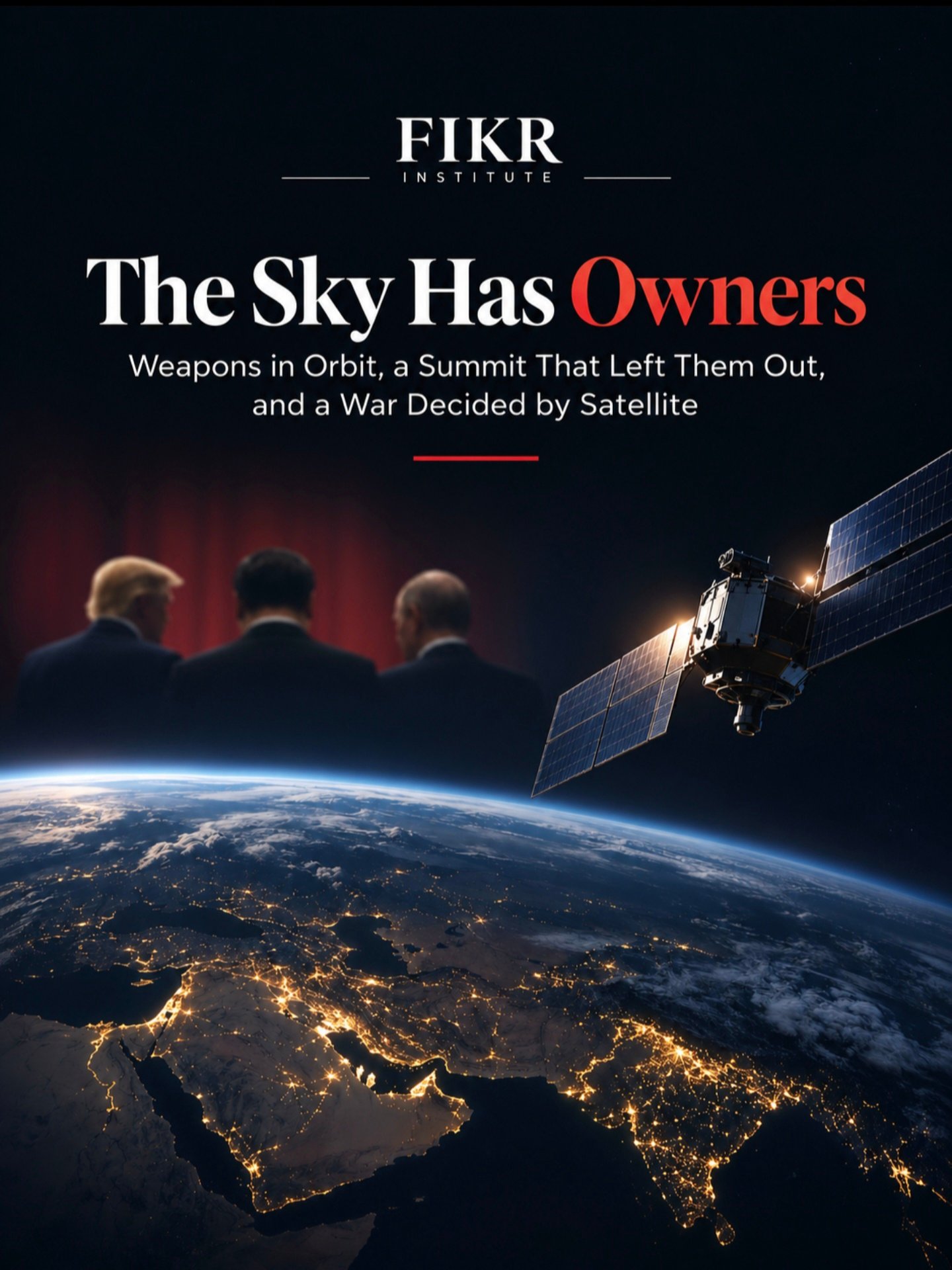
Speculation circulating online speaks of an American "GOD bomb" waiting in space. The record tells a quieter story, and a more consequential one.
On September 14, 2026, the Secretary of the Air Force, Troy Meink, told a conference near Washington that the United States now has space control weapons in orbit, capable of defending American forces against "hostile adversary action" [1]. It was the first time a Pentagon official confirmed that the United States has weapons in space [1]. He did not say what they are, when they were launched or how many are in orbit [2]. A day later, the Chief of Space Operations, General Douglas Schiess, said the Space Force operates weapons in orbit that can defend American forces against attacks enabled from space, which Arms Control Today read as a sign that the weapons could also be used to disable the satellites of other countries [3]. In the same month, US Space Command held its first live fly exercise in orbit, with allied forces running a parallel exercise [3].
The 1967 Outer Space Treaty bans nuclear weapons in space, but not other weapons [3]. What Washington has confirmed falls in that gap.
Most coverage stopped at the announcement. Fikr Institute follows it to where it should have been discussed, and was not.
Who Accused Whom
In February 2024, the United States accused Russia of developing a space based nuclear weapon to destroy satellites. Russia denied it, and Putin said Moscow opposed putting nuclear weapons in space [4]. Russia then vetoed a Security Council resolution reaffirming the treaty, by 13 votes to one, with China abstaining [5].
In May 2025, China and Russia called the American Golden Dome programme "deeply destabilizing," and said it would turn outer space into "an arena for armed confrontation." They proposed a treaty to prevent the placement of weapons in space and a pledge not to be the first to deploy them [6]. In 2026, days after a Trump visit to Beijing, they called Golden Dome "a clear threat to strategic stability" [7]. After the September announcement, a Chinese foreign ministry spokesman said China opposes the weaponization of space and urged the United States to stop expanding its military presence there [8]. Golden Dome itself plans interceptors based in space, with an initial capability possibly fielded by 2028 [9].
So by November, each side had accused the other of arming the sky, and the United States had said aloud that it already had.
The Summit That Left It Out
On November 19, the leaders of the three largest nuclear powers met in Shenzhen. Xi set the rule of the table: each should respect the core interests of the others and take care "not to challenge the red lines of one another" [10]. The declaration they agreed covered reform of the United Nations, refined fuel, the International Criminal Court and a dialogue on nuclear risk [11]. None of the four points reported by the Associated Press concerns space [11].
Two months after Washington confirmed weapons in orbit, and after Beijing and Moscow had called its space programme a threat to stability, the three sat together to discuss nuclear danger and left the sky off the page. Fikr Institute does not claim to know what was said in private. It observes what was put in writing, and what was not.
There is a reading that fits the record. If the bargain of Shenzhen is that each power respects the red lines of the others, then space may be the one field none of them wants to bind. Each is building there. Each accuses the others. And none signed anything that would limit what it puts in orbit.
Why the Sky Decides the Ground
Ukraine shows why this matters to everyone below. In November, President Zelenskyy said that many Russian drone strikes on Ukrainian energy sites were getting through because of restrictions on the operating speed of Starshield terminals, the military version of the Starlink satellite network. Starlink denied restricting speeds, and Elon Musk has said the US government controls Starshield [12]. Whoever imposed it, a limit set in orbit by a foreign owner decided whether a nation could defend its power grid.
That is the real weapon in space: not a bomb, but control over the satellites that armies, cities and economies depend on. A state that rents its eyes, its communications and its navigation from another can be blinded without a shot being fired.
The question for the Muslim world follows. Which Muslim state can say with confidence that its armies would still see, speak and navigate if the owners of the sky decided otherwise? Fikr Institute puts that question to readers, because no government has answered it publicly.
Coordination among the three powers on space is not claimed. Convergence is clear: Washington has declared weapons in orbit, Beijing and Moscow have condemned the American space programme while each develops its own, and the three left space out of the one declaration they signed together [1][6][11]. Exploitation is visible: those who own the satellites can decide who is defended on the ground, as Ukraine found this month [12]. The precedent is 2024, when an accusation of a nuclear weapon in space ended not in a new rule but in a veto [5].
The signs to watch are whether the dialogue on nuclear risk agreed at Shenzhen ever includes space, whether China or Russia announces weapons of its own in orbit, whether the Golden Dome interceptors move toward deployment, and whether any Muslim state begins to build satellites of its own that no foreign owner can switch off.
Fikr Institute judges that the most dangerous weapon in orbit is not the one rumoured online. It is the power to decide, from space, who on Earth can see and who cannot. The three powers that hold that power met in Shenzhen and did not write a word about it. For the countries below, that silence is the message.