
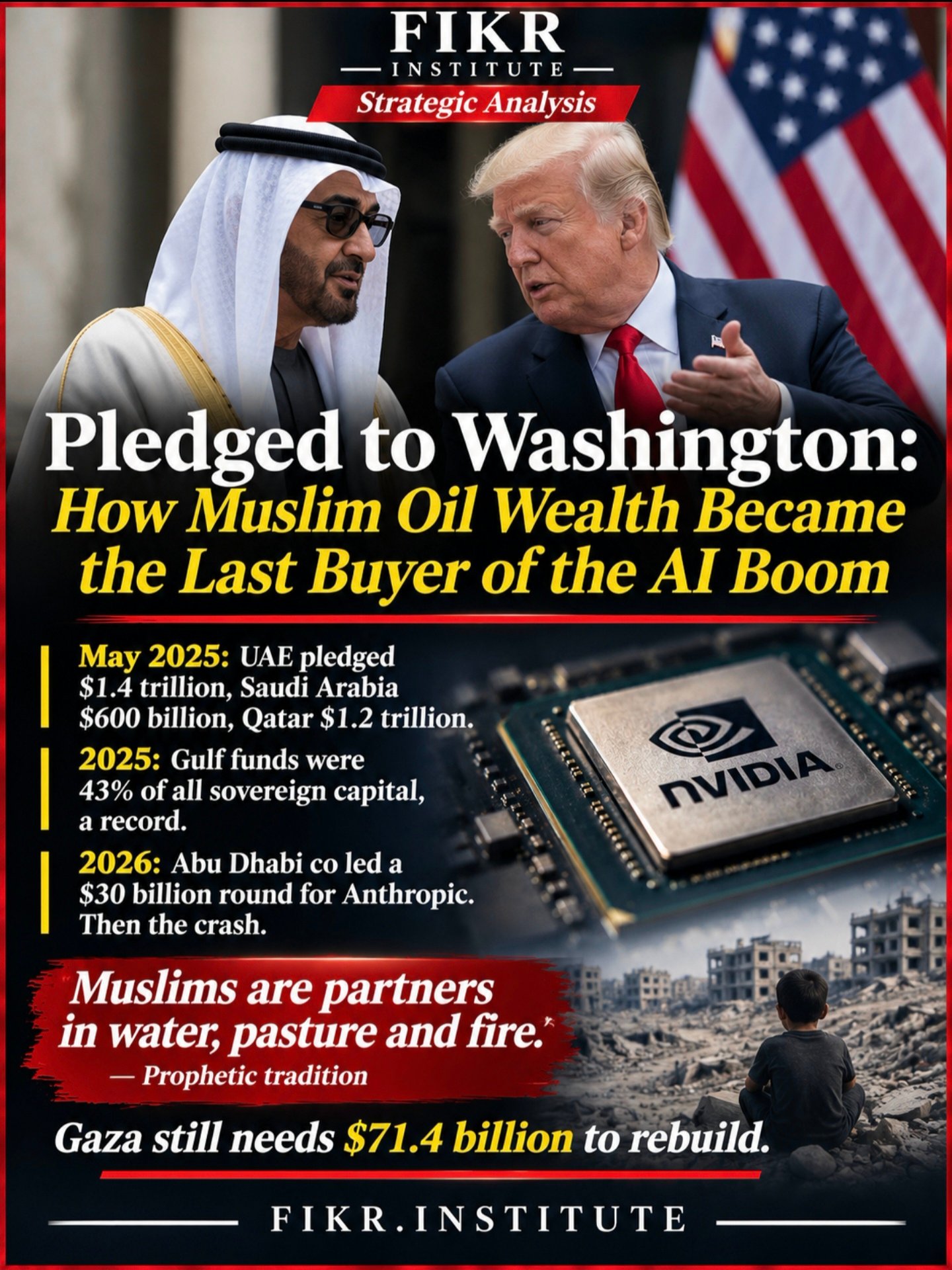
On November 20, Nvidia fell 14 percent and the Nasdaq 5.3 percent, and Anthropic, listed the day before, fell 8.5 percent [1]. Anthropic had priced its shares at 83 dollars, raising 81 billion dollars [2], at a valuation of about 1.5 trillion dollars [3]. Behind the largest listing in history, and behind the boom it crowned, stands a source of money that most coverage of the crash did not mention: the oil wealth of Muslim states.
Fikr Institute asks how that money got there, who decided to send it, and who carries the risk now that the boom is shaking.
Pledged in One Tour
The commitments were made in public, to one man. In May 2025, during the Gulf tour of President Trump, the UAE pledged 1.4 trillion dollars over a decade and Saudi Arabia 600 billion dollars over four years [4]. Qatar signed what the White House called "a $1.2 trillion economic exchange agreement" [5]. Trump said the tour "could be a total of $3.5, $4 trillion," without giving details [6]. The Washington Institute noted that some estimates put the real value nearer 730 billion dollars, since many deals were already under way [7].
The gap between the promise and the delivery is itself revealing. These were not ordinary investment decisions, made fund by fund on returns. They were pledges made to a head of state, at a time when Gulf governments were seeking American chips, American technology and American protection.
The Money at the Top
The money that did flow went to the top of the AI boom. In 2025, the seven largest Gulf sovereign funds deployed 126 billion dollars worldwide, 43 percent of all sovereign wealth fund capital, the largest share Global SWF has ever recorded [8]. In AI and digital assets alone, Mubadala of Abu Dhabi deployed 12.9 billion dollars, the Kuwait Investment Authority 6 billion and the Qatar Investment Authority 4 billion [9]. MGX, the Abu Dhabi AI investor, closed a fund of 49 billion dollars [10], and planned to contribute about 7 billion dollars to Stargate, the American AI infrastructure project [11].
The same money led the rounds that made the giants. MGX co led a 30 billion dollar round for Anthropic in February 2026 and holds stakes in OpenAI and xAI as well; Qatar had backed Anthropic a year earlier [12]. Gulf funds committed an estimated 7.5 billion dollars to Anthropic alone [13]. MGX then backed a later round that valued the company near 965 billion dollars [14].
The Last Buyer
The earliest Gulf money in Anthropic is, on paper, a large gain. Global SWF said the Gulf holdings were likely worth substantially more than was paid, though it could not estimate their value [13]. Fikr Institute does not claim otherwise.
But the role the Gulf has taken is not that of an early investor. It is that of the buyer who fills the rounds that grow too large for anyone else, and who keeps buying as the price rises. A round at 965 billion dollars, a fund of 49 billion, a pledge of trillions: these are the sums that keep a boom going when private money begins to hesitate. That is what a last buyer does.
And the last buyer is the one left holding the risk when the price turns. At the listing, a fifth of Anthropic shares were set aside for retail investors, and index funds were expected to take about 28 percent of the shares offered [15]. Ordinary savers came in at the top. So did the sovereign money that paid the highest prices before them. Behind both stands what the Federal Reserve warned of four days before the crash: more than 800 billion dollars of debt on the books of the seven largest AI firms, and more than 100 billion dollars of investment by suppliers in their own customers, a pattern Governor Michael Barr called circular financing [16].
This is not a claim that Gulf money keeps the American market afloat. The US stock market was worth 78.7 trillion dollars at the end of September [17]. The Gulf share of it is small. Its weight is at the margin, in the rounds and projects where the boom is most concentrated, and where a fall would hit hardest.
Whose Money Is It?
The Prophet, peace be upon him, said, according to the collection of Abu Dawud, that Muslims are partners in three things: water, pasture and fire [18]. In Islamic economic thought, this places resources of collective need, oil among them, outside the ownership of a few. The revenue of oil belongs, in that understanding, to the people, not to the families or funds that control the fields.
Measured by that principle, the question is not only whether these investments earn a profit. It is who decided to place the collective wealth of Muslims in American AI companies, and who was asked. A gain on paper goes to the funds. A loss falls on the treasury, and so on the people whose wealth it was.
In April 2026, the United Nations, the European Union and the World Bank estimated that Gaza needs 71.4 billion dollars over the next decade to recover and rebuild [19]. Three Gulf funds placed about a third of that sum in AI and digital assets in a single year [9]. MGX raised more than two thirds of it for one AI fund [10].
Coordination is not claimed: each fund made its own investments, and no document shows a single plan. Convergence is documented: trillions pledged to Washington in one tour, the largest share of sovereign capital ever recorded, and Gulf funds leading the largest rounds of the boom [4][5][8][12]. Exploitation is visible: the money that filled the top of the boom came from states whose security and technology depend on the country that received it [7]. The precedent is the earlier Trump term, when Gulf pledges were announced on a similar scale and many were never fulfilled [7].
The signs to watch are whether Gulf funds keep leading new AI rounds after the crash, whether the next large round, including the next one for OpenAI, is again filled by Gulf money, how much of the May 2025 pledges is delivered, and whether any Gulf government publishes what its people own, and what they have lost or gained.
Fikr Institute judges that Muslim oil wealth has become the buyer the AI boom relies on when others hesitate. It was pledged to Washington in public, placed at the top of the market, and invested without any accounting to the people to whom, by Islamic principle, it belongs. Whether it gains or loses, the question remains: why does Gaza wait for 71 billion dollars while trillions are promised to the builders of American AI?