
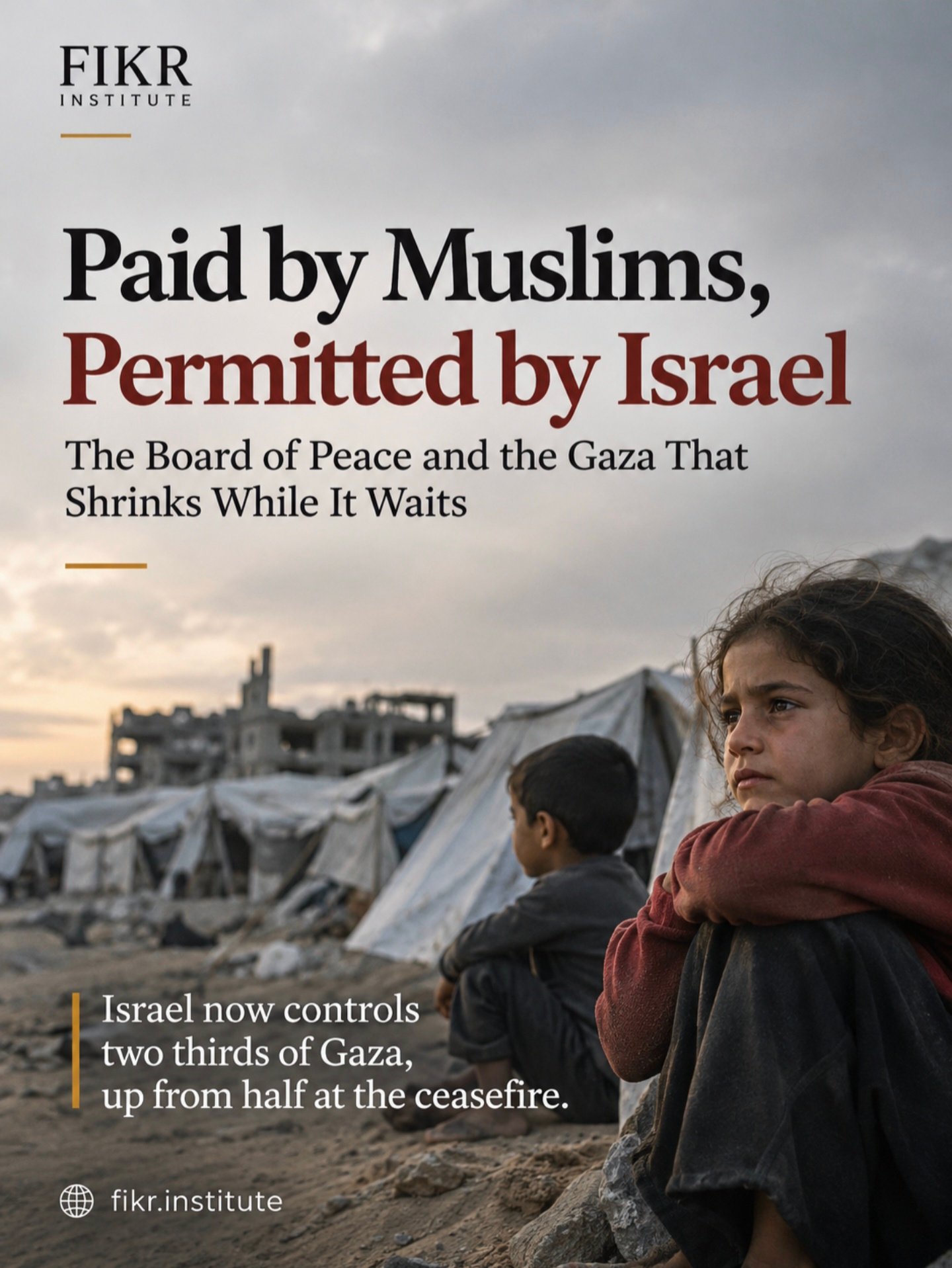
Thirteen months after the ceasefire, Israeli troops control about two thirds of Gaza, up from more than half when it began. Hamas controls a sliver along the coast. At least 1,600 Palestinians and five Israeli soldiers have been killed since the truce, by the tallies of each side [1]. More than two million Palestinians now live in the remaining third, mostly in tents [2].
Most coverage asks whether the ceasefire will hold. Fikr Institute asks a different question: who is paying for the peace, who is being asked to enforce it, and who holds the key to the door?
The Line That Keeps Moving
The Yellow Line was drawn under the Trump plan as the line to which Israeli forces would first withdraw [3]. It has not stayed where it was drawn. Forensic Architecture estimated that Israel controlled 58 percent of Gaza by December [3]. In April, Israeli military maps added an Orange Line, a restricted area covering some 11 percent more of Gaza beyond the Yellow Line [4]. On November 18, Israeli tanks crossed west of the line into central Gaza, and displaced families fled their tents again [2].
A ceasefire normally freezes a map. This one has redrawn it.
The Board That Cannot Enter
The body meant to end the war is the Board of Peace, established and chaired by President Trump [5]. Its own report to the Security Council this week accuses both sides of failing their commitments [5]. It says Hamas agreed in July to a roadmap to give up its weapons and hand Gaza to a civilian authority, and that Israel rejected it, saying it will not withdraw until Hamas is dismantled [5]. On November 18, Defence Minister Israel Katz repeated that position [6]. The report criticises Israel for an "absence of decisions" on training and deploying a Palestinian police force [5], and for not allowing the technocratic administration the board created to take up its work in Gaza, which in turn delays the international stabilisation force [7]. It says "Restrictions imposed by Israel on the entry of supplies and equipment, compounded by funding shortfalls, continued to impede preparedness and response efforts" [8]. It also accuses Hamas of taxing goods entering the territory; a senior Hamas official called the report "pure disinformation" [9].
The board summed up its own position: "The distance between what has been agreed and what is happening on the ground nonetheless remains the principal risk to the process" [7]. Gaza, it warned, faces "another winter in tents and rubble" [7].
Who Pays
Here is the part of the story that has not been told. The money for Gaza is overwhelmingly Muslim money. At the first meeting of the board in February, the UAE pledged 1.2 billion dollars, Qatar 1 billion and Saudi Arabia 1 billion [10], and Kuwait another 1 billion [11]. The board charter limits members to three year terms unless they pay 1 billion dollars each and earn permanent membership [12]. One Gulf business publication described the Saudi pledge as, in effect, the price of a permanent seat [13]. By May, the board itself was warning of a gap between what had been pledged and what had been paid [5][14].
Muslim states were also asked to supply the soldiers. Muslim majority nations offered troops for the stabilisation force, and Indonesia offered nearly half of it [15].
And the board includes Israel itself as a member [12]. Hamas has no seat [11].
So the arrangement is this. Muslim states pay for the board and for the reconstruction. Muslim states are asked to send the soldiers who will police Gaza and oversee disarmament. The board is chaired in Washington. And the decision whether the administration, the police and the materials may enter rests with the Israeli government, which sits on the same board and, by the report of the board itself, has not made those decisions [7][5].
What the Money Buys
In September, the board unveiled 66 projects costing 2.45 billion dollars over six months, while acknowledging that the full recovery of Gaza needs 71.4 billion dollars over a decade [16]. About 885 million dollars of the plan, more than a third, is for security, including the stabilisation force and Palestinian police [17]. One project would provide caravans for around 400,000 people living in tents, which means most of the displaced would stay in tents for the foreseeable future [18]. The plan also includes a digital identity system and digital payments for Gaza [19]. Who will hold that data, and under whose authority, the public record does not say. Fikr Institute puts the question to readers.
Set the sums side by side. In May 2025, the UAE pledged 1.4 trillion dollars to the United States and Saudi Arabia 600 billion [20]. To the Board of Peace, each pledged about one billion [10]. The UAE pledged more than a thousand times as much to Washington as to the board; Saudi Arabia, six hundred times as much.
Coordination is not claimed. Convergence is documented: the map of Israeli control has grown while the board that was meant to replace it cannot enter, and while Muslim money and Muslim troops wait for Israeli permission [1][7][15]. Exploitation is visible: those who fund and police the peace have no power to open the crossings, and the government that holds that power is not among the listed contributors [5][10][12]. The precedent is the May report of the board itself, which already warned that pledges were not being paid and called on others to contribute [14].
The signs to watch are what the board tells the Security Council at the end of November, whether the Yellow Line moves again, whether the technocratic administration is allowed to enter, whether any Muslim country sends troops before Israel withdraws, how much of the Gulf pledges is paid, and whether the board ever publishes a full account of what it has received and spent.
Fikr Institute judges that the ceasefire has become an arrangement in which Muslims pay, Muslims are asked to police, and Israel decides. The land under Israeli control has grown from half of Gaza to two thirds while the peace waits for permission. A peace funded by Muslim money and enforced by Muslim soldiers, on terms set by the occupying power, is not the end of the occupation. It is the occupation at a lower cost to the occupier.