
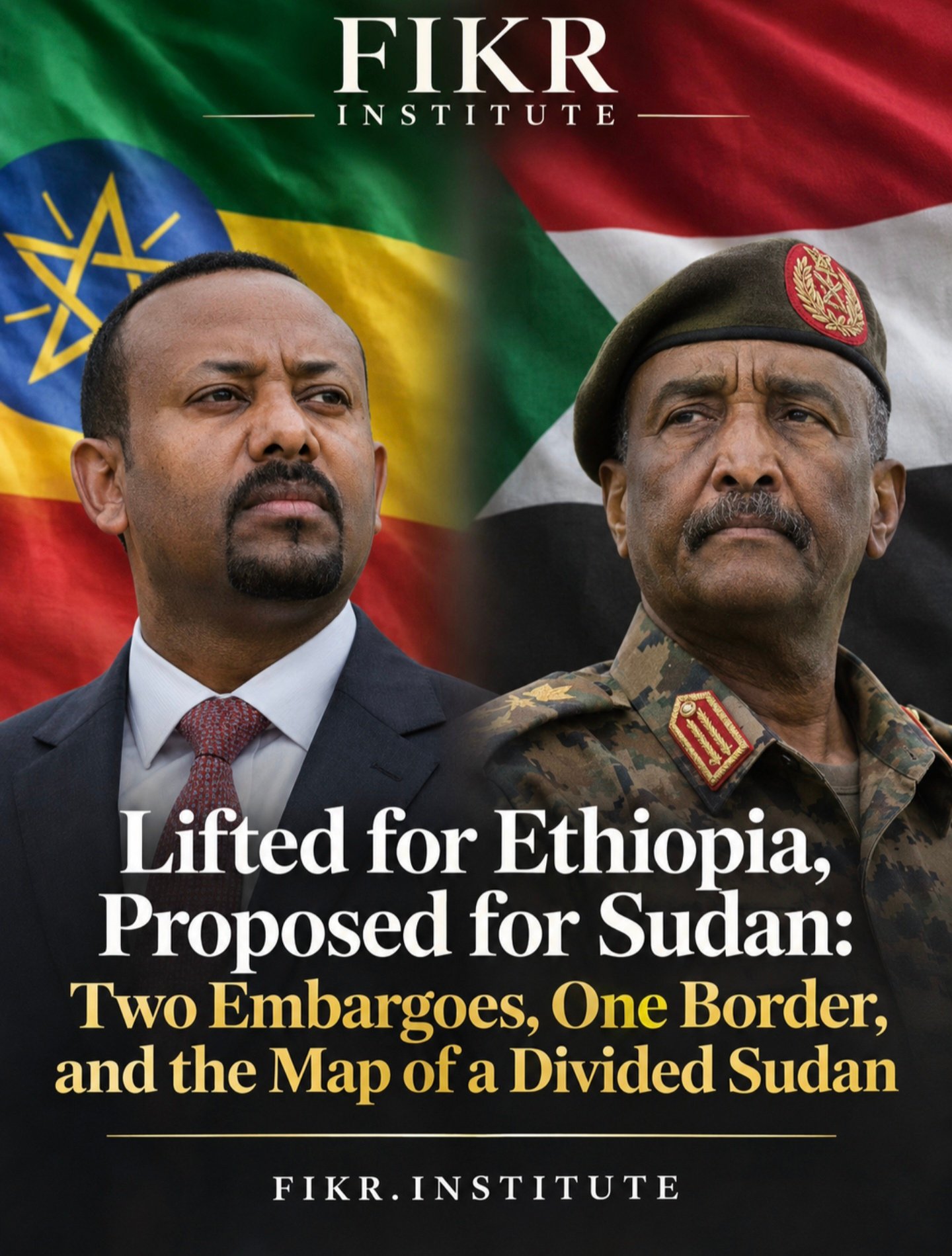
On November 4, Ethiopia closed the Sudanese consulate in the border town of Asosa and gave its six diplomats 48 hours to leave. Sudan answered by closing the Ethiopian consulate in Gedaref [1]. Days earlier, Sudan had filed complaints with the UN Security Council and the African Union, and its army led Sovereignty Council published a report alleging 70 attacks from February 15 to October 27 involving 187 one way attack drones, which it said killed or wounded 484 civilians and killed 176 soldiers [2]. Ethiopia denies involvement [3], and accuses Sudan of backing rebels in Tigray [1].
Most coverage treats this as a border quarrel between two neighbours at war. Fikr Institute asks a different question. What did the outside power that claims to be ending the war do with its own instruments, the embargo, the visa and the truce, while that border was being used?
The Border Is Documented
The case against the Asosa border does not rest on the word of one government. In February, Reuters reported that Ethiopia was hosting a secret camp in Benishangul Gumuz to train RSF fighters, with satellite imagery of hundreds of tents and of new drone infrastructure at Asosa airport. An Ethiopian security note it saw said 4,300 RSF fighters were training there in January, with supplies provided by the UAE [4]. The UAE rejected the report [5]. In April, the Humanitarian Research Lab at the Yale School of Public Health concluded with high confidence that there was activity "consistent with military assistance to the RSF" at an Ethiopian army base in Asosa [6]. In June, it reported that civilian vehicles were being repainted and modified at the same base [7]. Sudan first accused Ethiopia publicly in March [8]. Its November report names launch sites at Asosa airport, the Kurmuk border area and the Bahir Dar airbase [2].
What Washington Did With Its Embargoes
Now set the American record beside that border.
On February 5, 2026, five days before the Reuters report on the camp, the US Secretary of State decided to end the policy of denying arms export licences to the Ethiopian army, police and intelligence services [9]. In May, the State Department formally terminated the arms embargo on Ethiopia [10], and in September it published the final rule removing Ethiopia from the list of restricted countries [9]. Through the months in which a university laboratory documented RSF support at an Ethiopian army base, the restrictions on Ethiopia were being lifted.
In September, Washington moved the other way on Sudan. It pressed the Security Council to extend an arms embargo that applied only to Darfur to the whole of Sudan [11]. China, Russia and others resisted [12]. An embargo limited to Darfur bears on the RSF heartland. An embargo on the whole country bears equally on the army that holds the state.
One embargo lifted for the country hosting the base. One embargo proposed for the country being struck from it.
What Washington Said, and What It Did
The United States says it opposes partition. In March 2025, the State Department warned that a parallel government would "risk further instability & de facto partition of the country" [13]. Its envoy Massad Boulos has said Washington does not recognise any parallel government [14].
Its actions run the other way. On September 22, the State Department declared that "Neither the Sudanese Armed Forces, the Rapid Support Forces, nor their respective leaders, represent legitimate, constitutional governance for Sudan" [12][15]. That week, the army chief, Abdel Fattah al Burhan, was unable to address the General Assembly because the United States did not issue his visa; sources told Reuters and AFP the visa was tied to accepting a 90 day truce, and the State Department declined to comment [16][17]. Burhan replied that Sudan "will not respond to any pressure or blackmail," and that "Our goal is to clear all of Sudan, including Darfur, of these thugs" [18].
The truce itself is the key. The government in Port Sudan accepted a 90 day truce on condition that the RSF withdraw from the cities it holds [19]. The RSF accepted the truce and rejected withdrawal [20]. The RSF controls all five Darfur states except parts of North Darfur [21]. A truce without withdrawal freezes that map. The RSF and its allies have already sworn in a parallel government in Nyala, a step analysts warned could echo the secession of South Sudan in 2011 [22].
They claim to oppose partition. Even then, they press a truce that would freeze it, equate the army with the force that seized Darfur, and lift restrictions on the neighbour from whose soil the drones are launched.
Who Gains Outside Sudan
The war is Sudanese against Sudanese, Muslim against Muslim. The gains are elsewhere. Ethiopia, whose Nile dam its downstream neighbours call a continuing threat, received 12 Russian Su 35 fighters on October 28 and announced the S 400 to come [23]. Egypt and Sudan, meeting in Cairo on November 2, called the dam a continuing threat under the 1959 Nile Waters Agreement, and Egypt said it was prepared to invoke its mutual defence pact with Sudan [24][25]. Russia sells the jets. Washington holds the visa, the embargo and the truce, and so the power to decide who in Sudan is legitimate.
Coordination between Washington and Addis Ababa is not claimed, and no document shows it. Convergence is documented: the restrictions on Ethiopia were lifted while evidence of RSF support on Ethiopian soil was published, and an embargo was proposed for all of Sudan in the same season [9][6][11]. Exploitation is visible: every month the lines stay frozen, the parallel government in Nyala gains time, and Sudan loses its ability to contest the dam [22][24]. The precedent is South Sudan, where a long war ended in a referendum and a new border [22].
The signs to watch are whether the Security Council extends the arms embargo to all of Sudan, whether any American arms licence is granted to Ethiopia, whether the 90 day truce is signed without withdrawal from the cities, whether any state recognises the government in Nyala, and whether Egypt acts on its defence pact.
Fikr Institute judges that the strongest evidence in this crisis is not what Washington says but what it has done with its own instruments. It lifted the embargo on the country from which the drones are launched, proposed one on the country they strike, withheld a visa from the leader of the army defending the state, and pressed a truce that would leave Darfur where it is. Whether or not partition is the aim, it is the direction in which every one of these steps points.