
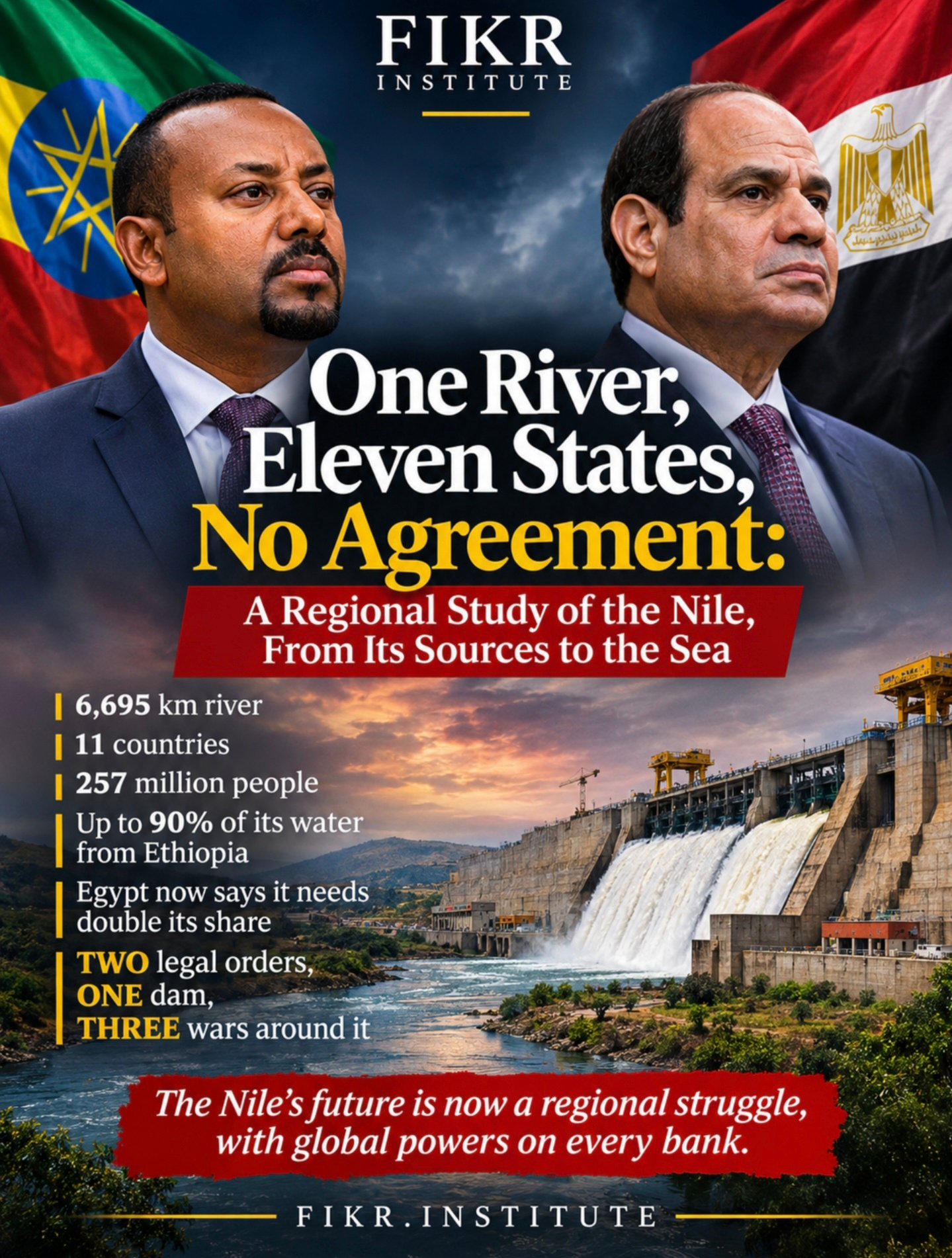
The Nile is the longest river in the world, at 6,695 kilometres, and it is shared by 11 countries: Burundi, the Democratic Republic of the Congo, Egypt, Eritrea, Ethiopia, Kenya, Rwanda, South Sudan, Sudan, Tanzania and Uganda [1][2]. More than 257 million people live in its basin, and the 11 countries together hold 556 million people [1][2].
This is the first part of a Fikr Institute study of the Nile. It sets out the river, the states along it and the powers around it. The second part will be a strategic forecast.
Where the River Begins and Ends
The Nile has two great branches. The White Nile flows from the lakes of the equator, from its source in Uganda through the Sudd, the largest freshwater wetland in Africa, in South Sudan [3]. The Blue Nile begins at Lake Tana in the Ethiopian highlands [4]. The two meet in Sudan and flow north through Egypt to the Mediterranean, through the delta in Lower Egypt [3].
The branches are not equal. The Blue Nile and the other rivers that come down from the Ethiopian highlands provide between 80 and 90 percent of the flow of the Nile, though mostly in a few months of rain. The White Nile is steadier and carries far less [5]. At Aswan, the river carries about 84 billion cubic metres a year [6].
That single fact shapes everything else. The water is born in the highlands of Ethiopia. The people who depend on it most live in the deserts of Sudan and Egypt.
The Old Order and the New
For most of the last century, the river was governed by agreements that Ethiopia never signed. The 1929 arrangement under British rule and the 1959 Nile Waters Agreement between Egypt and Sudan divided the flow between the two downstream states, about 66 percent to Egypt and 22 percent to Sudan [7]. A former Ethiopian water minister put the Ethiopian view in one line: "This agreement allocated 0 percent for Ethiopia" [8].
The upstream states built an alternative. The Cooperative Framework Agreement entered into force on October 13, 2024 [9], after South Sudan became the sixth state to ratify it, joining Ethiopia, Rwanda, Tanzania, Uganda and Burundi [10]. It creates a Nile River Basin Commission to replace the Nile Basin Initiative [9]. Egypt and Sudan have refused to sign it [11].
The basin now has two legal orders. Downstream, the 1959 agreement. Upstream, the new framework. No document binds them both.
The Dam
On September 9, 2025, Ethiopia inaugurated the Grand Ethiopian Renaissance Dam on the Blue Nile, and Egypt protested to the United Nations the same day [12]. It can hold 74 billion cubic metres and generate 5,150 megawatts [13]. It sits about 17 kilometres from the Sudanese border [14]. For Ethiopia, the case is development and electricity [15]. The dam was financed mainly by Ethiopians, with Chinese loans and investment as well [16].
For Egypt, the case is survival. It needs 88.55 billion cubic metres of water a year and has 65.35 billion in renewable resources, of which its Nile share is 55.5 billion [17]. Its share per person has fallen to about 500 cubic metres a year [18]. In August 2026, Ethiopia confirmed plans for three more dams on the Blue Nile [19], and the Egyptian irrigation minister called the Ethiopian statement that new dams would give Addis Ababa control over downstream flows an "extremely serious" admission [20]. On September 29, the Egyptian foreign minister told a meeting chaired by President Sisi, with military commanders present, that Egypt needs to double its share of the Nile [21], and said: "We will not allow additional dams or a repeat of what happened with the current Ethiopian dam" [22]. A week later, President Sisi called the Egyptian share a historical and legal right that cannot be negotiated [23].
Egypt, Ethiopia and Eritrea
The dispute over water has become a dispute over everything else. When fighting resumed in Tigray in late September, Ethiopia accused Egypt, Eritrea and Sudan of supporting the rebel alliance; all three deny it [24]. On October 1, Ethiopia expelled an Egyptian diplomat and Egypt expelled an Ethiopian one [25]. The same day, Ethiopia closed its embassy in Eritrea and expelled ten Eritrean diplomats, and Eritrea severed relations [24]. Ethiopia has told the Security Council that Eritrea invaded its territory; Eritrea says it faces a war of aggression aimed at its port of Assab [26]. The Ethiopian navy chief has called sea access "inevitable" [27], and on November 17 Eritrea accused the Ethiopian army chief of laying claim to its territory [28].
Egypt has answered by building around Ethiopia. It now has ground or naval facilities in four countries that border Ethiopia: Sudan, Eritrea, Djibouti and Somalia [25]. On October 4, President Sisi hosted the leaders of Sudan, Eritrea and Somalia at Alamein, in what they presented as an emerging regional alliance [29]. On November 2, Egypt and Sudan reaffirmed their mutual defence pact and warned against unilateral action on the Nile [30].
Sudan and South Sudan
Sudan sits between the two sides and is at war with itself. Its army led government accuses Ethiopia of allowing drones to be launched at it from Ethiopian soil, which Ethiopia denies [31]. Reuters reported in February that a camp training RSF fighters had been built in western Ethiopia, near the border and near the dam, with supplies from the UAE according to an Ethiopian security note; the UAE rejected the report [32][33][34].
South Sudan holds the White Nile and the swamp that slows it. It was the sixth state to ratify the upstream framework [10], yet it has also received Egyptian dredging equipment for rivers feeding the White Nile, reviving fears in Juba of the Jonglei Canal, a project designed to send more of the Sudd water north to Sudan and Egypt [35][36]. Meanwhile, South Sudan is sliding back toward war. Former vice president Riek Machar is on trial for murder, treason and crimes against humanity, which he denies [37], hundreds have died in clashes in recent weeks ahead of elections planned for December [38], and the country is described as at serious risk of returning to widespread armed conflict [39].
The Powers Around the River
The Nile is not only contested by its own states. Every outside power with interests in the region now has a hand on one of its banks.
On October 28, Prime Minister Abiy said Ethiopia had received 12 Russian Su 35 fighters and would also acquire four S 400 air defence batteries [40]. China helped finance the dam [16], and the Egyptian foreign minister says water security was a substantial part of talks during the recent visit of President Xi to Egypt [41]. The United States decided in February to end its arms embargo on Ethiopia [42], and in September lifted its sanctions on the ruling party and military of Eritrea [43], relieving both sides of a border that may become a war. Israel became the first state to recognise Somaliland in December 2025 [44], the territory through which Ethiopia has long sought access to the sea [45].
The states that depend on the river most, Egypt, Sudan and Somalia among them, are Muslim states downstream or along the Red Sea. The arms, loans and recognitions that change the balance come from outside.
Coordination among these powers is not claimed. Convergence is documented: the upstream state has received jets, a pledge of air defences, loans and the end of an American embargo, while the downstream states are left with treaties the upstream states reject [40][16][42][11]. Exploitation is visible: every outside power that arms, finances or recognises a party gains a lever over a river on which hundreds of millions depend [1]. The precedent is the 1959 agreement itself, a division of the river made without the state where most of its water begins [7][8].
The signs to watch, which the forecast will take up, are whether Ethiopia begins any of the three new dams, whether the S 400 is deployed near the dam, whether Ethiopia and Eritrea go to war over Assab, whether Egypt invokes its pact with Sudan, whether South Sudan holds its elections or returns to war, and whether any state that rejected the framework agreement signs it.
Fikr Institute judges that the Nile has entered a new era in which no single agreement governs the river, and every state along it is either at war, close to war or preparing for one. The water still begins in Ethiopia and still ends in Egypt. What has changed is who holds the levers in between, and most of them are held by powers that do not drink from the river at all.