
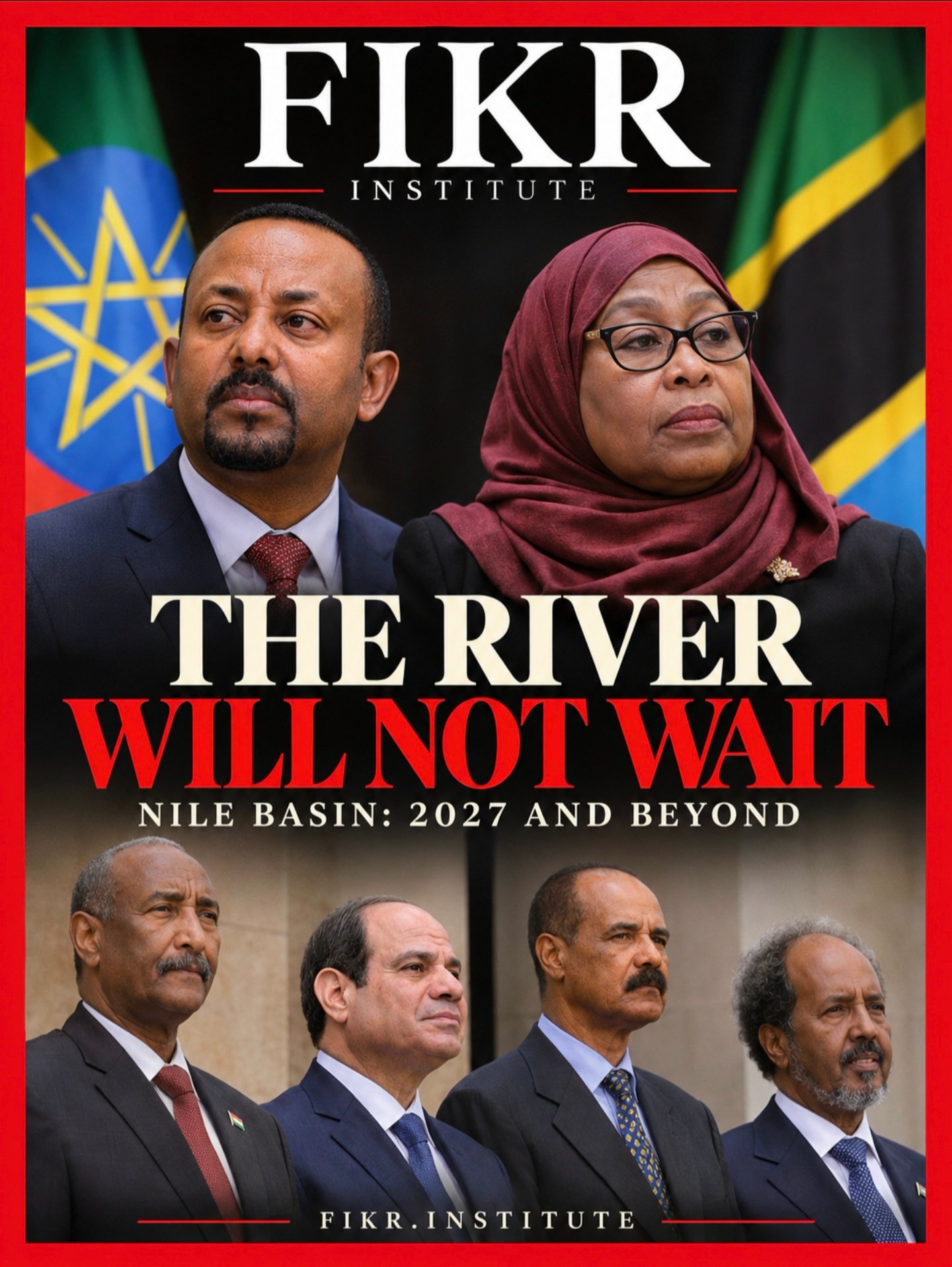
The first part of this study set out the Nile as it stands: one river, eleven states, two legal orders, one great dam, and outside powers on every bank [1]. This second part asks what comes next, over the coming one to two years and beyond.
States do not announce their intentions. A forecast has to read what they do, what they can afford, and who benefits from each outcome.
The Clock That Matters
The three new Ethiopian dams are the loudest threat, but they are not the nearest one. Ethiopia announced in March 2026 that Karadobi, Mandaya and Beko Abo would cost about 3.5 billion dollars each and be built within four to seven years [2][3]. Their final designs, financing, environmental assessments and operating rules are yet to be settled [4], and little is known about how Ethiopia will pay for them [5].
The dam that already exists is the one that matters now. Its reservoir can hold 74 billion cubic metres [6]. In August, the Ethiopian water minister said the new dams would give Addis Ababa control over downstream flows, a statement the Egyptian irrigation minister called an "extremely serious" admission [7]. Egypt needs 88.55 billion cubic metres a year and has 65.35 billion [8]. The first dry year that meets a full reservoir with no agreement on how to release it will test every promise made so far.
Fikr Institute judges that the coming danger is not a dam that has not been built, but the rules for a dam that already stands, and there are none.
Scenario One: Armed Standoff, No Water War
This is the most likely course. Egypt has made its strongest statements yet: its foreign minister says it needs to double its share, at a meeting attended by military commanders [9]. Yet Egypt has not struck the dam, and its response to the new dam plans has centred on diplomacy, international pressure and cooperation with Sudan [10].
Three facts weigh against a strike. The dam sits about 17 kilometres from the Sudanese border [11], so the first country to suffer from any damage to it would be Sudan, the ally Egypt is defending. On October 28, Prime Minister Abiy said Ethiopia had received 12 Su 35 fighters and would acquire four S 400 air defence batteries [12], though he did not say when or where they would be based [13]. And Egypt has chosen another tool: it now has ground or naval facilities in four countries that border Ethiopia [14].
In this scenario, the pressure moves from the river to its surroundings: accusations over Tigray, expelled diplomats, and alliances on the borders of Ethiopia, while the water itself is never touched.
Scenario Two: War Over Assab
This is the most dangerous course, and it is closer than the water war. Ethiopia and Eritrea have accused one another of launching war at the Security Council [15]. Fighting between federal forces and Tigrayan forces has been reported near the Eritrean border in November [16], and on November 17 Eritrea accused the Ethiopian army chief of laying claim to its territory [17]. Assab, a deepwater port with seven berths, is lightly used today [18]. Chatham House warned a year ago that partners must discourage Ethiopia from moving on it [19].
If this war comes, the Nile dispute and the Red Sea dispute become one war. Egypt is aligned with Eritrea and has facilities there [14][20]. Ethiopia has the new jets [12]. And Washington has already relieved both sides of restrictions: it decided in February to end its arms embargo on Ethiopia [21] and in September lifted its sanctions on the ruling party and military of Eritrea [22].
Fikr Institute judges that a war between Ethiopia and Eritrea is the most likely path by which the Nile dispute turns violent, because it allows every party to fight over the river without ever naming it.
Scenario Three: A Deal Under American Mediation
This is the least likely course in the near term. In January, President Trump wrote to President Sisi offering to restart American mediation and placing the dam at the very top of his agenda [23][24]. Egypt welcomed it [25]. In October, Trump repeated his criticism of the dam and called American financing of it a mistake [26].
They claim to want a fair settlement for Egypt, and even then they do not act on it. The same administration that offered mediation in January decided weeks later to end the arms embargo on Ethiopia, and later removed it from the list of states barred from American arms [21]. A mediator that arms one side and courts the other is not neutral; it is positioned to profit from both. Meanwhile Ethiopia rejects the 1959 agreement Egypt relies on, and Egypt rejects the upstream framework that six states have ratified [27]. No mediator has yet offered a text that bridges the two.
Sudan: The Share Without a State
Sudan holds a legal share of the river but has no single government to defend it. The UN envoy plans talks with the RSF on a civilian transition before Christmas, and the United States, which is pushing for an arms embargo on all of Sudan, says neither general has a future in its leadership [28]. Egypt and Sudan have reaffirmed their defence pact [29].
The question for the river is simple. If Sudan is divided, who signs for its water? Any Nile agreement made while Sudan is at war will be signed by whoever controls Khartoum, while the dam sits near territory the army does not fully control.
South Sudan: The Swing State of the White Nile
South Sudan was the sixth state to ratify the upstream framework [27], yet it has also received Egyptian dredging equipment, reviving fears of the Jonglei Canal [30]. Its first general election has been moved from December 22 to February 11, 2027 [31], analysts at the Institute for Security Studies judge that credible elections are no longer possible [32], and the country is at serious risk of returning to widespread war [33]. Whoever holds Juba after February holds the Sudd, and with it the one card Egypt has on the White Nile.
Who Benefits in Every Scenario
In the standoff, arms sellers gain: Russia has supplied jets and promised air defences [12]. In a war over Assab, the powers that lifted restrictions on both sides gain influence over both [21][22]. In a mediated deal, the mediator gains a seat at the table of a river it does not drink from [23]. China helped finance the dam [34], and Israel recognised Somaliland, the territory through which Ethiopia has long sought the sea [35].
Coordination among these powers is not claimed. Convergence is documented: each scenario rewards the same outside actors. Exploitation is visible: each crisis on the Nile becomes a market for weapons, loans and recognition. The precedent is the 1959 agreement, a division of the river made without the state where most of its water begins [1].
Signs to Watch
The forecast will change if any of the following occurs:
First, a contractor and a financier are named for any of the three new dams.
Second, S 400 batteries are seen near the dam or the Sudanese border.
Third, Ethiopian forces move toward Assab, or Egyptian forces deploy openly in Eritrea.
Fourth, a dry year meets a full reservoir with no release agreement.
Fifth, Egypt and Ethiopia accept a mediator and a text, not just an offer.
Sixth, South Sudan holds its February election, postpones again, or returns to war.
Seventh, Sudan signs any agreement with the RSF that changes who governs the border near the dam.
Fikr Institute judges that the Nile will not be settled by a treaty in the next two years, nor most likely by a strike on a dam. It will be decided on its borders: in Tigray, in Assab, in Darfur and in the Sudd. The people who drink from the river will pay for those wars. The powers that arm them will not.