
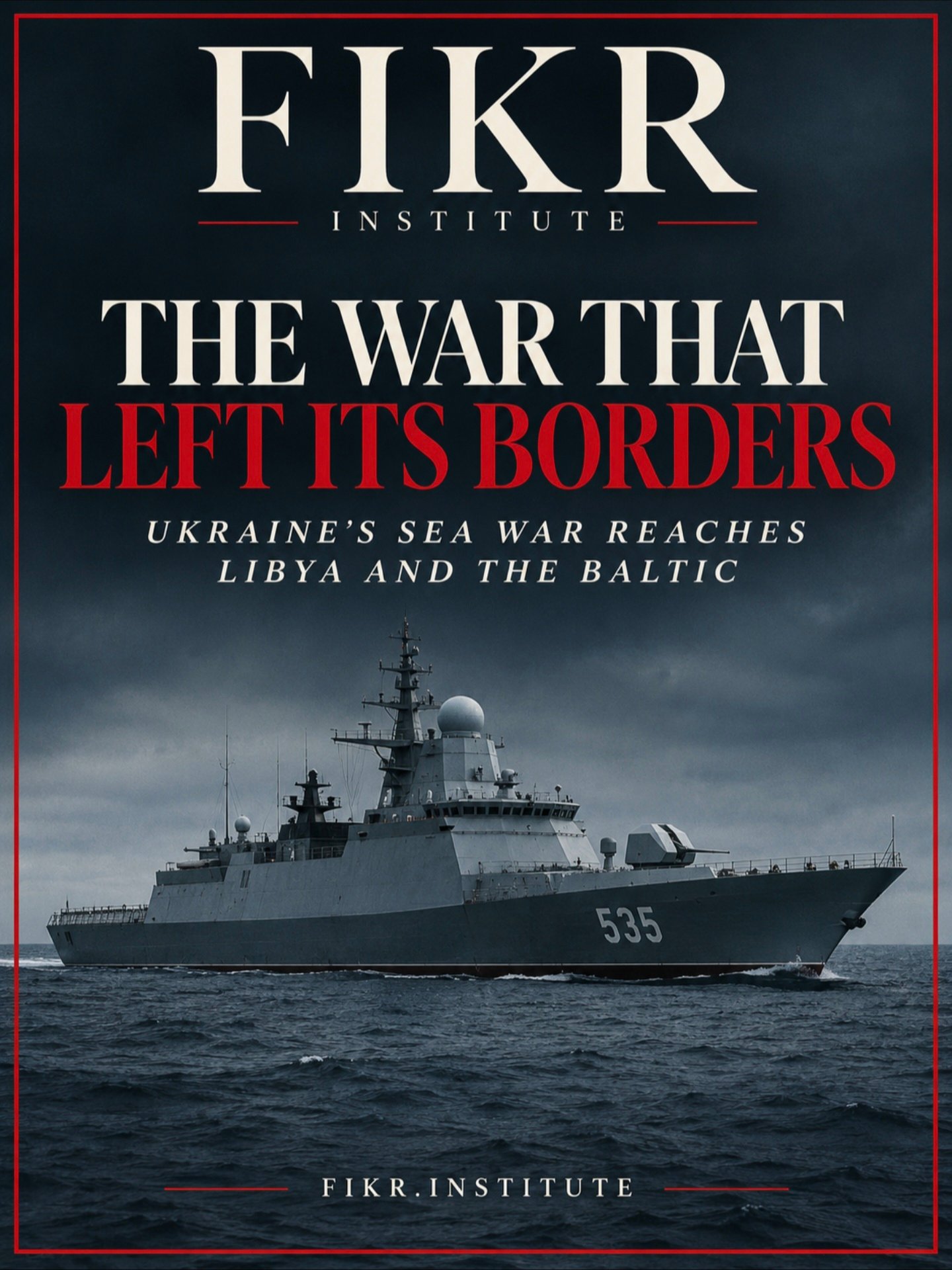
In two days, the war between Russia and Ukraine reached two seas that are not its own. On November 21, drones struck the Russian cargo ship Sparta II in the Gulf of Finland as it sailed for Kaliningrad, and it drifted, burning, into Finnish waters [1][2]. On November 22, Ukrainian sea drones sank the Russian corvette Merkury at its mooring in Benghazi, Libya, and struck the cargo ship Angara off the same coast [3][4].
Most coverage asks whether Ukraine can now hit Russia anywhere. This study asks a different question. Whose waters did this war just enter, and who pays for it?
What Happened in Benghazi
President Zelenskyy said the Merkury was attacked with seven sea drones, sinking the ship and destroying a helicopter on board [3]. Ukrainian intelligence said the drones were carried to the area and launched from a mother ship [3]. The security service called both vessels legitimate military targets [5]. Zelenskyy said the Angara was carrying Russian weapons [3], while early reports said the second ship hit off Benghazi sailed under a Maltese flag [6].
Why was a Russian warship in Benghazi at all? The eastern Libyan government said it had stopped to refuel and resupply on its way back to Russia, under maritime cooperation agreements between the two countries [7][3]. Eastern Libya was hosting a Russian warship. Its harbour then became a battlefield.
Libya Is Not a Party, and Both Libyan Governments Said So
The eastern government said Libya is not a party to the war between Russia and Ukraine, and announced a joint investigation with Russia [8]. Its leader, Osama Hammad, filed a complaint with the UN, asking an inquiry to establish whether Ukrainian personnel or facilities were present in Libya and whether sites in the west had been used to prepare and launch the drone boats [9]. The foreign ministry of the Tripoli government condemned the Ukrainian attack [10]. The UN mission warned that "Libya cannot afford, and must not become a battleground for foreign conflicts" [6].
This was not the first time. In March, the Russian gas tanker Arctic Metagaz was badly damaged between Libya and Malta and drifted toward the Libyan coast; Russia blamed Ukrainian sea drones launched from Libya [11][12]. According to reporting by RFI, the first such attack was in December 2025 on the tanker Qendil, sailing between Greece and Libya [13].
Italy reacted fastest. Foreign Minister Tajani told his Ukrainian counterpart that Italy is working to prevent the war from spreading to the Mediterranean and that Libyan sovereignty must be respected [14]. He said Rome had no prior knowledge of the operation and gave no support [15]. Italy fears the strikes could reignite civil war across the sea from its own coast [16].
What Happened in the Gulf of Finland
The Finnish Defence Forces said the Sparta II was hit in international waters west of the Russian island of Gogland, and that Ukraine was likely behind it [1]. The ship is under American sanctions and linked to Oboronlogistika, which provides logistics services to the Russian defence ministry [1]. It has been linked to weapons shipments from Syria to Russia [17]. On November 24, Zelenskyy confirmed the strike, saying any ship under the Russian flag, carrying weapons or sanctioned cargo, is a legitimate target in Russian or neutral waters [18].
The Baltic states were left to manage the consequences. The burning ship drifted into Finnish territorial waters before Russia towed it away [2]. Finland had already told Kyiv how sensitive the narrow gulf between Finland and Estonia is for environmental safety and civilian shipping [19]. Norway urged Ukraine to respect international law and regional stability [20], and Germany warned against escalation in the Baltic [16]. Lithuania publicly denied any role after drones also struck the Russian Baltic Fleet base at Baltiysk [21].
Moscow called the Baltic strike a very dangerous trend, promised Ukraine painful consequences, and said it hoped the Baltic states would press Kyiv to stop [22].
The Black Sea: Where Merchant Ships Already Pay
The Black Sea shows where this leads. Ships near Romania and Bulgaria, two NATO members, have been struck repeatedly since the summer. Seven sailors went missing when drones hit two tankers near the Sulina canal in October [23]; eleven went missing when a ship sank off Bulgaria days earlier [24]. On November 16, the Somali flagged Betul 8 sank in Bulgarian waters, carrying about 3,000 tonnes of wheat from Romania to Egypt [25]. The next day, a gas carrier was hit off Varna, and all 19 Filipino sailors were rescued [26].
No one has claimed these attacks, though most politicians and experts in Romania and Bulgaria blame Russia [25]. Initial assessments reported by Reuters pointed to Russia [27]. The Russian defence ministry has claimed strikes on ships it alleges were carrying military and dual use cargo to Ukraine [28]. According to Ambrey, five of the six ships attacked near Romania and Bulgaria since November 13 had called at Ukrainian ports during the year [29]. In Bulgaria, insurance costs are rising and ship repair orders are being cancelled [30].
The pattern is the same in every sea. Each side defines the cargo of the other as a weapon, and every ship that once called at the wrong port becomes a target.
Who Pays
The fighting parties are Russia and Ukraine. The waters belong to others.
Libya, a divided Muslim state that is not party to the war, has had a warship sunk in its harbour and its sovereignty argued over in New York [8][9]. Egypt saw a cargo of wheat bound for its ports sink off Bulgaria [25]. The ships sunk or hit fly the flags of Somalia and Liberia, and one gas carrier had a crew of 19 Filipino sailors [26]. Finland, Estonia, Bulgaria and Romania carry the rescue, the fires and the risk of pollution [2][23].
Who Benefits
Coordination is not claimed. Convergence is documented: both belligerents now treat the waters of third countries as part of the front, Russia by docking warships in Benghazi under agreements with the east, Ukraine by striking them there [7][3]. Exploitation is visible: a divided Libya offers both sides access without a single government able to refuse it, which is why the eastern government now asks the UN whether Ukrainian personnel operate in the west [9]. The precedent is the Black Sea itself, where attacks on merchant shipping near NATO coasts have become routine [25][23].
Readers may ask: if a warship in a Libyan harbour is a legitimate target, what is a Libyan harbour? And if a ship that once called at a Ukrainian port is a legitimate target, what is a wheat cargo bound for Egypt?
Strategic Forecast
Scenario one, the most likely: the campaign continues, with notice. Zelenskyy has said some European partners are worried, but has not said Ukraine will stop [18][31]. Expect further strikes on Russian military logistics in the Baltic and Mediterranean, framed as targeting weapons cargo, with closer warning to allies.
Scenario two: Russian escort and reprisal. Moscow has promised painful consequences [22]. The likely answer is not in Libya or Finland but in the Black Sea, through more strikes on ships linked to Ukrainian trade, and through escorts for its own ships in the Baltic, which would place more warships in a narrow gulf between two NATO states [19].
Scenario three: Libya is pulled in. If the eastern government and its Russian partner hold the west responsible, the maritime war becomes a Libyan dispute. This is the outcome Italy fears most [16].
Scenario four: the talks restrain the sea war. The strikes in the Baltic came as American envoys held new talks with Zelenskyy [32]. A ceasefire at sea is possible only if both sides judge that the cost to their allies outweighs the gain.
What It Means for Shipping
For shipping, the change is that the risk zone no longer follows the front line. A vessel is now judged by its flag, its owner, its last ports and its cargo, not by where it sails. Insurers are already pricing the western Black Sea higher [30]. If attacks continue in the Baltic and the Mediterranean, the same questions will reach ports from Ust Luga to Benghazi, and the first to pay will be small operators, poor flags and import dependent states.
Signs to watch: a Russian naval escort in the Gulf of Finland; any attack on a ship in Turkish or Egyptian waters; findings from the UN inquiry the eastern Libyan government has demanded; a change in war risk cover for the Baltic or the eastern Mediterranean; and any ceasefire at sea discussed in the talks.
Fikr Institute judges that the war has left its borders, but its costs have not stayed with the two states that are fighting it. They are paid in Libyan sovereignty, in Egyptian bread, and in the lives of sailors from countries that chose no side.