
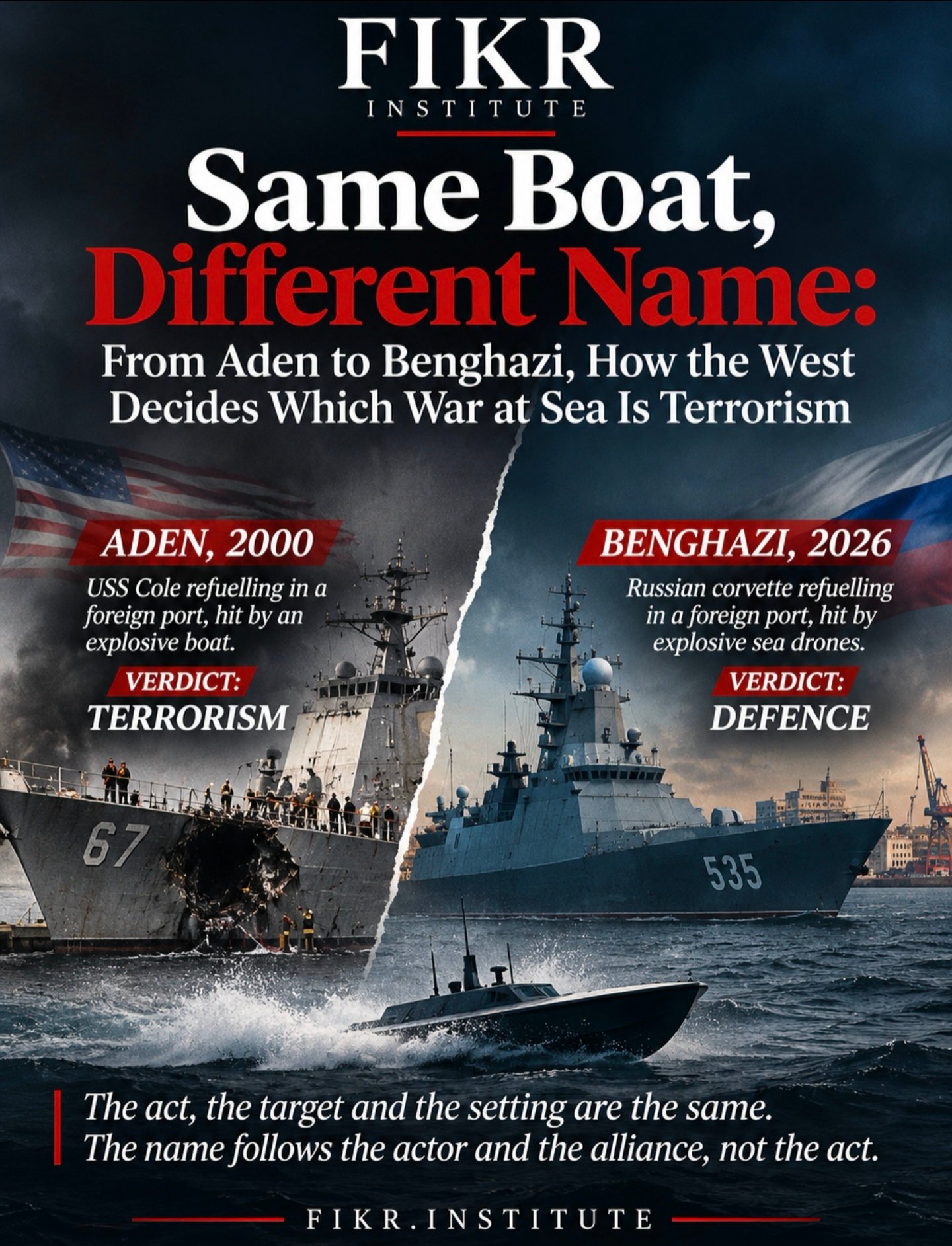
On October 12, 2000, an American destroyer was refuelling in the harbour of Aden, in Yemen, when a small boat loaded with explosives came alongside and blew a hole in its side, killing 17 sailors [1]. The ship was a warship. The port belonged to a third country. The United States called it terrorism, and its own navy still does [2][3].
On November 22, 2026, a Russian corvette was refuelling at Benghazi, in Libya, when Ukrainian sea drones loaded with explosives struck it and sank it [4]. The ship was a warship. The port belonged to a third country. Local authorities said at least 10 Libyan and Russian crew members died [5]. President Zelenskyy called it an "exemplary Ukrainian operation" [6], and no Western government statement we found called it terrorism.
This follow up to our study of the attacks [7] asks a plain question. When the act is the same, what decides the name?
Four Cases, Four Names
Al Qaeda in Aden. A warship in a foreign port, an explosive boat, a military target. The verdict in Washington: terrorism [2].
The Houthis in the Red Sea. The Houthis said they were acting in solidarity with Palestinians over the war in Gaza [8]. They attacked merchant ships, and they also fired on American warships. The Security Council demanded that they stop [9]. The United States and Britain bombed Yemen [10]. The European Union launched a naval operation against the threat [11]. In March 2025, Washington designated the Houthis a foreign terrorist organisation, citing attacks on commercial ships and on American service members, and accusing the group of sparing Chinese ships while targeting American and allied vessels [12][13].
Iran in the Gulf. When Iran seized the tanker Advantage Sweet in international waters in 2023, the US Navy called it "contrary to international law" [14]. When Iran seized the British tanker Stena Impero in 2019, London called it a clear breach of international law [15]. But two weeks earlier, British Royal Marines had boarded the Iranian tanker Grace 1 off Gibraltar to enforce European sanctions on Syria [16][17]. Iran called that piracy [17]. London said there was no comparison between the two seizures [18].
Ukraine in Benghazi and the Baltic. A warship sunk in a foreign port, and a cargo ship set on fire near Finnish waters. Zelenskyy said any ship under the Russian flag, or carrying weapons or sanctioned cargo, is a legitimate target in Russian or neutral waters [19]. Western governments expressed concern [20][21][22]. In the statements we reviewed, none used the word terrorism.
The Answers the West Will Give
Fairness requires setting out the distinctions that Western governments make, and then testing them.
First, they will say Ukraine is a state defending itself against invasion, while Al Qaeda and the Houthis are armed groups. That is the true dividing line, and it is the only one that holds. The Cole was a military target, and the attack was still called terrorism, because of who carried it out [2]. When the Houthis fired on American warships, those attacks were also cited as grounds for the terrorism designation [12]. The target does not decide the name. The actor does.
Second, they will say the Houthis attacked ordinary merchant ships, while Ukraine strikes military ones. Yet the Ukrainian standard announced this week extends to any ship flying the Russian flag or carrying cargo under sanctions [19]. Those sanctions are Western sanctions. In 2025, the Houthis announced their own sanctions on American oil companies and tankers, and the move was reported as a warning of attacks to come [23][24]. A sanctions list written in Sanaa was a threat. A sanctions list written in Washington and Brussels has become, for one side of this war, a target list.
Third, they will say the law decides. The 1907 Hague Convention on neutral powers states that any act of hostility by belligerent warships in the territorial waters of a neutral power violates neutrality and is strictly forbidden [25]. Both Libyan governments condemned the attack, and the UN mission said Libya must not become a battleground for foreign conflicts [26][27]. Fikr Institute does not judge the legal question here. It notes that the Western governments who invoke international law against the Houthis and Iran have not, in any statement we found, invoked this rule, nor condemn the breach of Libyan sovereignty. Italy spoke of concern [20].
They claim to defend a rules based order at sea, and even then they do not apply its rules to their partners.
The Mirror in Moscow
The same logic runs the other way. Moscow calls the Ukrainian strikes "terrorist practices" [28], the word Washington uses for the Houthis. Each capital names the explosive boat of its enemy terrorism and the explosive boat of its friend defence. The label does not describe the act. It describes the alliance.
Who Funds, Who Is Bombed
The difference in name produces a difference in consequence. The terrorism label on the Houthis came with sanctions, criminal penalties for material support, and air strikes on Yemen [13][10]. Ukraine, by contrast, receives support for the same weapon. Britain and Norway lead a Maritime Capability Coalition for the Ukrainian navy [29][30]. In June 2026, Norway committed NOK 1.2 billion for maritime drones for Ukraine, and its prime minister said Ukraine uses them for reconnaissance and military offensives [31]. This week, the Norwegian defence minister urged Ukraine to respect international law in the Baltic [21].
The Western objections to the Baltic strikes were about proximity, not principle. Finland had warned Kyiv how sensitive the narrow gulf is for its own environmental safety and civilian shipping [32]. Italy fears a war on its southern shore [22]. The concern arrived when the war came close to European coasts, not when it entered a Libyan port.
And the ports that pay are in Muslim lands. Aden in 2000. Yemen, bombed in 2024. Benghazi in 2026.
The Hypothesis Levels
Coordination between Western capitals and the Benghazi strike is not claimed. Convergence is documented: Western states fund and supply the naval drone capability Ukraine uses, and did not condemn its use in a third country [31][29][20]. Exploitation is visible: the label of terrorism functions as a licence to strike, and the label of self defence as a licence to fund [13][31]. The precedent is Gibraltar in 2019, where London declared that its own seizure was law and the Iranian seizure was a crime [18].
What It Means for the Future
First, the precedent will not stay with its author. A rule that a warship in a neutral port is a fair target, and that a sanctions list is a target list, is now on record. Russia, Iran, the Houthis and any state with a drone boat can cite it, and they will cite Benghazi when they do.
Second, the label of terrorism loses its force. Much of the world can see the scene in Aden and the scene in Benghazi side by side. When the same act receives two names, the word stops describing conduct and starts describing loyalty, and audiences across the Muslim world and the global south will treat it that way.
Third, the sea becomes a front everywhere. Naval drones are cheap, and the reach demonstrated off Libya and Finland will be copied. Shipping will be judged by flag, owner and cargo, and every state with a sanctions list will be tempted to treat it as a list of targets.
Fourth, for Muslim states and movements, nothing changes in the name they will be given. An act committed by them will still be called terrorism. An act committed against them, or in their ports, by a Western partner will be called defence.
Questions for Readers
If a warship refuelling in Aden was a victim of terrorism, what was the warship refuelling in Benghazi? If a Houthi sanctions list was a threat, what is a sanctions list that Zelenskyy calls a target list? And if the law of the sea binds the Houthis and Iran, whom else does it bind?
Signs to Watch
Whether any Western government condemns the breach of Libyan sovereignty; whether the Security Council takes up the complaint of the eastern Libyan government; whether Russia strikes a ship linked to Ukraine in a third country port and cites Benghazi; and whether the Houthis or Iran invoke the Ukrainian standard in their own waters.
Fikr Institute judges that the West does not decide what is terrorism by the act, the target or the place. It decides by the actor and the alliance. That double standard is not new, but Benghazi has made it visible, and the precedent it sets will be used by others long after this war ends.