
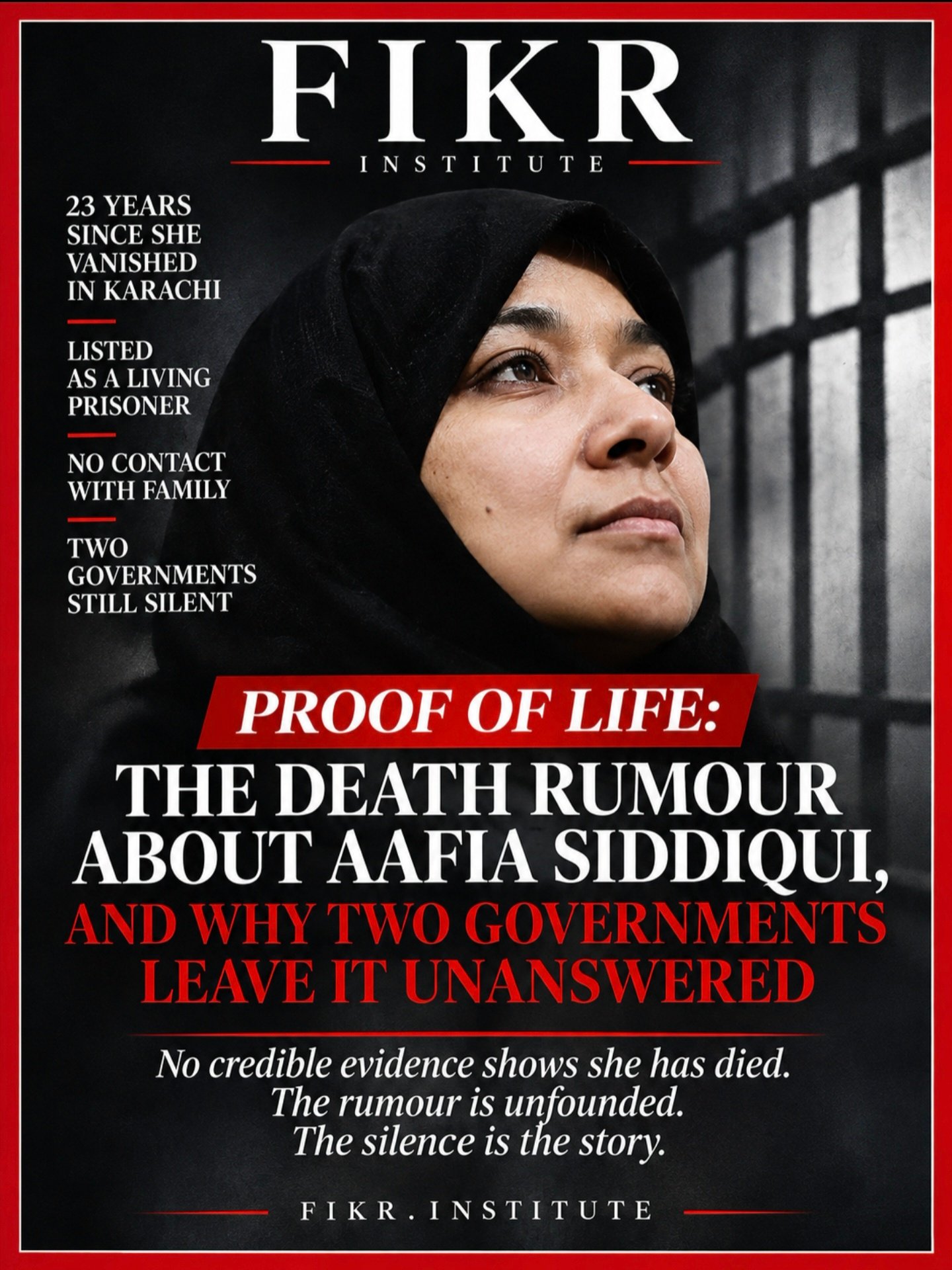
In the last days of November 2026, speculation circulating online claimed that Dr Aafia Siddiqui had died in an American prison. No major outlet has reported her death. No government has announced it. Her family has not confirmed it.
Fikr Institute has found no credible evidence that she has died. But the rumour has exposed a question more troubling than the rumour itself. Twenty three years after she disappeared, why is there still no reliable way for her own family to know whether she is alive?
What Is Known Today
On November 26, her sister, Dr Fowzia Siddiqui, said the rumours of death had begun before the false reports of her release had even stopped [1]. She said the family has not been able to contact Aafia directly, that neither the American prison authorities nor the Pakistani government had officially confirmed her condition, and that her name still appears among living prisoners in the official prison database [1]. She asked the American embassy, the Pakistani foreign ministry and the office of the prime minister for authentic proof of life, and said that the family cannot be satisfied by verbal assurances [1].
Twelve days earlier, the same movement had denied a different rumour, that she was about to be released. "We wish this rumour were based on truth," its spokesperson said [2].
So the facts as of today are narrow. She is listed as a living prisoner. No one has confirmed her death. And no one has yet given the family the proof they asked for.
This Has Happened Before
The death rumour is not new. It circulated in 2016, when the family called it a hoax and said it was the duty of the government to confirm or refute it [3]. It returned in 2018, when the family said neither government had told them anything, though her name was still on the online prisoner list [4]. That time, the Chief Justice of Pakistan ordered the embassy to report within three days [5], and the consul general in Houston visited her and called the rumours baseless [6][7]. In 2021, Pakistan formally requested consular access to clarify rumours of her death [8]. In 2022, the consul general again visited her after another false report [9].
Each time, the public answer came only after the rumour had spread. The family has, for long periods, had no contact with her at all. When her sister finally saw her in 2023, it was the first time in 20 years [10]. The same vacuum that existed in 2016 exists today.
The Vacuum Began in 2003
The silence did not begin in prison. It began in Karachi. According to her family, she vanished in March 2003 with her three children, Ahmed, Mariam and Suleman [11]. Human rights organisations included her on a 2007 list of people suspected of having been held in secret American custody [12]. The Human Rights Commission of Pakistan demanded an official investigation into the disappearance of her and her children [13]. In 2010, Amnesty International said it had no information to confirm where she had been during those years [14]. The Pakistani government said it could not comment on her whereabouts between 2003 and 2008 because of the sensitivity of the case [15].
She surfaced in Ghazni, Afghanistan, in July 2008, with her eldest son [16]. Human Rights Watch said the boy, then 11, should never have been handed to the Afghan intelligence agency [16]. She was later convicted in New York of attempting to kill American personnel and sentenced to 86 years [17][18]. She has denied the charges [19].
Five years of her life remain officially unexplained by both governments. The fate of her youngest child has never been publicly established [12].
What Has Been Tried
Pakistan has asked, and been refused. Prime Minister Shehbaz Sharif wrote to President Biden in October 2024 seeking her release [18]. In January 2025, the Islamabad High Court was told that Biden had rejected the clemency plea and that Washington had refused a prisoner exchange agreement [20][21]. The judge remarked that the United States was showing Pakistan its worth [20].
Inside Pakistan, the effort to compel the government stalled. In February 2026, the Federal Constitutional Court halted contempt proceedings that the Islamabad High Court had begun against the prime minister and cabinet over the case [22][23], and a larger bench of the High Court then withdrew the contempt order, ruling that the bench that issued it had not been properly constituted [24].
What Is Alleged About Her Treatment
In September 2024, her lawyers filed a lawsuit in Texas against the Bureau of Prisons alleging sexual assault, medical neglect, physical attacks and denial of access to an imam, including rapes she reported in 2011, 2012, 2015, 2017 and 2018 [25]. These are allegations in a court filing, not judicial findings. The prison where she is held has its own record. In November 2026, ProPublica and The Marshall Project reported that 12 employees of FMC Carswell had been accused of sexual assault in the last five years [26], as part of more than 185 cases across federal women prisons [27]. The Bureau of Prisons says it has zero tolerance for sexual abuse [28].
Some claims now circulating online go further: that she was punished for memorising the Quran, that she was deliberately given cancer, or that she has died. Fikr Institute found no credible evidence for these claims, and does not repeat them as fact. They harm her cause, because every claim that collapses makes the documented allegations easier to dismiss.
Who Benefits From the Silence
Fikr Institute does not claim that anyone planted this rumour. No evidence shows that. What is documented is a pattern: false reports of release and false reports of death arrive in cycles, each one torments her family, and each one dies only when an official voice is finally heard [1][2][9].
The silence serves those who would prefer that her case stay closed. Washington does not have to explain where she was before 2008. Islamabad does not have to explain how a citizen vanished from Karachi with three children. A rumour can be answered with one consular visit; the missing five years have never been answered at all [14][15].
Questions for Readers
If her name is on a list of living prisoners, why can her family not hear her voice? Why does reassurance reach the public only after a rumour, and never before it? Why have two governments, after 23 years, still not told her family where she was taken in 2003, and what happened to her youngest son?
Signs to Watch
Whether the Pakistani consulate in Houston visits her and makes its findings public; whether the Bureau of Prisons or the American embassy responds to the request for proof of life; whether the family is allowed a call or a visit; and whether the Texas lawsuit reaches a ruling on its merits.
Fikr Institute judges that there is no credible evidence that Aafia Siddiqui has died, that the only official record cited by her family lists her as a living prisoner, and that the rumour of her death is unfounded. But the rumour could only spread because two governments have allowed a vacuum to stand for 23 years. The cure for a false rumour is not denial. It is proof of life, given to her family, and an honest account of the years no one will explain.