
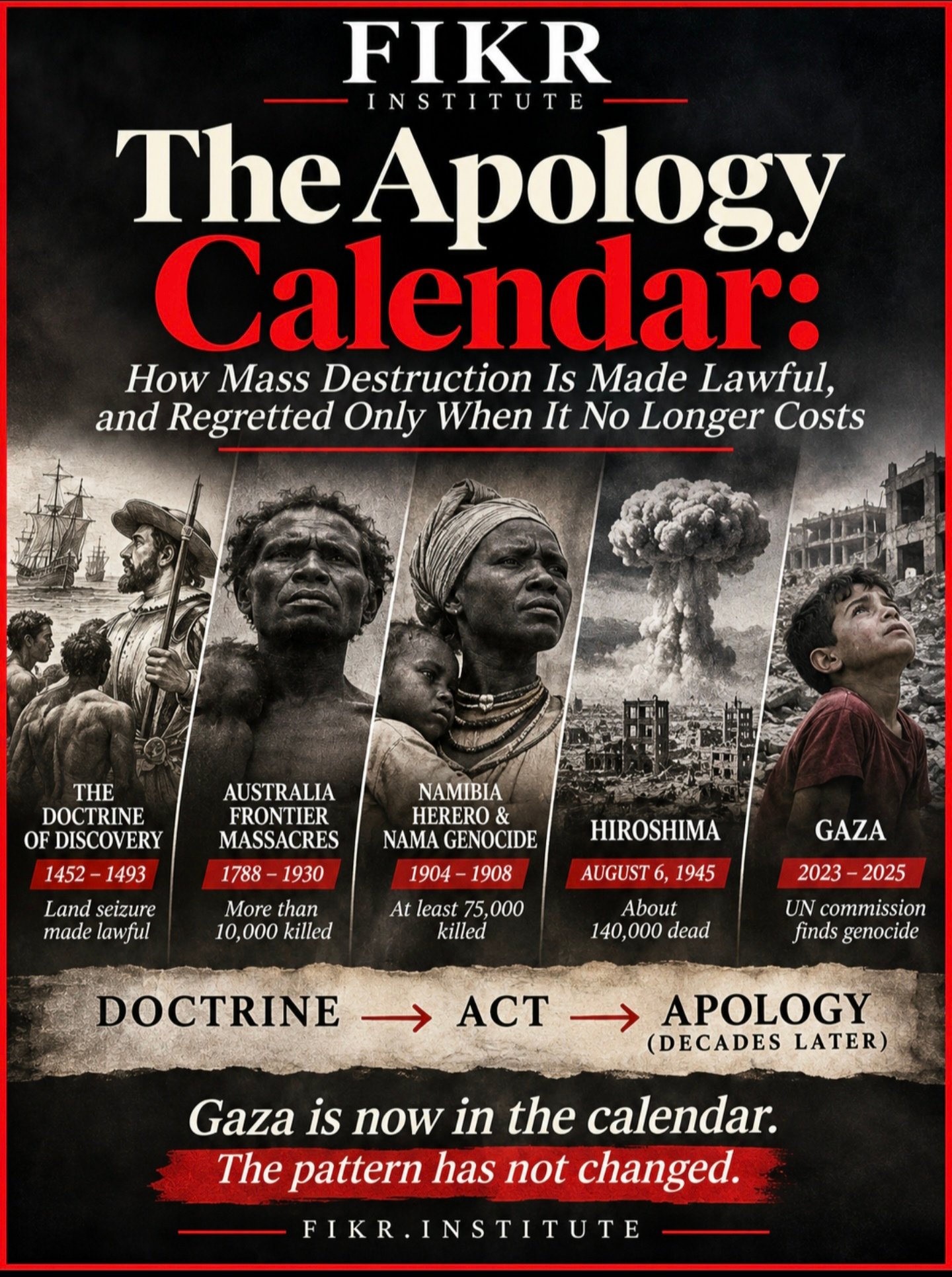
Histories of mass killing usually ask how many died. This study asks a different question: how long did it take the responsible state to say so, and what words did it choose when it finally did?
The answer forms a calendar. It has three stages, and they repeat across five centuries. First, a doctrine makes the act lawful at home. Second, the act is carried out. Third, recognition arrives decades or centuries later, when the victims are dead and the words cost nothing.
This is not a claim about any people or any civilisation. Many of those who forced recognition came from inside the same societies, and every crime here was committed by identifiable governments, armies and courts. The pattern belongs to institutions of power, not to nations.
Stage One: The Doctrine
Every case begins with paper. In 1452, 1455 and 1493, papal bulls gave Christian kingdoms religious backing to seize lands in Africa and the Americas, the basis of what later became the Doctrine of Discovery [1][2]. In Australia, British law rested on terra nullius, the claim that the continent belonged to no one before Britain arrived [3]. In the United States, the Indian Removal Act of 1830 gave legal form to the expulsion of Native nations from their lands [4].
The twentieth century changed the language, not the method. In Korea, the US Air Force adopted a policy it called "selective destruction", using "air pressure" to force the other side to settle [5]. In May 1953, its aircraft attacked irrigation dams for the first time, causing extensive flood damage [6], after approval was given to strike dams and the irrigation systems that supported them [7].
In each case, the act was not hidden. It was authorised.
Stage Two: The Act
On the Australian frontier, historians at the University of Newcastle now estimate that more than 10,000 Aboriginal and Torres Strait Islander people were killed in at least 414 massacres between 1788 and 1930 [8]. Around half of the massacres in the final stage of their research were carried out by colonial officials, such as police and soldiers, alone or with settlers [9].
In German South West Africa, now Namibia, at least 65,000 Herero and 10,000 Nama were killed between 1904 and 1908 [10]. In Hiroshima, an estimated 140,000 people had died by the end of 1945 [11], and about 74,000 in Nagasaki [12].
Stage Three: The Words
This is where the calendar becomes visible. Recognition comes, but late, and it is worded so that it carries no obligation.
Australia. The High Court rejected terra nullius in 1992, 204 years after British settlement [3]. Eddie Mabo, who brought the case, had died months before the ruling [13].
The Vatican. In 2023, five centuries after the bulls, the Vatican repudiated the Doctrine of Discovery and said the bulls did not adequately reflect the equal dignity and rights of Indigenous peoples [1]. It did not rescind the bulls themselves [2].
The United States. In 2009, Congress passed an apology to Native peoples as an amendment to the Defense Appropriations bill [14]. It contained a disclaimer: nothing in it "authorizes or supports any claim against the United States" [4]. It was signed as part of a defence spending law, and the White House had no plans for what would follow [15].
Germany and Namibia. In 2021, 113 years after the killings ended, Germany called them genocide for the first time [10]. It offered 1.1 billion euros over 30 years for development projects [16], and stopped short of calling the payment reparations [17]. The Joint Declaration has still not been concluded, and negotiations continue [18]. Herero representatives reject it, saying the process continued without them [19].
Britain and Kenya. In 2013, Britain said it "sincerely regrets" the torture of Kenyans in the 1950s and paid 19.9 million pounds to 5,228 survivors [20]. It denied legal liability and insisted the settlement set no precedent [21][22].
Britain and Amritsar. In 2019, a century after the massacre, Prime Minister May said, "We deeply regret what happened and the suffering caused", but stopped short of a full apology [23][24]. Her predecessor had called it deeply shameful, and also did not apologise [25].
The Netherlands. In 2022, the Dutch government apologised for its role in slavery, without concrete plans for repair or reparations [26]. No country has committed to reparations for its role in the slave trade [27].
The United States and Hiroshima. In 2016, the first sitting American president to visit Hiroshima did not apologise [28]. Before the visit, the White House said President Truman made the decision "for the right reasons" [29][30].
What the Calendar Shows
Three patterns run through every case.
First, recognition is forced, not offered. Terra nullius fell because Eddie Mabo went to court [3]. Kenyans won their settlement as claimants [20]. The Vatican acted after decades of Indigenous demands [2].
Second, recognition is drafted by lawyers. "Regret" instead of apology [20][23]. "Development" instead of reparations [17]. A disclaimer against claims [4]. The words acknowledge the suffering while protecting the state.
Third, the speed of recognition depends on who the victims were and what power they held at the time. West Germany signed the Luxembourg Agreement with Israel in 1952, seven years after the Holocaust ended, committing three billion marks [31]. It has granted formal reparations to no other country [32]. The Herero and Nama waited 113 years and were told the money was not reparations [10][17]. The recognition owed to the Jewish victims was right, and it came because those who spoke for them had a state and allies to press the claim. The African victims had neither, and waited a century.
Coordination is not claimed; no institution planned this calendar across five centuries. Convergence is documented: governments as different as Britain, Germany, the United States and the Netherlands chose almost identical formulas of regret without liability [20][17][4][26]. Exploitation is visible: delay serves the state, because every decade that passes reduces the number of living claimants. The precedent is the law itself, which declared the act lawful when it was done and declared it regrettable only when no one could collect.
Gaza and the Calendar
In September 2025, the UN Commission of Inquiry concluded that Israel has committed genocide against Palestinians in Gaza [33]. Israel rejected the finding and called it a "libellous rant" [34]. The final legal determination rests with the International Court of Justice [35].
The calendar predicts the stages that follow. A doctrine already exists: self defence. The act has been documented by a UN commission. What remains is the third stage. If the pattern holds, recognition will come when the survivors are old or dead, in words drafted to carry no liability.
Questions for Readers
If the doctrine is always written before the killing and the apology only after the victims die, what is the law protecting? Why did one people receive reparations in seven years and another wait 113 years for a payment that was not to be called reparations? And who in Gaza will still be alive when the word regret is finally spoken?
Fikr Institute judges that the recurring machinery of mass destruction is not hidden in the past; it is written into how states justify, conduct and later remember their crimes. The question is not whether recognition will come. It is whether those who suffer will live to hear it, and whether it will carry any obligation at all.