
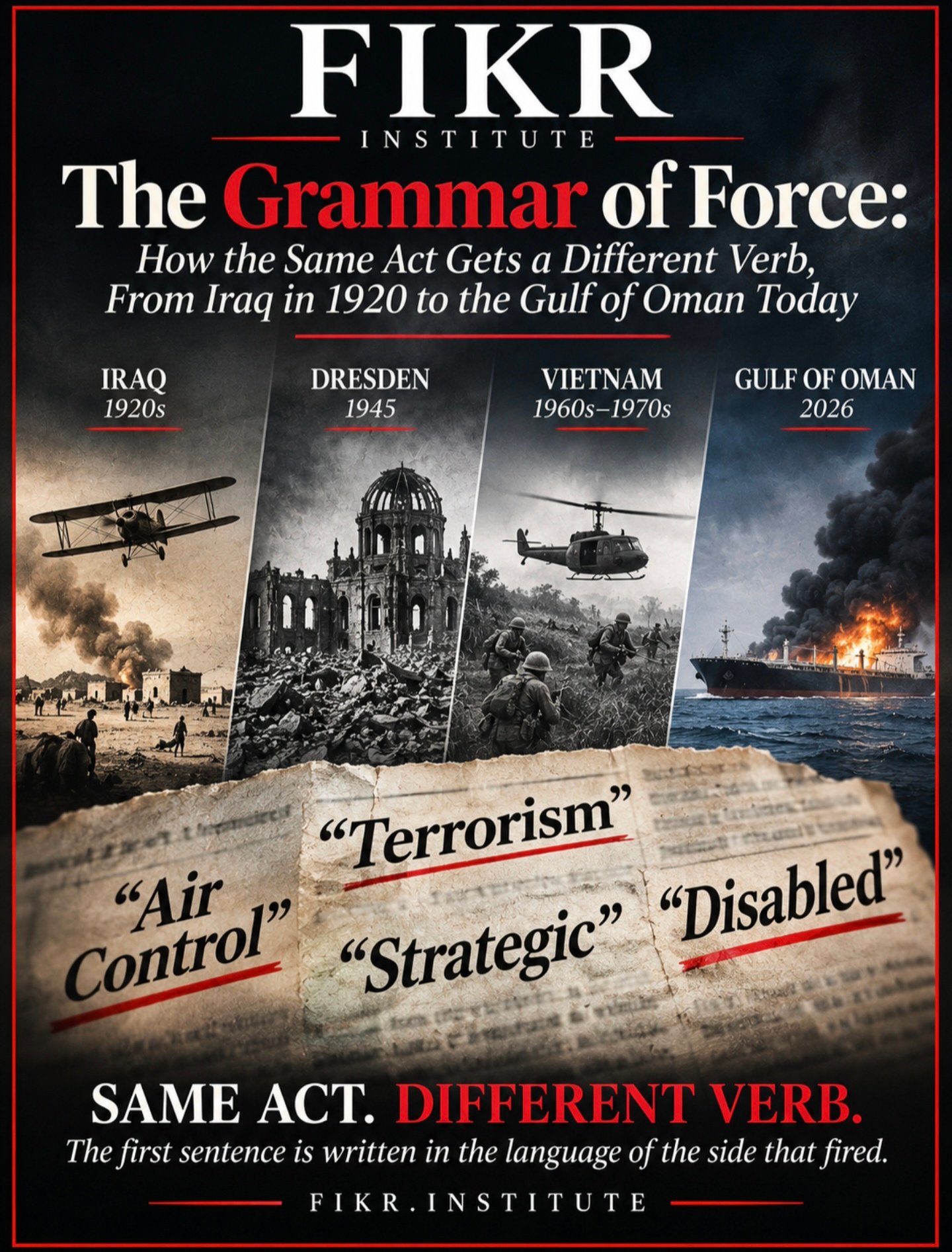
On November 27, 2026, the Associated Press reported that the US military had disabled a merchant ship trying to run its blockade of Iranian ports [1]. The facts in the report are precise. A military aircraft fired precision munitions at the stern of the Palau flagged Pacific Archer, which had sailed from Bandar Abbas; CENTCOM said its propulsion was disabled and its civilian crew unharmed [2]. It was at least the 15th vessel disabled since the blockade began in the spring [3].
The facts are not the question. The verbs are. An aircraft fired on a civilian ship. The sentence that reached the world said the ship was disabled, for trying to breach a blockade, and that the blockade belonged to the military.
This study traces that grammar across a century. Its finding is not that Western governments hide their violence. It is that they rename it, and that the rules of renaming have barely changed.
Rule One: Their Act Is Moral, Ours Is Technical
In the same week, the same waters produced two vocabularies. A shipping trade journal reported that Iran had continued its regular attacks on ships, while the United States took action against a bulker it said was trying to evade its blockade [4]. ABC described the United States as enforcing a blockade, and Iran as claiming attacks on shipping [5]. When CENTCOM marked one month of the blockade, it said it had disabled four ships to ensure compliance [6].
The deaths are not changed by the verb. In June, three Indian sailors were killed when American forces struck the tanker Settebello, according to Indian officials, and the head of the International Maritime Organization condemned the attack [1].
This pattern has been measured. In 1991, Robert Entman compared American coverage of two airliners shot down: Korean Air 007 by the Soviet Union in 1983, and Iran Air 655 by the United States in 1988 [7]. The Soviet shootdown was portrayed as an intentional and deliberate attack [8]; the American one was framed around the difficulties of operating military technology [7]. Two planes, two sets of verbs.
Iran uses its own vocabulary. It calls American strikes on its tankers war crimes and aggression [9], and the IRGC speaks of restricted zones it enforces with force [10]. Every power has a grammar. The difference is whose grammar becomes the language of the international wire.
Rule Two: When We Bomb, We Are Policing
The grammar is older than the jet. After the First World War, Britain governed Iraq by what it called air control [11]. The historian Peter Sluglett found that commanders and colonial officials bombed and strafed Iraqi villages to teach obedience and to force tax collection from even the poorest Iraqis [12]. Officially, air control was described as a method less costly to life and suffering [12]. The method spread to the Northwest Frontier and to Aden [11].
George Orwell saw it plainly in 1946. He wrote that when villages are bombarded from the air, their people driven out, their cattle shot and their huts burned, this is called pacification [13][14].
Rule Three: Their Bombing Is Terror, Ours Is Strategy
During the Blitz, British newspapers described the German attacks on London as terror bombing [15]. Then, in February 1942, the Air Ministry directed Bomber Command to focus on the morale of the enemy civil population, and in particular of the industrial workers [16].
After Dresden, an Associated Press correspondent reported that Allied air commanders had adopted deliberate terror bombing [17]. American headlines followed, and the US Secretary of War demanded an investigation [18]. On March 28, 1945, Churchill himself wrote that the bombing of German cities simply for the sake of increasing the terror, though under other pretexts, should be reviewed [19][20]. He then withheld that memorandum [17], and the official line held that Dresden was a legitimate military target [21].
Nazi Germany started the war and carried out genocide. That does not change the point here: the same act, a city bombed to break its people, received one word in London and another in Dresden.
Rule Four: We Count Their Victims, Not Ours
In 1982, President Reagan said that despite blanket bombing and chemical and biological weapons, Afghan freedom fighters had held back the Soviet occupation force [22]. In 1985 he accused the Soviets of turning their military might against the civilian population [23]. Western human rights investigators documented Soviet abuses in detail [24], and a UN rapporteur accused Soviet forces of a deliberate policy of bombarding villages [25].
The Afghans were counted when the Soviets killed them. Twenty years later, in the same country, the commander of US Central Command told journalists that US forces did not do body counts [26][27]. In Iraq, the Pentagon released no composite estimate of Iraqi civilian deaths [28], and the work fell largely to volunteers and researchers [27].
Vietnam shows the other side of the same rule. There, the Pentagon did count. But most American statistics on the war, beyond its own forces and casualties, are problematic [29].
The drone wars refined the method. In 2012, The New York Times reported that the Obama administration counted all men of military age in a strike zone as combatants [30]. An official told ProPublica it was assumed that a group of men in a house where an attack was being planned were all part of it [31]. The count was low because the definition was wide.
Rule Five: When a Word Is Exposed, the Word Changes
In April 1968, the US Army recognised that search and destroy had become associated with aimless searches and the destruction of property, and General Westmoreland ordered the term discontinued [32]. The operations continued under other names. Churchill withdrew his memorandum, and the area bombing continued [17]. Air control became doctrine. Each time, the policy survived and the vocabulary was replaced.
Who Exposes It
This pattern was not uncovered by outsiders alone. The correspondent who wrote of terror bombing in 1945 worked for the Associated Press [17][21]. The New York Times won the Pulitzer Prize in 2022 for exposing the civilian toll of US airstrikes [33], after its reporter sued the Pentagon to obtain more than 1,300 secret casualty assessments [34]. Western journalists have repeatedly broken the accounts of their own governments. What they have not changed is the first draft, the sentence that reaches the world on the day of the act, written in the verbs the military supplies.
Whose Victims Are Worthy
In 1988, Edward Herman and Noam Chomsky described worthy and unworthy victims: those killed by enemy states receive more sympathetic and sustained coverage than those killed by allies [35]. The pattern continues. An analysis published by The Intercept in 2026 found that, after October 2023, many outlets routinely attached the qualifier Hamas run to Palestinian death counts, while the same State Department, World Health Organization and human rights groups had long used those figures [36].
Across the last century, the people on the receiving end of this grammar have increasingly been Muslim: Iraq in the 1920s, Afghanistan, Iraq again, Pakistan, Yemen, Gaza and now Iran [12][27][30][36][1].
The Hypothesis Levels
Coordination is not claimed; there is no central dictionary. Convergence is documented: from air control to disabled, the verbs supplied by the military become the verbs printed by the press [12][1][4]. Exploitation is visible: a softened verb lowers the political cost of force, at home and at the United Nations. The precedent is a century of renaming, from pacification to search and destroy to collateral damage [13][32].
Questions for Readers
If a bomb on a ship is called disabling, what would a bomb on a city be called? Why are the dead counted carefully when an enemy kills them, and left to volunteers when an ally does? And who first wrote the sentence that you read this morning?
Signs to Watch
Whether wire services begin to attribute the word disabled to CENTCOM rather than adopt it; whether the next death of a sailor in the blockade is reported as a death or as a disabling; and whether any Western government publishes a count of the civilians killed in its war with Iran.
Fikr Institute judges that the double standard lies less in what is reported than in the verb chosen on the first day. The facts often emerge later, through the courage of reporters inside the same societies. But the first sentence, the one that shapes public opinion, is still written in the language of the side that fired.