
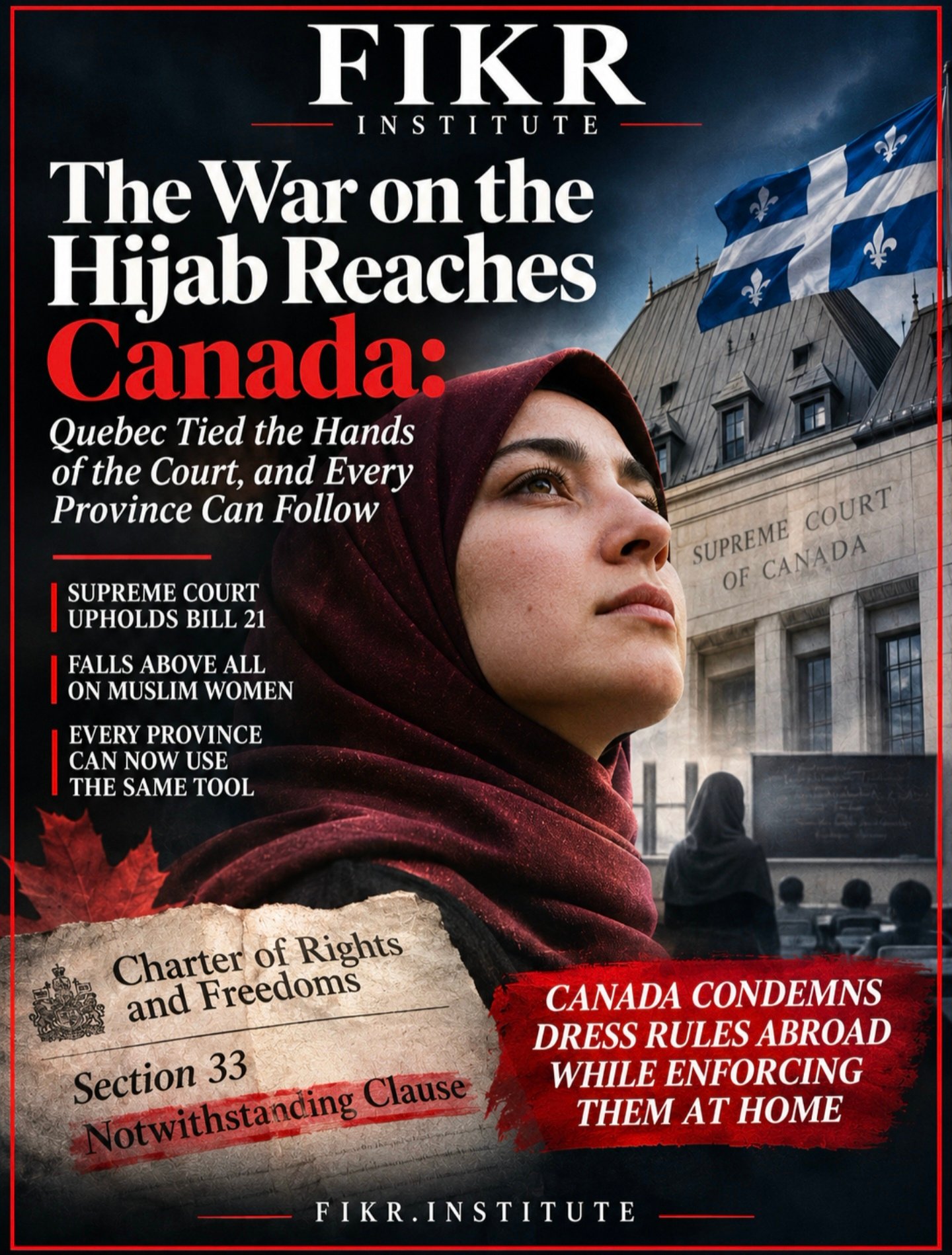
On November 27, 2026, the Supreme Court of Canada upheld the secularism law of Quebec, known as Bill 21, and found that the province had validly invoked the notwithstanding clause in section 33 of the Charter [1]. The law continues to bar public school teachers, police officers and some other public employees from wearing religious symbols at work [2]. One part fell: the Court unanimously struck down the ban on face coverings for members of the National Assembly, because section 33 cannot override democratic rights [1] [3].
The National Council of Canadian Muslims, one of the groups that challenged the law, called the ruling a dark day in our constitutional democracy [2].
Fikr Institute has written about the hijab in Afghanistan under the Taliban and in the schools of Azerbaijan. In both cases, Western governments spoke loudly. This study asks a different question. If a woman in a headscarf can be kept out of a Canadian classroom by law, and the highest court in the country can do nothing about it, then on what ground does Canada stand when it lectures others?
What the Court Said, and What It Did Not Say
The ruling must be read with care, because it is often reported as an endorsement. It is not.
The Court held that the exercise of the override power is not subject to any limit other than those expressly set out in section 33 [1]. The power itself is not new. Provincial legislatures have held it since 1982, and a declaration under it expires after five years unless renewed [4]. What the ruling settled is how far it reaches. The Court added that a legislative body is not required to show a link or relationship between the law in question and the rights or freedoms it intends to override [5].
That is a ruling about power, not about justice, and the bench was closely divided. Four judges held that courts keep the power to declare whether such a law is consistent with Charter rights, despite the override [1]. Three of them, Justice Kasirer and Justices Karakatsanis and a colleague in joint reasons, would have issued that declaration, finding that sections 6 and 8 of Bill 21 unjustifiably infringe freedom of religion, freedom of expression and equality rights [6].
The closest vote concerned women. Section 28 of the Charter guarantees rights equally to male and female persons, and section 33 cannot override it [7]. Justice Sheilah Martin held that Bill 21 is unconstitutional on that ground [8], and three judges, Justices Martin and Karakatsanis and a colleague, concluded that section 28 should serve as the basis for striking down the heart of the law [9]. The majority held that section 28 does not create a distinct right that can be invoked to challenge a law [1]. On whether a law that falls above all on women breaches equality between the sexes, the highest court in Canada divided four to three [9].
The Court, in other words, did not say the law is fair. The notwithstanding clause prevented it from invalidating the principal restrictions on the basis of the rights Quebec had overridden, even though courts keep the authority to examine their compatibility with those rights. The hands that were tied belong to the Court. The hands that tied them belong to the National Assembly of Quebec.
Respect for judicial independence does not require silence about the political consequences of a law, or about the constitutional provision under which it operates. The criticism in this study is directed at the legislature that chose the instrument.
The Declared Aim and the Recorded Effect
The declared aim of Bill 21 is the neutrality of the state. The law names no religion and bans every visible symbol. To judge a law by its text alone, however, is to judge it by what its authors chose to say. The better test is what it does, and to whom.
Months before the law was tabled, the new minister responsible for the status of women in Quebec, Isabelle Charest, said the Muslim head scarf did not correspond to her values and was not a way for women to flourish in society [10]. She said it does have, at some point, some significance about oppression of women [11]. One garment, of one faith, was named before the law was written.
When the law reached court, the trial judge measured its effect. Justice Marc André Blanchard of the Quebec Superior Court wrote that the evidence undoubtedly shows the effects of the law will be felt negatively above all by Muslim women [12]. He described it as a cruel consequence which dehumanizes the individuals concerned [13], and still upheld most of it, because the notwithstanding clause left him no choice.
The record since then is consistent. The English Montreal School Board, which carried the challenge to the Supreme Court, states that every documented case of termination under Bill 21 has involved a Muslim woman teacher [14]. In December 2021, Fatemeh Anvari, a third grade teacher, was removed from her classroom and reassigned because she wore a hijab [15].
The law also affects Sikh men, Jewish men and others who wear visible symbols, and their harm is real. But the courts did not describe an even burden. They described a burden that falls above all on Muslim women.
The deeper question is not only whether secularism treats religions equally. It is whether a doctrine that separates religion from public life can accommodate a religion whose followers understand their obligations as extending into public life. Quebec has turned that tension into employment law. The Muslim woman may hold her belief, but her ability to practise it visibly at work becomes conditional on the permission of the state.
For Muslim women who understand the hijab as a religious obligation, the issue is not freedom to choose an item of clothing. It is whether obedience to their convictions can be made a ground for exclusion from professional and public life.
A Ladder, Not a Law
Bill 21 was not the end of a process. It was the first rung.
In 2019, the ban covered employees in positions of authority. In 2025, Bill 94 extended the restrictions across school environments [16]. In April 2026, Bill 9 passed by 77 votes to 27 [17]. It bans religious symbols for subsidized daycare workers, with those already in their posts exempted, phases out public subsidies for religious private schools, and bans prayer spaces in public institutions including universities, as well as group prayer in public spaces such as parks without municipal authorization [18]. The prayer provisions apply from September 2026 [16].
The origin of the prayer ban deserves attention. The minister responsible for secularism, Jean François Roberge, announced it in August 2025 amid tension over Muslim prayers held during pro Palestinian demonstrations, including those in front of the Notre Dame Basilica of Montreal, organized to draw attention to the humanitarian crisis in Gaza [19]. He called the proliferation of street prayer a serious and sensitive issue [20]. A government report had found that municipalities already had the necessary powers to regulate street prayer and had not called for a province wide ban [21]. The province legislated anyway, and the minister has described street prayers as potential acts of provocation [22].
The objection did not come only from Muslims. The Catholic Archbishop of Montreal called the plan an impractical and discriminatory affront to fundamental freedoms [19].
The documented trigger for a general law on prayer was a series of Muslim prayers at protests about Gaza. The record shows the trigger; it does not by itself prove the purpose. Readers may still ask which public act was really being regulated.
In the Words of Canada
Canada does not lack a vocabulary for this. It uses it abroad.
On August 15, 2024, three federal ministers condemned the Taliban, saying the violations of the rights of Afghan women had led to restrictions on their freedom of movement and dress as well as their access to education, health services and justice, along with their ability to work [23]. The statement called the treatment of women by the Taliban nothing short of horrifying [24]. A month later, Canada joined Australia, Germany and the Netherlands in announcing their intention to hold Afghanistan accountable under the convention on the rights of women known as CEDAW [25].
In October 2022, Canada sanctioned the morality police of Iran, citing the systematic persecution of women [26]. The Prime Minister said the death of Mahsa Amini was a direct result of the systemic harassment and repression that women face in Iran [27].
Dress. The ability to work. Those are the words Canada chose. Inside Quebec, a woman who wears a hijab cannot become a public school teacher, a police officer or a Crown prosecutor, and from now on cannot take a new job in a subsidized daycare [2] [13] [18]. Canada claims to lead the world on human rights, and even then it does not apply its own words at home.
The Woman Between Two Extremes
The pattern is older than any single government. In Herat, United Nations monitors recorded that Taliban officials arrested at least 30 women accused of wearing improper hijab between June 6 and 8, 2026 [28]. Between July and September, at least 52 women and one girl were arrested or detained in Kabul and Herat over dress codes and guardian rules [29]. In Azerbaijan, a secular state with a Muslim majority, pupils and teachers wearing hijabs were denied entry to schools from October 12, 2026 [30]. One English teacher with 23 years of experience was turned away from her school in Baku, and so was her daughter [31].
In one place she is punished for too little cloth. In another she is shut out for too much. In Quebec she keeps her freedom and loses her classroom. The ideologies differ. The method is the same. A state decides what a woman must wear in order to take part in public life, and calls it protection.
Each of these states says it acts for her. None of them asks her.
The Instrument Travels
The hijab ban has not spread beyond Quebec. What has spread is the legal instrument that made it untouchable.
For decades, section 33 was treated as a last resort. Researchers note that many law professors describe its growing use since 2018 as a betrayal of that norm [32]. Emily Laxer of York University counted that in five years the clause had been credibly invoked seven times by governments in Ontario, Quebec, New Brunswick and Saskatchewan [33]. Saskatchewan used it in 2023 to shield its school pronoun law, and Alberta later passed a similar law [34]. In 2025, Alberta used the clause four times in a single month [35]. Alberta also defended the use of the clause by Quebec in its secularism law [36].
The courts did not stop the pattern. In August 2025, the Saskatchewan Court of Appeal held that a preemptive use of the clause does not bar courts from saying whether a law infringes rights [37], but it could not strike the law down. The Supreme Court has now confirmed that approach nationally: courts may examine and declare, but the shielded law stands.
Students of public administration know how this works. A tool is tested in one jurisdiction. When it survives, others adopt it. Every legislature has held this power since 1982. What the Supreme Court has now confirmed is that it may be used preemptively, with no duty to justify the rights it overrides. Quebec used it against religious minorities. Saskatchewan and Alberta used it on gender identity. Ontario used it on election advertising [33]. The next target is not written in the ruling. It will be chosen by whoever holds a majority.
The reaction among premiers shows the division. Alberta Premier Danielle Smith hailed the ruling as a win for provincial rights [38]. Manitoba Premier Wab Kinew called Bill 21 legislative racism [39] and said Manitoba would never use the clause, but accepted that it is still going to stand [38]. He expects tension when the premiers meet in Toronto next month [40]. Prime Minister Mark Carney said the federal government will not use the clause and that the broader implications will be studied [4]. Manitoba and the federal government had argued at the Supreme Court in favour of judicial declarations [9].
A promise by one premier binds no successor. The power remains with the office, not with the person.
Who Benefits
States rarely state their hidden interests. Their actions and their beneficiaries are the better evidence.
A provincial government gains a way to settle a contested question without a court deciding it. Muslim women, who had done nothing but apply for jobs, lose careers. Whether these laws also serve electoral purposes is a question the record raises but does not settle, and readers can weigh it themselves.
Which group was named by a minister before the law was drafted? Which group fills every documented termination? Which public act triggered the prayer ban? And when the instrument travels to another province, who will be its next target?
Reading the Pattern
Coordination: Fikr Institute found no evidence that provinces have coordinated their use of section 33, and makes no such claim.
Convergence: Governments with different targets, from religious minorities to transgender youth to unions, have converged on one method, which is to shield a law from invalidation on specified Charter grounds before any court rules.
Exploitation: Muslim prayers at Gaza protests became the stated occasion for a general law on public prayer, even after a government report said existing powers were enough.
Precedent: The Supreme Court has confirmed that no link need be shown between a law and the rights it overrides. That holding now applies to every legislature.
Signs to watch: the meeting of premiers in Toronto next month [40]; the renewal of the notwithstanding clause for Bill 21, which must happen by 2029 [4]; and any new bill in any province that touches religious dress, prayer or public employment.
Fikr Institute judges that the war on the hijab has reached Canada, not through a decree like that of the Taliban, but through a legislature that shielded its law from invalidation and a constitution that allowed it. The Court did not approve the law. Three of its judges would have declared that it infringes fundamental freedoms, and three would have struck down its heart on grounds of equality between the sexes. Canada condemns restrictions on dress and work abroad while one of its provinces enforces them at home. The question for Canadians is not only what Quebec has done. It is what every other province can now do the same way, and whom it will choose.