
Abstract:
The Iraq war is remembered as an intelligence failure. The declassified documentary record describes something different and more precise. In November 2001, sixteen months before the invasion, talking points prepared for the American defence secretary listed possible ways to start a war with Iraq, treating the justification as an open question and the objective as settled. In September 2002 the intelligence directorate of the Joint Staff reported internally that assessments of Iraqi weapons rested on assumption rather than hard evidence. In February 2002 the Defence Intelligence Agency had already judged the detainee whose testimony supplied the al Qaeda link to be misleading his interrogators. In July 2002 the head of British foreign intelligence returned from Washington and reported that facts were being arranged to fit a decision already taken. This analysis examines what those documents establish about the order in which the war was assembled, and why that order, rather than the falsehoods themselves, is what made Iraq the reference case for every manufactured pretext since.
Main Article:
A pretext is not a lie told after the fact. It is a requirement identified in advance, and the interesting question about any war is never whether the stated reason was true but when the reason was chosen relative to the decision.
Most states do not leave a record of that sequence. In the case of Iraq, four documents do.
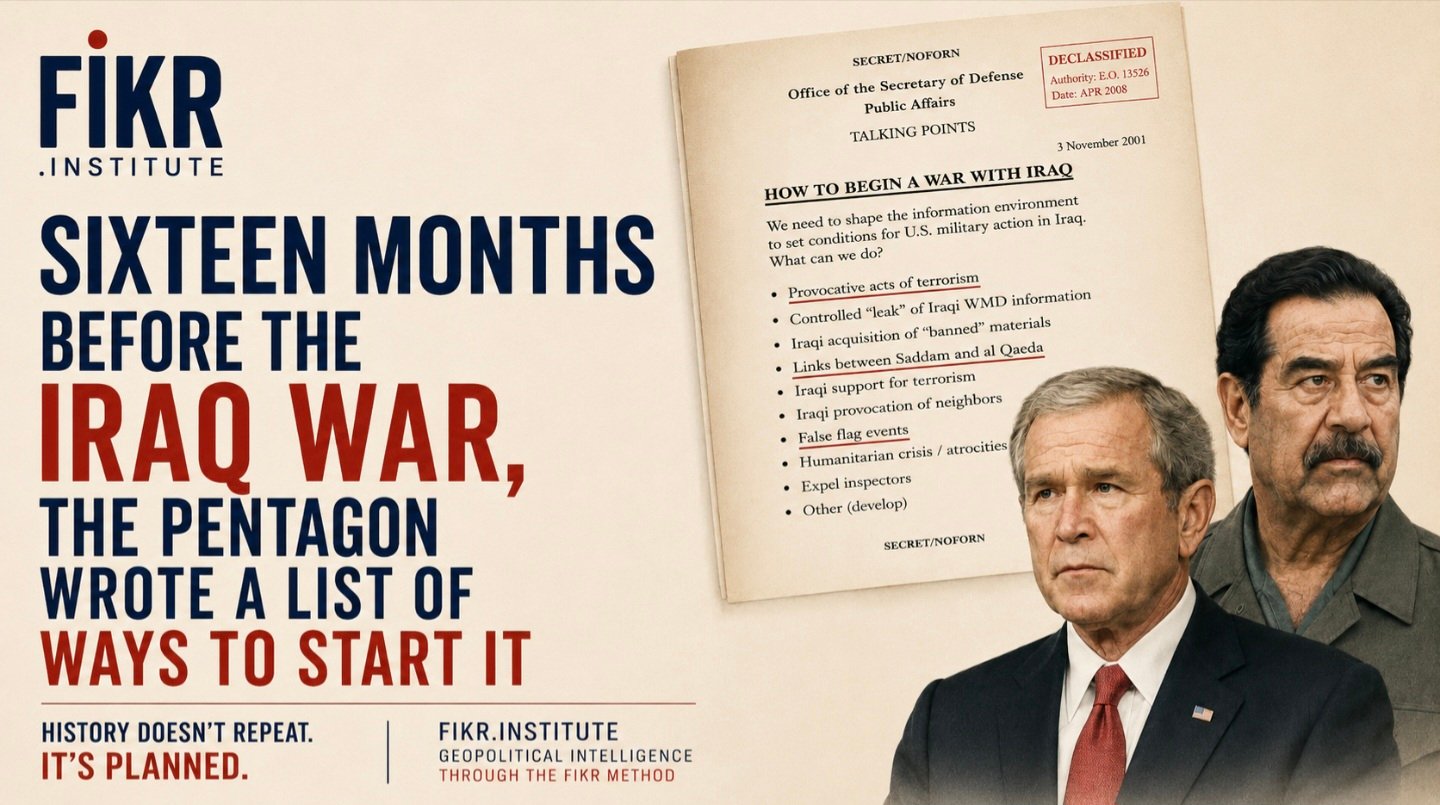
The earliest is a page of talking points prepared for the American defence secretary ahead of a meeting with General Tommy Franks on 27 November 2001, less than three months after the September attacks and while the war in Afghanistan was still underway. It sets out the shape of a campaign against Iraq. Then it asks how to start.
What follows that question is a list. Saddam Hussein moving against the Kurds in the north. The discovery of a connection between him and the September attacks or the anthrax letters. A dispute over weapons inspections. The document adds a note to begin thinking about inspection demands.
Read that as what it is. A government does not compile a menu of possible triggers for a war it has not decided to fight. The presence of the list settles the sequence on its own. The objective was fixed in November 2001. The justification was an open procurement question.
Two of the three options on that list were outside American control. The third was not.
The direction of travel had been set earlier still. Notes taken by an aide in the Pentagon on the afternoon of 11 September 2001 record the defence secretary asking for the best available information quickly, in order to judge whether it was good enough to strike Saddam Hussein at the same time as Osama bin Laden rather than bin Laden alone, and tasking the senior Pentagon lawyer to speak with his deputy about additional support for a connection between the two [1].
Note the verb. Support was to be found for a conclusion. It was not to be derived from evidence.
The conclusion needed a foundation, and the foundation arrived from an interrogation cell. A senior al Qaeda figure captured in late 2001 told debriefers that Iraq had trained al Qaeda operatives in chemical and biological weapons. In February 2002 the Defence Intelligence Agency assessed in writing that he lacked specific detail on the Iraqis involved, on the materials, and on the location, and that he was more likely than not intentionally misleading his debriefers [2].
That assessment was made thirteen months before the invasion. The claim it doubted was repeated by the American president in Cincinnati in October 2002 and presented to the United Nations Security Council by the secretary of state in February 2003. The detainee recanted in January 2004 [2][3].
The pattern repeats with the weapons themselves. On 16 August 2002 the defence secretary asked the head of the intelligence directorate of the Joint Staff to estimate, as a percentage, how much was not known about Iraqi weapons programmes. The answer came back on 5 September in a report titled Iraq, Status of WMD Programs. It stated that assessments relied heavily on analytic assumptions and judgment rather than hard evidence, and that there was no precise measure of how much remained unknown [4].
The document was not circulated beyond a small group.
This is the feature that matters most, and it is the one usually missed. The system was not blind. It produced an accurate internal warning, on time, in writing, from its own intelligence directorate. The warning simply did not travel. An institution that generates the correct assessment and then declines to distribute it is not failing to know. It is managing what is known.
Six weeks before that report, the head of British foreign intelligence had returned from Washington and briefed the prime minister and his cabinet. The minutes of that meeting on 23 July 2002 were leaked to the journalist Michael Smith and published by The Sunday Times on 1 May 2005 [5]. They record his report that military action was now seen as inevitable, that the American president wanted to remove Saddam Hussein through military action justified by the conjunction of terrorism and weapons of mass destruction, and that the intelligence and facts were being fixed around the policy [5][6].
The same minutes record two further observations that received far less attention and are arguably more damning. The American National Security Council had no patience with the United Nations route. And there was little discussion in Washington of what would follow the military action [5].
The first tells you the inspections were an obstacle rather than a test. The second tells you the war was not being planned as a solution to a problem, because a solution requires an account of the state that follows it.
What happened next confirmed both.
The Security Council passed Resolution 1441 on 8 November 2002, giving Iraq a final opportunity to comply. Inspectors returned on 27 November. Between then and 18 March 2003 the United Nations Monitoring, Verification and Inspection Commission carried out 731 inspections at 411 sites, and the International Atomic Energy Agency a further 237 inspections at 148 sites, including sites never inspected before [7]. Access was provided. No evidence was found of the continuation or resumption of prohibited weapons programmes, and the head of the inspection body reported this to the Security Council in those terms [8].
Recall the November 2001 list. A dispute over weapons inspections was one of the three ways of starting the war. Inspections had been identified in advance as a mechanism that could generate a casus belli.
They generated the opposite. Iraq complied, and the compliance was inconvenient, so the process was abandoned rather than credited. The invasion began on 19 March 2003, the day after the inspectors withdrew.
No stockpiles were found. The claim of a working relationship with al Qaeda was never substantiated. The secretary of state who presented the case in New York later described his role in it as a permanent mark on his record.
Set the four documents in order and the architecture is visible. The objective is set in late 2001. A menu of justifications is drawn up. Evidence is sought to support a conclusion rather than tested against it. The internal assessment that contradicts the case is written, filed and withheld. The allied intelligence chief observes the arrangement in plain language and the observation stays classified for three years. The verification mechanism is invoked, produces the wrong answer, and is discarded.
None of these steps required anyone to invent a document or forge a photograph. Each step was, taken alone, defensible in bureaucratic terms. That is precisely why the case became the template.
The record does not establish that every official involved believed the case was false. It establishes something narrower and harder to argue with, which is that the decision preceded the evidence and the evidence was assembled to fit it. Those are two different accusations, and only the second is documented. The second is sufficient.
Iraq is now the standard against which later claims are measured, and states know it. Every subsequent government asserting an imminent threat has done so into a public that has seen this sequence once already. That is the durable consequence, and it is not a moral improvement. It is an erosion. A population that cannot distinguish a real warning from a manufactured one is not safer for its scepticism. It is merely harder to warn.
The documents survive because of leaks, declassification requests and a single journalist. They do not survive because the system corrected itself. Nothing in the record suggests it did.
A pretext is a requirement identified in advance. In November 2001 someone wrote the requirement down, under a heading asking how to start, and then listed the options.
The war took sixteen more months to arrive. The question of why had already been answered.
References:
1. NBC News, reporting on declassified Pentagon memoranda and the notes taken by Stephen Cambone on 11 September 2001.
2. CNN, reporting on the Senate Select Committee on Intelligence findings regarding the February 2002 Defence Intelligence Agency assessment.
3. NPR, interview on the declassified Defence Intelligence Agency document and the January 2004 recantation.
4. The Rumsfeld Papers, declassified September 2002 Joint Staff report titled Iraq, Status of WMD Programs.
5. Michael Smith, published account of the Downing Street memoranda and the meeting of 23 July 2002.
6. Slate, analysis of the contents of the Downing Street memorandum published by The Sunday Times on 1 May 2005.
7. Arms Control Association, tally of UNMOVIC and IAEA inspections conducted between November 2002 and March 2003.
8. United Nations Security Council, press release on the final briefing by the executive chairman of UNMOVIC, June 2003.