
Abstract
On April 17, 2026, France and the United Kingdom convened fifty-one countries at the Elysee Palace to establish a multinational navigation mission for the Strait of Hormuz. The United States was absent, excluded on the basis that the mission is limited to non-belligerent countries. Before the conference ended, a French presidential official stated the mission's deployment conditions: an Iranian commitment not to fire on passing ships, and an American commitment not to block ships entering or leaving the strait. Washington was formally placed in the same category of risk as Tehran. The summit produced a governance framework, a follow-up military planning conference at Northwood, and a joint communique asserting that Hormuz is a global commons rather than a bilateral American and Iranian negotiating instrument. Operationally, deployment remains conditional and uncertain. Structurally, Paris is the first significant institutional expression of the evidence that American military power in the Gulf has become a source of instability as much as security, and that European states are building the replacement architecture for a function Washington can no longer perform on terms the international community accepts.
Main Article
When the world's preeminent naval power is excluded from the planning conference to restore freedom of navigation in the world's most critical energy chokepoint, the exclusion is not a diplomatic slight. It is a structural statement about who the international community now considers responsible for the crisis in that chokepoint.
---
The joint communique of France and the United Kingdom, issued on April 17, 2026, following the Paris summit on the Strait of Hormuz, contained a sentence that will outlast the war that produced it. A French presidential official, speaking to AFP ahead of the conference, stated that the proposed multinational navigation mission would require two conditions before it could deploy: an Iranian commitment not to fire on passing ships, and a United States commitment not to block any ships leaving or entering the strait. (1) France placed the world's preeminent naval power and the state that power is blockading in the same sentence, as equivalent preconditions for restoring international navigation. Washington was assigned the same category of risk as Tehran.
That sentence is the analytical key to everything that happened in Paris on April 17.
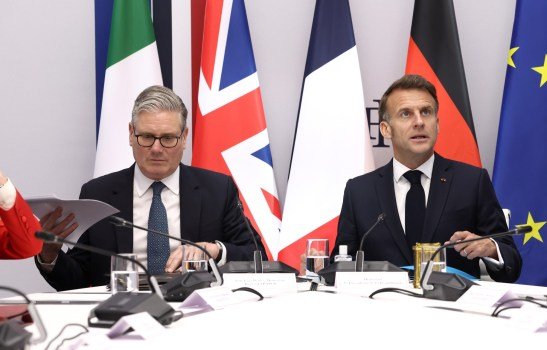
Fifty-one countries gathered at the Elysee Palace under the co-chairmanship of Emmanuel Macron and Keir Starmer. Germany's Friedrich Merz and Italy's Giorgia Meloni attended in person. Representatives from Middle Eastern and Asian states joined by video. The European Commission President Ursula von der Leyen participated. The EU's foreign policy chief cited existing international law obligations and offered to reinforce the Aspides naval mission already operating in the Red Sea. The IEA director had warned the day before that Europe had perhaps six weeks of jet fuel remaining. The gathering was not a diplomatic formality. It was an emergency meeting of states whose economies were being damaged by a war they had neither started nor joined, managed by a power that was now treating the world's most important energy corridor as a bilateral instrument of its own political negotiation. (2)
The United States was not present. The initiative was formally described as limited to non-belligerent countries. Washington is a combatant. That is the stated reason. It is also the structural reason, because a governance initiative for a contested international waterway that visibly includes the military power enforcing a unilateral blockade of that waterway has no international legitimacy before it begins. The Paris summit's designers understood this. The exclusion of the United States was not incidental. It was the precondition for the conference having any meaning at all.
The historical architecture that makes this moment legible requires going back to the governance frameworks that have successfully managed international chokepoints over the past century.
The Montreux Convention of 1936 gave Turkey sovereign authority over the Bosphorus and the Dardanelles while guaranteeing international transit rights. Its durability across ninety years of geopolitical upheaval rests on a single structural feature: Turkey's management of the straits is not perceived as the extension of any great power's political agenda. During the 2022 Russian invasion of Ukraine, Turkey's invocation of the Montreux Convention to close the straits to warships of all belligerent nations was accepted by the international community precisely because the Convention's authority is structurally independent of American, Russian, or European preferences. (3) The Suez Canal Authority, established after Egypt's nationalization of the canal in 1956 and the subsequent failure of the Anglo-French military operation to reverse it, functions on the same principle. The Panama Canal, transferred from American to Panamanian authority in 1999 after decades of political struggle, now processes more tonnage with higher revenue than it ever did under direct American administration, because its governance is universally accepted as legitimate. (4)
Every successful chokepoint governance structure in modern history rests on perceived independence from the political interests of any single major power. The Paris summit is the first attempt to apply this principle to the Strait of Hormuz, and it is being organized explicitly by states that are not parties to the conflict, against the background of a blockade imposed by a state that is.
The Suez Crisis of 1956 is the historical event the Paris summit most closely mirrors, but with the roles reversed in ways that illuminate the depth of the structural shift underway.
In 1956, Britain and France launched a military operation to reassert control over the Suez Canal after Egypt's President Nasser nationalized it. The United States, under Eisenhower, forced them to withdraw through financial pressure, refusing to support sterling and threatening to withhold IMF assistance unless the military operation ended. The consequence was the definitive end of independent European military capacity in the Middle East for a generation. Britain and France accepted the lesson that without American support, they could not sustain military operations in the region, and they organized their subsequent foreign policies around that constraint. (5)
The Paris summit of 2026 describes the same geography, the same chokepoint politics, and the same cast of European powers, but inverted. Britain and France are now organizing an independent multinational force in the Persian Gulf region precisely because American military capacity in that region has become the source of instability rather than the guarantor of order. The financial pressure that runs in the opposite direction from 1956 is Europe's jet fuel emergency, its supply chain disruption, its energy security crisis, all of which are the direct consequence of a war Washington initiated and a blockade Washington imposed. Europe is not organizing against Washington. It is organizing around Washington because it has no other option.
This matters for what the summit actually decided, which is less than it announced and more than it appears.
The communique committed France and the United Kingdom to establishing an independent and strictly defensive multinational mission to protect merchant vessels, conduct mine clearance operations, and reassure commercial shipping operators. A follow-up military planning conference was announced for the following week at the UK's Permanent Joint Headquarters in Northwood. More than a dozen countries had already offered to contribute military assets. (6) The conditions for deployment were stated carefully: the mission would proceed only after a sustainable ceasefire agreement, when security conditions allow, and only after both Iran and the United States had provided the commitments the French official described. Germany's Merz attached a further condition, requiring either parliamentary authorization or a UN Security Council resolution before German forces could participate. Italy's Meloni said deployment must wait until hostilities have ceased. (7)
In operational terms, the mission does not yet exist and may not exist for weeks or months. What exists is the political architecture for a mission, a governance framework that excludes the United States, an international consensus around the principle that the strait belongs to the world rather than to any single military power, and a formal institutional structure being built by European states to fill a security function that American power has been unable or unwilling to perform on terms the international community accepts.
The language Starmer used at the opening of the summit is worth examining precisely because it was chosen carefully. He said: "The unconditional and immediate reopening of the Strait is a global responsibility." (8) Three words carry the weight of the entire strategic argument. Unconditional means the strait's openness cannot be linked to any bilateral negotiation, whether over Iran's nuclear program, sanctions relief, or any other political condition. Immediate means before a comprehensive settlement. Global responsibility means the strait is not a bilateral American and Iranian matter. It belongs to every state whose economy depends on its being open, which is essentially every economy in the world.
Those three qualifiers directly contradict the current American position, which treats the strait's status as a negotiating instrument in its bilateral confrontation with Iran, explicitly linking the blockade of Iranian ports to progress on the nuclear file, and making the resumption of normal commerce conditional on the outcome of a political negotiation that may take months or years to resolve. Starmer did not name this position directly. He stated the alternative principle with sufficient clarity that the contrast was unmistakable to every government in the room.
What Paris produced, decoded in full, is the institutional expression of three simultaneous crises converging on the same moment.
The first is Europe's energy and economic emergency. The IEA's six-week jet fuel warning is not a rhetorical device. European airlines are warning of flight cancellations. Supply chains are disrupted. The economic cost of the strait's closure is accumulating in ways that European governments cannot absorb politically. France and Britain organized the summit because their domestic populations are paying the price of a war those governments opposed and a blockade they explicitly declined to join. (9)
The second is the crisis of American reliability as a security guarantor. The Paris summit is the Hormuz expression of a pattern that has been building across multiple domains. The American withdrawal from the Saudi defence umbrella, documented through the Patriot removals of 2021. The American tolerance of the Israeli strike on Qatar in September 2025 without response, which drove Riyadh into the Pakistan defence pact. The 2026 National Defense Strategy's explicit instruction that regional allies take primary responsibility for their own security. And now the American blockade of an open strait, maintained against an international community that has credited Iran for the reopening. Each of these moments has added to the accumulated evidence that Washington's commitments in the Middle East are conditional, negotiable, and organized around American domestic political requirements rather than the security needs of the states and global systems that depend on American guarantees. (10)
The third crisis is the institutional vacuum that the American retrenchment is creating. The postwar international order was built around American willingness to manage global commons, including freedom of navigation, as public goods. The legal frameworks, the military enforcement, the diplomatic architecture, and the economic arrangements of the postwar period all rested on the premise that the United States would bear the costs of maintaining an open international system because it benefited from that system more than anyone else. The Paris summit is the first significant institutional response to the evidence that this premise no longer holds in the Persian Gulf. Europe is attempting to build the replacement architecture before the vacuum becomes permanent.
The summit's limitation is also its most revealing feature. Every significant European government attached conditions to participation that make near-term deployment uncertain. Germany needs parliamentary authorization or a UN Security Council resolution, which Russia and China would veto. Italy will not deploy until hostilities cease. The UK's navy, described by Trump as effectively non-existent in a public taunt that humiliated Starmer domestically, has deployed one major warship to the eastern Mediterranean. France has sent its nuclear carrier and several frigates, making it the only European state with genuine regional military capacity for this mission. (11)
Fifty-one countries endorsed a principle. Fewer than a dozen are likely to commit military assets. The military planning conference at Northwood next week will reveal which states have translated political solidarity into operational commitment and which have contributed what the communique diplomatically describes as political solidarity, meaning presence at the table without ships at sea.
But the operational limitations do not diminish the structural significance of what Paris produced. The Hormuz summit of April 17, 2026 is the moment the international community formally stated that the world's most critical energy waterway is a global commons that cannot be managed as a bilateral instrument by any single military power, and organized an institutional structure to enforce that principle without the participation of the state that currently holds the largest naval force in the region.
The postwar order was built in San Francisco in 1945. It is being revised, institution by institution, in the places where its contradictions become too expensive for the states that were supposed to benefit from it to continue absorbing. Paris is one such place. The Northwood planning conference next week will be another.
The world's preeminent naval power was not invited. That is the sentence history will remember about April 17, 2026.
---
(1) Al Jazeera, "Macron and Starmer Host Allies for Summit on Hormuz Maritime Security," April 17, 2026.
(2) Government of the United Kingdom, "Joint Statement by President Macron and Prime Minister Starmer, Co-chairs of the International Summit on the Strait of Hormuz: 17 April 2026," GOV.UK, April 17, 2026; EU News, "The Strait of Hormuz Has Reopened: The Willing from Paris Ready for a Peace Mission," April 17, 2026.
(3) UN News, "Montreux Convention: What Is It and How Does It Affect the War in Ukraine?," March 2022.
(4) Panama Canal Authority, "Annual Report 2024," Panama City, 2024.
(5) William Roger Louis and Roger Owen, eds., Suez 1956: The Crisis and Its Consequences (Oxford: Clarendon Press, 1989), 12-19.
(6) Government of the United Kingdom, "Joint Statement by President Macron and Prime Minister Starmer," April 17, 2026; TASS, "Britain and France to Lead Multinational Mission in Strait of Hormuz," April 17, 2026.
(7) EU News, "The Strait of Hormuz Has Reopened," April 17, 2026.
(8) Strait of Hormuz News and Views, "Thirty Nations in Paris, No United States: Why Today's Hormuz Summit Changes Everything," April 17, 2026, citing UK Prime Minister's opening remarks, GOV.UK.
(9) Fox News, "Live Updates: Trump Announces Israel-Lebanon Ceasefire as US Enforces Blockade on Iranian Ports," April 16, 2026, citing IEA Director Fatih Birol.
(10) US Department of War, 2026 National Defense Strategy, January 23, 2026; Al Jazeera, "US Pulls Antimissile Batteries from Middle East," June 18, 2021; Council on Foreign Relations, "Pakistan-Saudi Arabia Defense Pact," September 18, 2025.
(11) Washington Times, "Macron and Starmer Hold International Summit on Reopening the Strait of Hormuz," April 17, 2026