
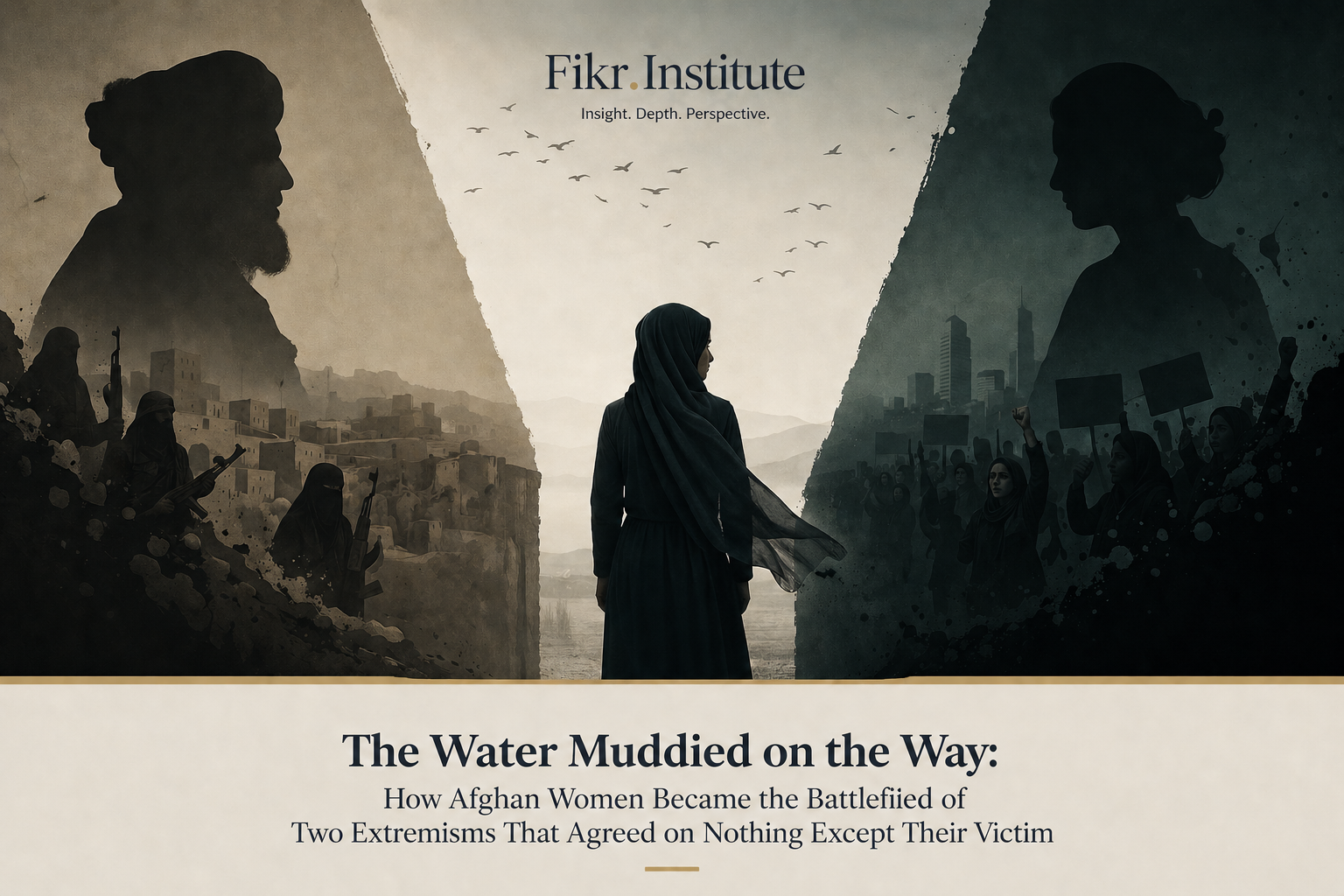
Abstract:
The Prophet Muhammad, peace be upon him, commanded that seeking knowledge is an obligation upon every Muslim. Fourteen centuries of Islamic scholarship have never restricted that obligation by gender. Fatima al-Fihri, a Muslim woman, founded the oldest continuously operating university in the world in 859. Al-Azhar has educated women since the tenth century. The Taliban`s ban on girls` education above grade six has no foundation in any of this. What it has is a foundation in history, and that history did not begin in 2021 or 1996 or even 1979. It began when Babur killed Ibrahim Lodi at Panipat in 1526, ended Pashtun rule over the subcontinent, and set in motion a chain of deliberate suppressions whose final link is a government in Kabul banning girls from secondary school while invoking the name of a civilization those suppressions were designed to destroy. Between that first suppression and this current one, Afghan women have been the instrument of every political project that passed through this land. Mughal emperors used them by denying their communities education that might restore Pashtun political power. British colonial administrators used them by leaving the tribal belt without schools for three centuries. Amanullah Khan used them by attaching forced unveiling to the idea of their liberation. Zahir Shah used them across forty years of royal government by making Western dress the price of a university seat. The communist government used them as proof of socialist virtue. The Mujahideen used them as proof of communist corruption. The American era used them as a symbol of the modernity its presence was supposedly delivering. The Taliban uses them now as the line behind which it defends everything the previous six cycles attacked. In every case the women were not the authors of their situation. They were its terrain. This article does not excuse the ban. It explains where the ban actually came from, because a wound treated at the wrong point heals nothing.
Main Article:
Start with what Islam actually says.
The Prophet Muhammad, peace be upon him, did not say seeking knowledge is an obligation upon every Muslim man. He said every Muslim. Fatima al-Fihri built the University of al-Qarawiyyin in Fez in 859. It is still operating. Al-Azhar educated women from its founding. The major schools of Islamic jurisprudence have never produced a ruling that prohibits women`s education. This is not a contested point within Islamic scholarship. It is settled.(1)
So the Taliban`s ban is not an Islamic position. It is a historical one. And the history that produced it is longer and more complicated than the people who criticize the ban, and the people who enforce it, usually acknowledge.
It begins in 1526.
At the First Battle of Panipat on April 21 of that year, Babur killed Ibrahim Lodi on the battlefield. Ibrahim Lodi was a Pashtun. He was the last sultan of the Delhi Sultanate, the dynasty through which Afghans had governed the subcontinent. When he died, Afghan political power over the region died with him, and a Mughal empire took its place that had every strategic reason to ensure it would not revive. The Mughals were not going to educate the people they had just defeated into the capacity to defeat them again.(2)
The Pashtun Sur dynasty proved the threat was real. Sher Shah Suri defeated Humayun at Chausa on June 26, 1539, and routed him again at Kannauj on May 17, 1540, taking back everything Babur had won. The Sur Empire built the Grand Trunk Road, standardized currency, and created an administrative system so effective that Akbar copied it after the Mughals returned. These were not backward people. They were a civilization capable of governance at the highest level. When Mughal power was restored permanently after Sher Shah`s death, it faced a specific and documented problem: how do you govern a population that has just proved it can build empires?(3)
You do not educate them.
Two figures emerged from the centuries of Mughal suppression that followed, and both of them demonstrate what Pashtun learning could produce when it was not systematically prevented.
Pir Roshan, Bayazid Khan Ansari, born around 1525, created the Pashto alphabet from nothing. Before him, Pashtuns had no written script for their own language. He gave them one, then used it to build a literature, a spiritual movement, and an armed resistance simultaneously. He wrote in Pashto, Persian, and Arabic. His Roshaniyya movement spread across Pashtun territories for a century after his death. The Mughals brought religious scholars against him, then armies. They killed him and most of his sons. His youngest son continued the movement. His followers resisted in Waziristan, Kurram, Tirah, and Nangarhar for a hundred years after he was gone. The Soviet Union assigned its orientalists specifically to study the Roshaniyya movement before it invaded Afghanistan, because what Pir Roshan had built still shaped the region`s culture four centuries later.(4)
Khushal Khan Khattak, born 1613, was a tribal chief, warrior, Islamic scholar, and the greatest poet in the Pashto language. He wrote over 200 works, over 45,000 poems, covering jurisprudence, philosophy, medicine, ethics, falconry, and politics. He translated Arabic and Persian legal texts into Pashto so that ordinary Pashtuns could access Islamic scholarship without going through imperial institutions that served imperial interests. He organized resistance against Aurangzeb. He asked to be buried where the dust of Mughal horses` hooves would not fall on his grave. The Tarikh-e-Marsa records that he had 32 daughters. Pashtun historical tradition, preserved in Pashto-language scholarship, records that he educated them, and that several of his children became his literary successors in the tradition he built. A man who translated Islamic jurisprudence into Pashto so that his people could reach their own religion educated his daughters so that they could reach it too. The man who did this under Mughal occupation is now the national poet of a country whose government bans their descendants from secondary school.(5)
The British did not improve on the Mughals in this respect. The Northwest Frontier Province and the tribal belt received almost no formal educational investment from the colonial administration. The tribal social structure was useful as a managed buffer zone. Educated populations ask questions. The first modern school in Afghanistan, the Habibiya in Kabul, opened in the last decade of the nineteenth century. The regions that would become Afghanistan`s rural and tribal heartland entered the twentieth century carrying three hundred years of deliberate educational deprivation. The water had been blocked at every channel before it ever reached them.(6)
Then the water started flowing again. But someone muddied it on the way.
Amanullah Khan won Afghanistan`s full independence from Britain in 1919 and genuinely wanted his country to develop. His six-month tour of Europe in 1927 and 1928 gave him ideas his society was not prepared to receive in the form he intended to deliver them. He came back and made Western dress mandatory for men in government. He prohibited women from wearing the hijab on specific roads. He changed Friday to a working day. He sent his wife Queen Soraya unveiled to public events and required other women to appear without the veil in official gatherings. He did all of this while most Afghans could not afford basic food. The Shinwari uprising that toppled him listed ten grievances, five of them directly related to his policies on women. The grievance was not women`s education. It was the bundle. It was being told by your government that your daughter could attend school only if she abandoned the visible expression of her faith. Rural Afghans who had been denied schools for three centuries were now offered them at a price they experienced as an attack on everything the schools had not managed to destroy.(7)
Nadir Shah replaced Amanullah and closed all girls` schools. His son Zahir Shah, who ruled for forty years from 1933 to 1973, reopened them gradually. And here is where the story is most badly told in the Western accounts that now circulate photographs of Kabul women in Western dress as evidence of what Afghanistan once was and could be again.
What those photographs show is Kabul. A small urban elite concentrated in the capital. The Origins journal at Ohio State University confirmed in its history of Afghan women`s rights that the modernization of the Zahir Shah era was confined to a very small urban population primarily around Kabul. But the photographs do not show what the policy attached to that modernization cost the majority who are not in them. Afghan women who wished to attend secondary schools, universities, or enter the formal job market during the 1960s and 1970s were required in practice to adopt Western dress and present themselves without hijab. This was not a formal written law in every case. It was a social and institutional requirement enforced by the environment of those institutions. The choice presented to Afghan women was not between education and ignorance. It was between their Islamic identity and their educational access. H.R. McMaster, Trump`s National Security Adviser, showed Trump photographs from this exact era in 2017 to argue for continuing the American occupation. The photographs were real. The story they were used to tell was not.(8)
Across four decades of Zahir Shah`s reign, through the republic that followed, into the communist government that came after it, this association was confirmed and deepened. The communist government sent literacy workers into purdah villages with programs that required women in traditional seclusion to participate in mixed ideological sessions. The Mujahideen resistance, armed and funded by the CIA and ISI, made women`s education a symbol of communist moral corruption. An entire generation of fighters was organized around the conviction that girls in school meant something was being done to their culture rather than for their daughters. When those fighters became the Taliban, they carried that conviction into government.(9)
The American era did not break the pattern. In the cities, in universities, in government offices, and on screens that reached rural areas, Western cultural norms were promoted and visibly associated with the foreign military presence. Rural and traditional Afghans who watched this, many of whom had lived through the communist version of the same experience, drew the same conclusion their fathers had drawn. The association was not invented by the Taliban. It was confirmed by six consecutive political cycles in which women`s formal access to education and professional life arrived packaged with demands that their communities experienced as cultural warfare.(10)
The Taliban that returned in 2021 is not one thing on this question. Multiple senior figures, including members of the political commission, have expressed preference for allowing girls` education within Islamic frameworks. The faction that holds the ban in place is the one whose authority comes from the communities that lived through all six cycles most directly. They are not following Islamic law. No senior Islamic scholar anywhere in the world has produced a ruling supporting the ban. What they are following is a wound that has been reopened six times in a hundred years, each time by a government that used women`s bodies and women`s dress and women`s visibility as the instrument of its political project, whatever that project happened to be.
The Islamic tradition that Khushal Khan Khattak served, the tradition he translated into Pashto so that his own daughters could reach it, is unambiguous. Knowledge is an obligation. It has no gender. The oldest university in the world was built by a Muslim woman. The ban contradicts this tradition completely.
But the ban did not come from the tradition. It came from what was done to the people who should have been taught that tradition across five centuries of deliberate, strategic, and sometimes well-intentioned suppression of their capacity to learn anything at all.
The water was muddied upstream. That is where it needs to be cleaned.
References:
(1) Radio Free Europe / Radio Liberty, "Islam Does Not Ban Girls` Education. So Why Does the Taliban?" August 14, 2023; Wikipedia, "University of al-Qarawiyyin," updated 2026; Middle East Council on Global Affairs, "Women`s Education: Cultural and Religious Solutions from the Heart of Afghanistan," November 2025.
(2) Wikipedia, "Battle of Panipat (1526)," updated 2026; Wikipedia, "Ibrahim Lodi," updated 2026; Britannica, "Delhi Sultanate," updated 2026.
(3) Wikipedia, "Sher Shah Suri," updated April 2026; Britannica, "Sher Shah of Sur," updated March 2026; Wikipedia, "Battle of Chausa" and "Battle of Kannauj," updated 2026.
(4) Wikipedia, "Pir Roshan," updated February 2026; Grokipedia, "Bayazid Ansari: Pir Roshan," January 2026; The Asian Mirror, "Who Is Founder of Pashto Script Pir Roshan," November 2022.
(5) Wikipedia, "Khushal Khattak," updated February 2026; Pashto Poetry and Prose, "Khushal Baba," November 2020, citing Tarikh-e-Marsa on 32 daughters; alamahabibi.net, "Khushal Khan Khatak," confirming children as literary successors; Goodreads, Paul Smith translation, "Khushal Khan Khattak: The Great Warrior Poet," confirming 57 sons and 30 daughters; Pashto-language historical tradition on daughters` education as preserved in Afghan and Pakistani scholarly sources communicated to the author.
(6) Middle East Council on Global Affairs, op. cit.; Wikipedia, "Habibiya High School," updated 2026.
(7) Wikipedia, "Amanullah Khan," updated April 2026; Sustaine, "A Reflection on the Failure of the First Renovation Process in Afghanistan," July 2025; Wikipedia, "Afghan Civil War 1928-1929," updated February 2026.
(8) Origins Ohio State, "The Long, Long Struggle for Women`s Rights in Afghanistan"; The National, "The Dream of a Secular Afghanistan Still Holds Power," July 2021, confirming H.R. McMaster showed Trump 1972 Kabul photographs to justify continued occupation; Wiley Online Library, "75 Years of Women Representation in Afghanistan," 2024.
(9) Radio Free Europe / Radio Liberty, op. cit.; LSE Public Policy Review, "The Rise and Fall of Women`s Rights in Afghanistan," May 2022; Wikipedia, "Women in Afghanistan," updated April 2026.
(10) Origins Ohio State, op. cit.; Ajam Media Collective, "The Weaponization of Nostalgia," 2017. Note: The assessment of how promotion of Western cultural norms in cities, universities, and government offices during the American period deepened the association between women`s education and cultural imposition among rural and traditional communities is based on the analytical pattern confirmed across the six historical cycles described, and is consistent with documented accounts of how Taliban commanders characterized the American period in recorded interviews.