
Abstract:
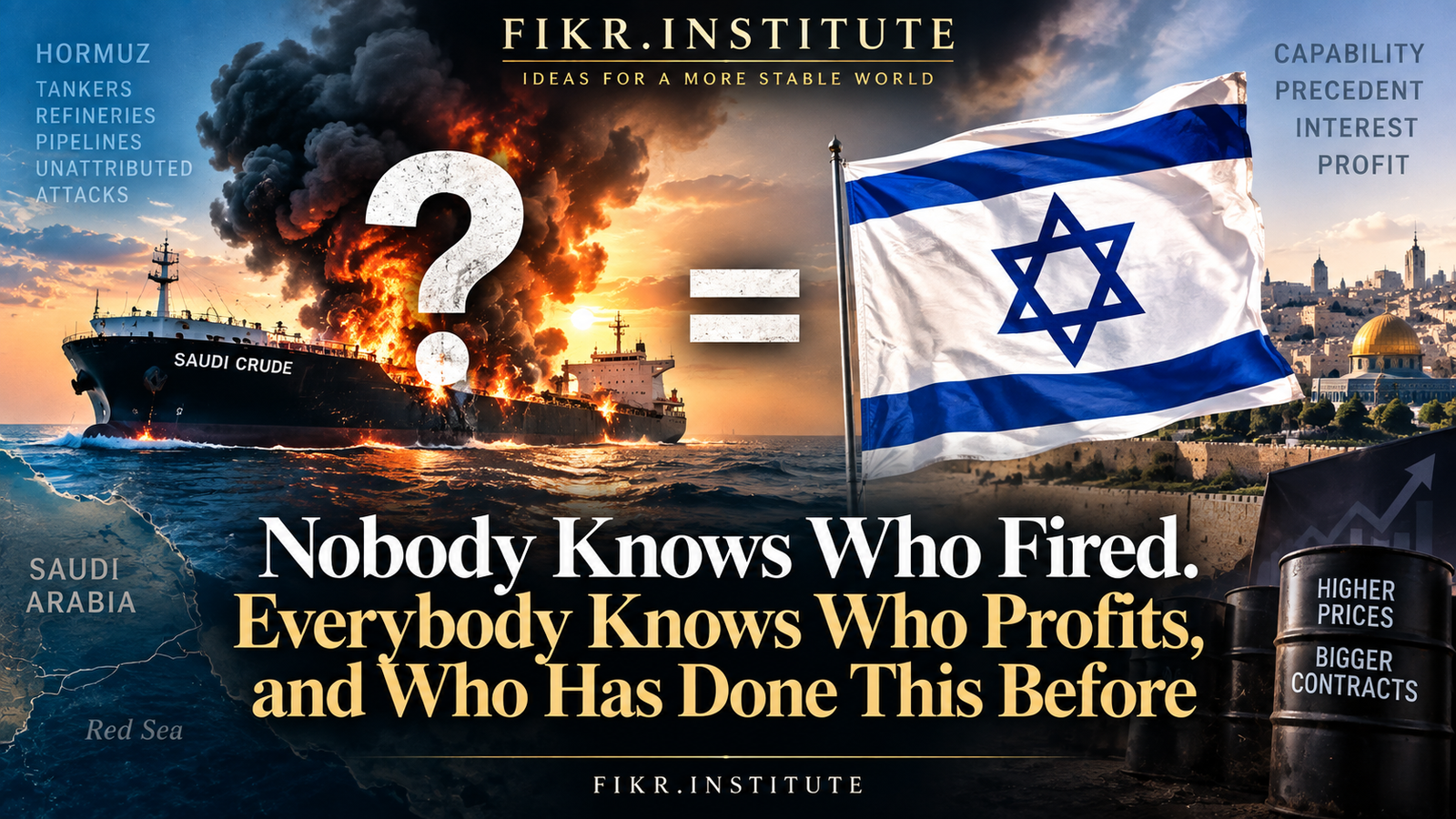
Since March 2026, some of the most consequential attacks on Saudi energy have had no confirmed author. Iran denied striking the Ras Tanura refinery and its officials blamed Israel; Riyadh blamed no one. Drones that shut the East West pipeline were launched from Iraq, with no faction named. Two supertankers loaded with Saudi crude were hit by unidentified projectiles in the Strait of Hormuz. Each attack has deepened hostility between Muslim states, while tanker owners and the suppliers of replacement munitions collect the revenue. This article sets these attribution gaps against three questions: who is able to act, who has done this before, and who benefits. It documents two secret Israeli military sites in the Iraqi desert reported this year, the Lavon Affair of 1954 in which Israeli agents bombed Western targets in Egypt to be blamed on Egyptians, and a consistent Israeli interest in a weaker Saudi Arabia. The evidence does not establish that Israel carried out any of these attacks. It does establish that no honest investigation of them can leave Israel out.
Main Article:
When an attack has no author, the first question is who was able to carry it out. The second is who has done it before.
On 1 September, two supertankers, the Saudi flagged Sidr and the Liberian flagged Senegal Prosperity, each loaded with about two million barrels of Saudi crude from the Juaymah terminal, were struck by projectiles near Khasab in the Strait of Hormuz. [1] No state or group claimed the attack, and none has been identified. [1] It is one of a series.
On 2 March, the Ras Tanura refinery halted processing after a drone attack. An Iranian military source denied that Aramco facilities had been among its targets, and Iranian officials called the strike an Israeli false flag. [2] The Iranian ambassador in Riyadh repeated that if Tehran had been responsible, it would have announced it. [3] The Saudi defence ministry blamed no one. [3] On 11 September, drones struck the East West pipeline, the route built to carry Saudi crude around Hormuz, and Riyadh said they had been launched from Iraq. [4] Iraqi forces later seized a launching platform in Maysan province, near the Iranian border, a region where Iran aligned militias have long been present, but Baghdad has named no faction and no operator. [5] On 15 September, the Saudi led coalition said it destroyed a drone south of Makkah; the Houthis denied targeting the city. [6]
Four attacks. Four accounts in dispute. One direction of effect.
Each strike has pushed Muslim states further apart. Riyadh is now at open war with the Houthis and has traced drones to Iraqi soil, while the drone near Makkah turned a regional conflict into a question of the holiest city in Islam. Whoever fired, the result has been the same: Muslim states spending their money, their missiles and their credibility on each other.
The revenue from that result is measurable. Reuters reports that benchmark supertanker freight has passed $30 a barrel, a record, and that freight now accounts for more than a quarter of the cost of crude, against two to three per cent before the war. [7] One analyst described it as "one of the biggest wealth transfers from oil producers to tanker owners." [7] More than $20 billion of new supertankers have been ordered this year, the largest buying spree in 25 years. [8] The Congressional Budget Office puts the direct American cost of the war at $38 billion by 1 August, rising by $3 billion or more each month, most of it for the replacement of munitions and equipment. [9] That money is paid by taxpayers and received by the manufacturers who replace what was fired.
Profit does not prove authorship. Capability comes closer.
The Wall Street Journal has reported that Israel had built and defended a secret military site in the Iraqi desert near Najaf, close to the Saudi border, housing special forces and a logistics hub for its air force, established before the war on Iran began. [10] A senior Iraqi official later said Iraq had been "subjected to an American deception." [10] The New York Times later reported a second covert site in the western desert near Nukhaib, which Iraqi officials confirmed. [11] Israel has not commented on either. [10][11] The drones that struck the Saudi pipeline were launched from Iraq. Israel is the foreign state documented this year as having run covert military sites on Iraqi soil.
The record of the past points the same way. In the summer of 1954, an Israeli military intelligence cell in Egypt planted bombs at American and British cultural and information centres in Cairo and Alexandria. The purpose was to have the attacks blamed on Egyptians and so keep British forces at Suez. [12] The operation failed, the network was exposed, and in 2005 the Israeli president publicly honoured its surviving members. [12] That was a state attacking the property of Western powers in order to turn them against an Arab government.
False attribution has opened wars before. On 4 August 1964, Washington reported a second North Vietnamese attack on American destroyers in the Gulf of Tonkin, and Congress authorised war three days later. A history later declassified by the National Security Agency concluded that the second attack did not happen. [13] The war was fought on an account of who fired that was false.
The interest is also on the record. When the United States moved this month to sell F 35 jets to Saudi Arabia, officials in Tel Aviv voiced concern, [14] and the Israeli military had earlier submitted documents to its political leadership opposing the sale on the grounds that it could erode Israeli air superiority. [15] A Saudi Arabia that is strong is treated in Tel Aviv as a threat to be limited. A Saudi Arabia at war with its neighbours, cut off from its export routes and fighting over the skies of Makkah, is not a threat to anyone.
Capability, precedent and interest do not make a verdict. The launching platform in Maysan was found in an area where Iran aligned factions operate, and the Houthis and Iran each carry their own record of attacks on Saudi targets. The evidence available does not establish that Israel carried out any of the attacks examined here, and Fikr Institute neither asserts nor rejects that it did. What the evidence does establish is that of all the states able to strike Saudi energy without leaving a signature, one has been reported this year running covert sites inside Iraq, and the same state has a documented history of attacking American and British property so that an Arab state would take the blame.
When an attack has no author, the question is who was able to carry it out, and who has done it before. Every attribution in this war has been contested. Israel answers both questions.
It is the judgement of Fikr Institute that Israel has the means, the documented precedent and the strategic interest to carry out attacks designed to set Muslim states against one another, and that it is the state actor most capable of doing so in this war. The companies that sell replacement munitions and charter the tankers profit from every strike, whoever fires it. Any investigation of these attacks that does not examine Israel is not an investigation. It is a decision about whom to blame.
References:
1. Korea Herald, "Two Tankers Carrying Saudi Oil Attacked in Strait of Hormuz," September 1, 2026.
2. The Maritime Executive, "Iran Denies Involvement in Strike on Saudi Arabia Ras Tanura Refinery," March 2026. Note: Iranian claim of an Israeli false flag is an assertion by an interested party and has not been independently verified.
3. Al Jazeera, "Iran Ambassador to Saudi Arabia Denies Attacks on Its Oil Facilities," March 15, 2026.
4. Al Jazeera, "Saudi Arabia Says East West Pipeline Hit by Drones Launched from Iraq," September 11, 2026.
5. Al Jazeera, "Iraq Seizes Drone Launching Platform Used for Targeting Saudi Oil Pipeline," September 13, 2026.
6. Middle East Eye, "Pakistan Says Time Has Come to Implement Mecca Defence Pact," September 17, 2026.
7. Reuters, Ron Bousso, "Hormuz Shuttles Keep Oil Flowing, but at a High Cost," September 21, 2026.
8. Baird Maritime, "VLCC Orders Top $20b in Biggest Buying Spree in 25 Years," September 2026.
9. PBS NewsHour, "Iran War Has Cost the U.S. More Than $38 Billion So Far, Budget Office Says," September 16, 2026.
10. Al Jazeera, "A Secret Israeli Base in Iraq? What We Know," May 12, 2026, citing The Wall Street Journal.
11. Kurdistan24, "Israeli Second Secret Base in Iraq Revealed by New York Times," May 2026.
12. Jewish Virtual Library, "The Lavon Affair."
13. National Security Agency, "The Gulf of Tonkin Mystery: The SIGINT Hounds Were Howling," declassified December 2005.
14. France 24, "US Approves $24.3 Billion Sale of 48 F 35 Warplanes to Saudi Arabia," September 18, 2026.
15. Stars and Stripes, "Trump Administration Advances $24 Billion F 35 Sale to Saudi Arabia," September 18, 2026, citing Ynet.