
Abstract:
On 30 July 2026, tens of thousands of migrants surged into the Spanish enclave of Ceuta from Morocco and at least 34 died, many by drowning. This article looks past the official account to timing and benefit. The surface trigger was real: a Spanish court ruling ended summary returns, and smuggling networks exploited it. But the deeper question is why the border collapsed when it did, and who was served. Under Sanchez, Spain had become Europe leading critic of Israel, recognizing Palestine, calling Gaza a genocide, and defying Washington over the Iran war. Months earlier, an Israeli outlet published an explicit call for Israel to help Morocco seize Ceuta to punish Spanish defiance. When the border broke, Israel UN ambassador celebrated the catastrophe and demanded Spain surrender the enclaves, and a Spanish minister replied that it was becoming clear. Assembled, these documented facts render the coincidence explanation implausible. It does not claim to prove an order was given. It argues a Muslim state turned the desperation of Muslim migrants into a weapon serving Israeli pressure against the one Western country that broke ranks over Palestine, coercion for a world that watches only for armies.
Main Article:
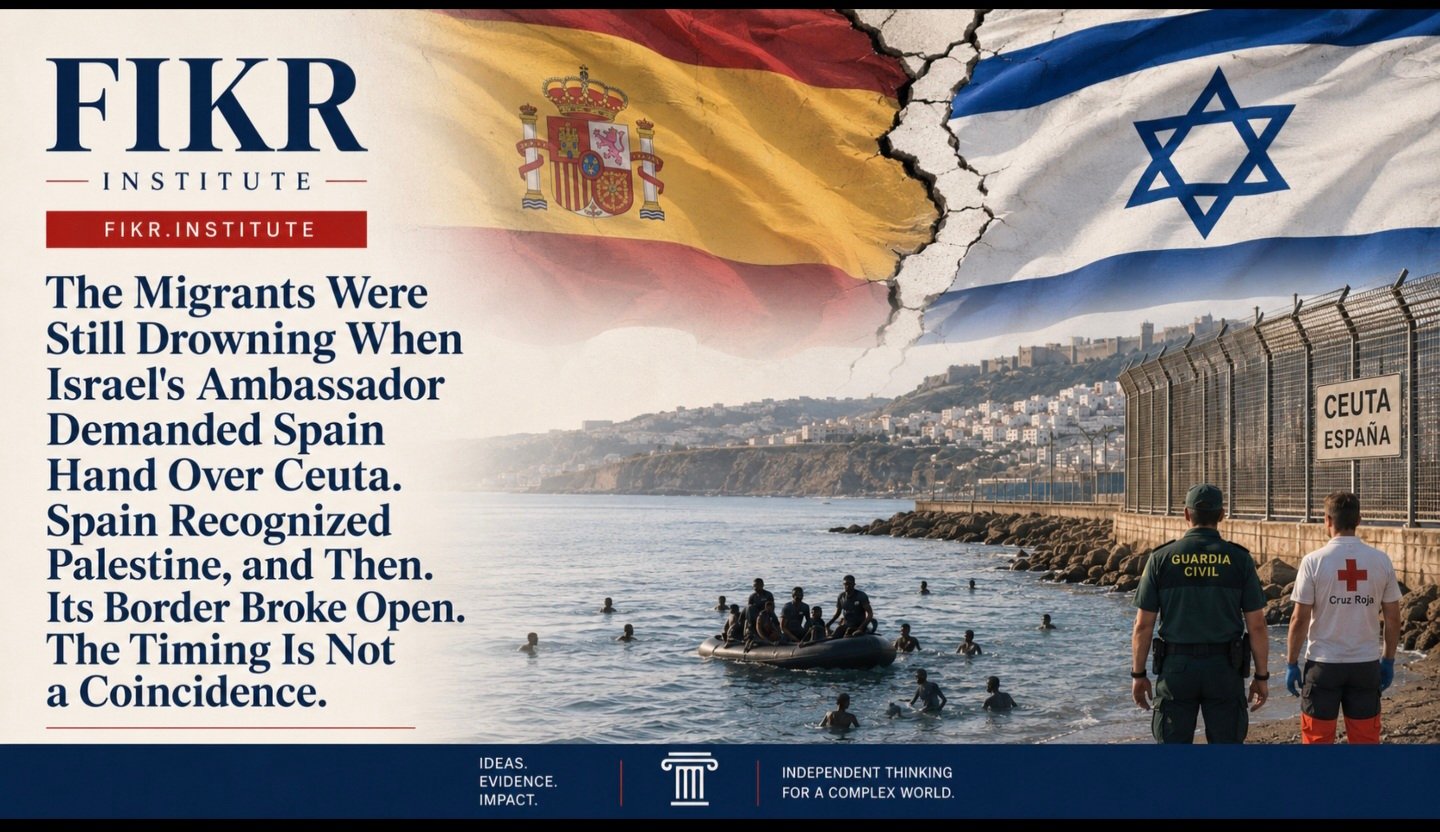
The migrants were still in the water, some of them drowning, when the ambassador of Israel reached for the moment. Thirty four people would die in the crossing into Ceuta on the thirtieth of July 2026, many of them swept under while swimming around the border breakwater, and as the bodies were being counted the Israeli representative to the United Nations, Danny Danon, posted to the world that Spain, which never misses an opportunity to lecture Israel, had declared an emergency over its own borders, and that perhaps before it lectured anyone further it should explain why it still maintains colonial enclaves in Africa. He was calling, in the hour of Spanish catastrophe, for Spain to surrender Ceuta and Melilla. The dead were not yet buried, and a foreign government was using them to demand Spanish territory.
That post is the thread. Pull it, and the whole shape of what happened at Ceuta begins to come apart in the hands, and what is underneath is not a story about migration at all.
Start with the surface, because the surface is real and must be acknowledged. In early July 2026, the Spanish Supreme Court ruled that migrants intercepted at sea could no longer be summarily returned to Morocco, which removed the deterrent that had held the numbers down, and smuggling networks spread the word that the door to Ceuta had effectively opened. Prime Minister Sanchez blamed the traffickers. On the Moroccan side, border guards who for years had blocked these crossings were, by numerous accounts, suddenly absent from the gates, and tens of thousands walked and swam through in a single day, more than half the population of the enclave arriving in hours. This is the official story, and every piece of it is true, and it explains the mechanism of the surge without explaining the thing that matters, which is the timing. A mechanism tells you how a thing was possible. It does not tell you why it happened precisely when it did.
So ask the question this publication asks of every major event, the question the surface account is designed to leave unasked. Why now. What had changed in the days and weeks before the border collapsed, and who was served by its collapse.
What had changed was that Spain had broken ranks. Under Sanchez, Spain had become one of the sharpest European critics of Israel through the Gaza war, recognizing the state of Palestine, backing sanctions on Israeli officials, describing the conduct in Gaza as genocide, and moving to restrict its ports and airspace to the machinery of the wars Washington and Israel were prosecuting. Spain had, in the language of alliances, defected. It had taken the side its patrons had told it not to take, and it had done so loudly, at the United Nations and in the European councils, becoming the most visible Western dissenter on the two wars that mattered most to Washington and to Israel.
And Spain had been warned. This is the part the surface account cannot absorb, because it turns coincidence into sequence. Months before the border broke, in April 2026, an article appeared in the Israeli outlet Ynet, written by a Moroccan fellow of a pro Israeli think tank, calling openly for Israel to help Morocco recover Ceuta and Melilla, so that the United States and Israel could, in the writer own words, punish a NATO member that had repeatedly chosen obstruction. The weaponization of Ceuta against Spain was proposed in print, in an Israeli publication, as a tool to punish Spanish defiance, months before the migrants crossed. The idea was not invented after the fact by conspiracy theorists. It was published in advance by the people who wished to see it done.
Now the sequence assembles itself, and every link in it is a documented fact rather than a supposition. Spain defies Washington and Israel over Gaza and Iran. Israeli aligned voices publish calls to weaponize Ceuta against Spain as punishment. The border then collapses, through a valve that Morocco controls and has opened before for exactly such purposes. And in the moment of collapse, the ambassador of Israel publicly celebrates the Spanish catastrophe and demands, precisely as the April article had urged, that Spain give up the enclaves. The thing that was proposed as a punishment happened, and the party that had proposed it stood up in the hour it happened to claim the prize it had named in advance. One does not need to have witnessed an order given to read a sequence this clean. The convergence is the evidence.
Spain itself saw it. When Danon posted his taunt, the Spanish transport minister, Oscar Puente, quoted it back and replied that it all seemed to be becoming quite clear. A sitting minister of the Spanish government, watching the Israeli ambassador demand Spanish territory in the middle of the border crisis, said in public that the picture was clarifying. Spanish commentators went further, one reviving a years old post by the Israeli prime minister son that had referred to Israeli support for separatist movements in the enclaves, and asking whether the migration pressure was revenge against Sanchez that all Spaniards were paying for. The Spanish political class was reading the same sequence, and naming it, while the prime minister himself stayed carefully vague, because a prime minister who cannot yet prove a thing cannot afford to say it, and must speak of traffickers while his ministers speak of what is becoming clear.
Here the analysis must be disciplined, because the strength of the case lies precisely in not overstating it. There is no document proving that Israel or the United States ordered Morocco to open the border. That order, if it was given, was given in a room no journalist was in. What exists instead is the convergence, and the convergence is composed entirely of established facts: the Spanish defiance, the published calls for punishment, the controlled valve, the timing, the celebration, the demand for the enclaves, the Spanish minister saying it is becoming clear. Each of these is real. Laid in sequence, they do not prove a conspiracy in the way a court demands proof. They do something that in the reading of world affairs matters more, which is to render the innocent explanation, the explanation of pure coincidence, so improbable that it collapses under its own weight. A border that fails by accident does not fail the week the punishment was due, through the valve of the state that was urged to open it, to the public delight of the power that urged it. Too many things arrive on cue.
And there is a bitter inversion at the center of this that must be named, because it is the moral fact the geopolitics is built on. Morocco is a Muslim state, and the people it released into the sea were Muslims, the poor and the desperate of North Africa, and the pressure their bodies were used to apply served, in the end, the interests of Israel against a European state whose crime was to have stood up for Palestine. A Muslim government turned the desperation of Muslims into a weapon aimed at the one Western country that had broken with Israel over the killing of Muslims in Gaza. Spain, which is not Muslim, had recognized Palestine and called Gaza a genocide. Morocco, which is Muslim, opened its border to punish Spain for it. The migrants drowning around the Ceuta breakwater were the ammunition in a transaction whose beneficiary was the state their own governments claim to oppose. That is the shape of the thing, and it is uglier than any simple story of migration, because it reveals how thoroughly the desperation of the powerless can be converted into currency by the powerful, and how a shared faith offers no protection at all when a client state is doing a patron bidding.
Who benefits, then, the question that unlocks every event of this kind. Morocco benefits, gaining leverage over Spain and a demonstration to all of Europe that it holds the migration valve. But Morocco is the instrument, not the author, and the deeper beneficiary is the party that Spain had defied and that stood up to celebrate the moment the blow landed. The United States and Israel had watched a NATO member break ranks on Gaza and on Iran, and they had signaled, through their aligned voices, that this defiance would be punished. The punishment arrived in the form of a border catastrophe that no one could formally pin on them, delivered through a client state that could absorb the blame, against a target that would find no forum in which to accuse anyone, because how does a state file a complaint that its neighbor opened a gate. It is deniable, it is unattributable, and it lands exactly where the defiance came from. It is coercion built for a world that watches only for armies, and it wears the face of a humanitarian accident.
The migrants were still in the water when the ambassador reached for the moment, and that reach told the truth that the official story conceals. A government does not celebrate a catastrophe it did not want. Danon reached for Ceuta because Ceuta had, at that moment, become useful to Israel, a blow landing on an enemy at the hour of that enemy need, and his glee was the involuntary confession that the blow was welcome and its target correctly chosen. Spain broke ranks over Palestine, and its border broke open, and the ambassador of the state Spain had defied demanded its territory over the bodies in the water. The court ruling was the mechanism. The punishment was the point. And the dead were Muslims, spent by a Muslim state, to serve the power that their deaths were supposed to be a protest against.
References:
1. JNS and the Cleveland Jewish News, "Danon Accuses Spain of Hypocrisy After It Deploys Military to Moroccan Enclave," 30 July 2026. Citing the verbatim post by Israeli UN Ambassador Danny Danon stating that Spain never misses an opportunity to lecture Israel and demanding it explain why it maintains colonial enclaves in Africa, dated 30 July 2026, and the context of Spanish recognition of Palestine and sanctions on Israeli officials.
2. Anadolu Agency, "Spanish Politicians, Commentators Accuse Israel of Stirring Chaos Over Ceuta Migration Crisis," 31 July 2026. Citing the response of Spanish Transport Minister Oscar Puente quoting Danon and replying that it all seemed to be becoming quite clear, the commentary of Carolina Alonso alleging Israeli retaliation for Madrid stance on Gaza, and the revival by journalist Jose Vizner of a post referring to alleged Israeli support for separatist movements in the enclaves.
3. Reporting on the Ynet article of April 2026 by a Moroccan Middle East Forum fellow calling for Israel to help Morocco recover Ceuta and Melilla so that the United States and Israel could punish a NATO member that had chosen obstruction, as documented in contemporary coverage of the diplomatic exchange.
4. CNN, Time, and Al Jazeera, 30 and 31 July 2026. Citing the scale of the crossing with tens of thousands entering Ceuta and at least 34 dead, the early July Spanish Supreme Court ruling ending summary returns of migrants intercepted at sea, Prime Minister Sanchez blaming trafficking networks, and the deployment of Spanish and Moroccan security forces.
5. Documentation of the May 2021 precedent in which Morocco loosened border controls and roughly 10,000 people entered Ceuta amid a Western Sahara dispute, establishing the migration valve as an instrument Morocco has previously opened and closed for political effect.