
Abstract:
The Protestant Bible contains 66 books. The Catholic Bible contains 73. The Eastern Orthodox Bible contains 76. The Ethiopian Orthodox Bible contains 81. These are not four translations of the same text. They are four different collections of texts, each decided by a different council of human beings at a different moment in history, often at a moment when political power required a specific theological conclusion. The seven books Martin Luther removed from the Protestant Old Testament in the 16th century included 2 Maccabees, which contains the most direct scriptural justification for the Catholic doctrine of purgatory he was politically and theologically attacking. The King James Bible of 1611 was commissioned by a king who called the most popular existing English Bible's marginal notes seditious because they suggested bad rulers could be challenged, and who ordered the new translation published without any such notes. The Council of Trent formalized the Catholic canon of 73 books in 1546 not as a timeless theological declaration but as a direct institutional response to the Protestant Reformation that had just split Christendom. In April 2026, Donald Trump posted AI-generated images of himself appearing as Jesus Christ, his Secretary of War recited a monologue from a Quentin Tarantino film as scripture at a Pentagon prayer service, his spiritual advisor compared him to the crucified Christ at a White House Easter event, and the Pope responded from Cameroon with the most direct condemnation of the manipulation of God's name for political and military gain that a sitting pontiff has delivered in the modern era. These are not disconnected events. They are the latest expression of the oldest pattern in the history of the Biblical text: those who hold power have always shaped what the text says, what it means, and whose interests it serves.
Main Article:
The text that survives is not always the text that was written. What survives, across millennia of councils, translations, reformations, and royal commissions, is what power decided should survive, stripped of what power decided was dangerous, and interpreted through frameworks that power decided were orthodox.
This is not a conspiracy. It is the documented history of the most widely distributed book in human civilization.
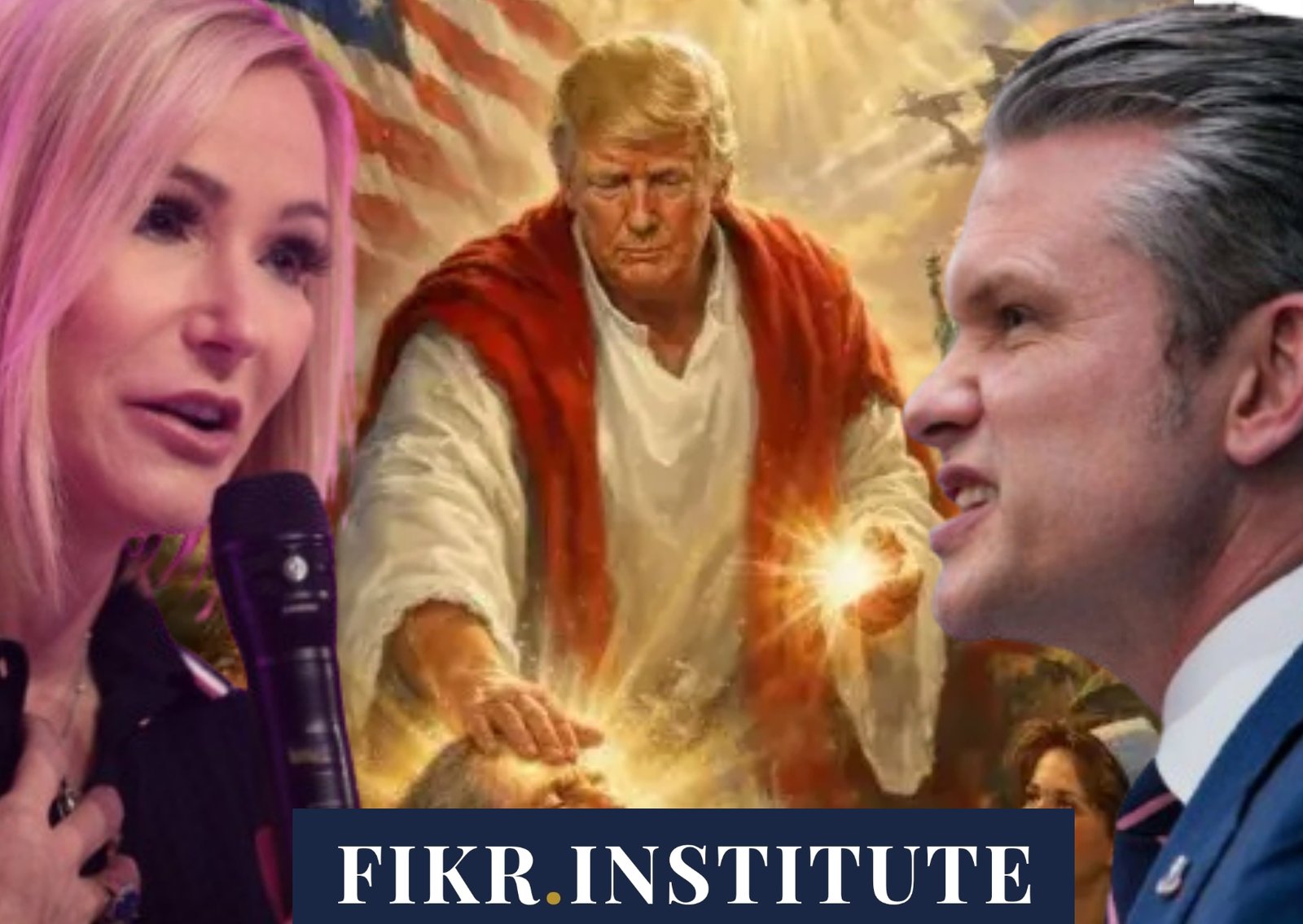
In the week of Easter 2026, the pattern announced itself with unusual visibility. On Easter Sunday, the President of the United States posted to his Truth Social account an artificial intelligence generated image of himself appearing as Jesus Christ. He later claimed the figure in the image was a doctor. He then posted a second image in which Jesus, arms draped around the President's shoulders, embraced him against a background of the American flag. "The Radical Left Lunatics might not like this," he wrote, "but I think it is quite nice." (1) At the Pentagon two days later, the Secretary of War conducted a worship service at which he recited, as holy scripture, a monologue written by Quentin Tarantino for a 1994 film about professional assassins. The monologue, delivered in the film by a hitman seconds before he shoots a man to death, is attributed in the film to the Book of Ezekiel. The actual Book of Ezekiel 25:17 reads, in the King James translation: "And I will execute great vengeance upon them with furious rebukes; and they shall know that I am the Lord." The Tarantino version, which the Secretary of War read as prayer in an official government ceremony, was itself adapted from a 1973 Japanese martial arts film called Bodyguard Kiba. (2) The Secretary of War then held a press conference at which he called journalists Pharisees and compared the President to Jesus, whose miracles the Pharisees had witnessed and whose goodness they had explained away in pursuit of their agenda. (3) At a White House Easter lunch, the President's spiritual advisor, who leads the official White House Faith Office, told the President to his face: "No one has paid the price like you have paid the price. It almost cost you your life. You were betrayed and arrested and falsely accused. It's a familiar pattern that our Lord and Savior showed us." (4)
From Bamenda, in Cameroon, Pope Leo XIV said: "Blessed are the peacemakers. But woe to those who manipulate religion and the very name of God for their own military, economic and political gain, dragging that which is sacred into darkness and filth." (5)
The Bishop of Rome does not issue statements like this as political commentary. He issues them when the principle that scripture possesses authority independent of political power is being visibly threatened at a scale that institutional silence would itself become a statement.
To understand why the Pope said what he said, and what it reveals, it is necessary to understand what the historical record of the text he is defending actually shows.
There is no single Bible. There are many Bibles.
The Protestant Bible, used by the majority of Christians in the English-speaking world, contains 66 books. The Roman Catholic Bible contains 73 books. The Eastern Orthodox Bible contains 76 books. The Ethiopian Orthodox Bible, representing the oldest continuous Christian tradition in Africa and one of the oldest in the world, contains 81 books. Each of these institutions claims its Bible is the authoritative Word of God. Each of them disagrees with the others about which words are in it. (6)
The seven books that appear in the Catholic Bible but not in the Protestant Bible are Tobit, Judith, First and Second Maccabees, the Wisdom of Solomon, Sirach, and Baruch. They were present in the Greek Septuagint, the version of the Old Testament used by early Christians for the first several centuries of the faith. They were present in the Latin Vulgate, which was the Bible of Western Christianity for over a thousand years. They were removed from the Protestant canon in the 16th century, not through a discovery of new manuscripts, not through advances in textual scholarship, but through a decision made in the middle of one of the most violent political and theological confrontations in European history.
Martin Luther, whose Reformation launched that confrontation, removed the Deuterocanonical books from the Protestant Old Testament and placed them in a separate section he labeled books that are not equal to scripture but useful and good to read. His theological argument was that these books were not present in the narrower Hebrew canon. His political argument was inseparable from the theological one. Second Maccabees 12:43 to 45 describes prayer and offering for the dead as a means of securing their resurrection. This is the most direct scriptural foundation for the Catholic doctrine of purgatory. Luther was arguing that purgatory was a human invention with no basis in scripture. The books that provided that scriptural basis were removed from his Bible. The Council of Trent, the Catholic Church's formal institutional response to the Reformation, issued its canon decree in 1546 declaring all 73 books authoritative, with anathema for those who rejected them. A theological decision about the contents of God's Word was issued as a counter-move in a political war that had divided the continent into armed camps. (7)
This pattern, in which the boundaries of the sacred text are decided at moments of political necessity by institutions whose survival depends on the outcome, is not the exception in the history of the Biblical canon. It is the rule.
Henry VIII of England required a divorce that the Bishop of Rome would not grant. He did not change his mind about the divorce. He changed the institution that had authority over marriage. In 1534 he declared himself Supreme Head of the Church of England. In 1539 he authorized the Great Bible, the first official English Bible sanctioned by royal decree, to be placed in every parish church in his kingdom. Scripture did not resolve his marital situation. He reorganized the institution that interpreted scripture until the institution confirmed his marital situation. That Bible, produced by a king who had executed two wives and would execute two more, became the authorized Word of God for every English-speaking Protestant for the following decades. (8)
King James I of England came to power in 1603 as a committed believer in the divine right of kings, the doctrine that monarchs derive their authority directly from God and are accountable to no human institution. The most widely read English Bible of his time was the Geneva Bible, first produced in 1560 by Protestant scholars in exile. The Geneva Bible was beloved by English Protestants because its margins were filled with annotations explaining and applying the text. James hated those annotations. He called them partial, untrue, seditious, and savoring too much of dangerous and traitorous conceits. Specifically, the Geneva Bible's annotators had described the Pharaoh of Exodus as a tyrant and had provided marginal commentary suggesting that rulers who behave badly can be legitimately resisted. James found this constitutionally threatening. In 1604 he commissioned a new translation that would be published, in his explicit instructions, without any marginal notes. He ordered the translators to use the word church rather than congregation throughout, reinforcing the episcopal hierarchy over congregational independence. He directed them to render Romans 13:1 in a way that emphasized absolute submission to governing authorities. The scholars he appointed spent seven years producing a Bible whose dedication to "the most high and mighty Prince James by the Grace of God" appeared on its first page. That Bible, the King James Version of 1611, became the most widely read English Bible in history and remains so today. It carried, embedded in its translation choices, the political requirements of the man who commissioned it. (9)
The Council of Nicaea in 325 AD is the most frequently cited moment of political intervention in the Biblical text, and it requires the same precision as the other cases. Emperor Constantine did not forge the Gospels. Manuscripts predating Nicaea by two centuries show no wholesale textual changes of the kind that would indicate fabrication. What Nicaea did was something more structurally consequential. A Roman emperor who had converted to Christianity, whose conversion carried the plausibility of political calculation, convened the first empire-wide council of Christian bishops, presided over it with imperial authority, and used the weight of Roman state power to settle a theological debate about the nature of Christ that had divided the church for decades. The position he backed, that the Son and the Father are of the same essence, became orthodoxy. The alternative position, Arianism, which held that the Son was created by the Father and therefore of a different and lesser essence, was declared heresy and its advocates suppressed by imperial force. The theological content of Christianity, specifically the nature of the being at the center of its scripture, was decided at a gathering where one party had the Roman army. (10)
The books that did not make it into any recognized canon are no less revealing than those that did. The Gnostic Gospels, discovered at Nag Hammadi in Egypt in 1945, included the Gospel of Thomas, the Gospel of Philip, and the Gospel of Truth, among others. These texts, many of which claim apostolic authorship, circulated among early Christian communities and were read as scripture by significant portions of the early church. They were systematically suppressed by the institutional church from the fourth century onward, condemned as heretical, and ordered burned. Their rediscovery in 1945 revealed not a marginal or obviously fraudulent body of writing but a substantial alternative tradition of early Christian faith that the institutional church had determined, at moments of political consolidation, must not survive. (11) The Book of Enoch, rejected from the Protestant and Catholic canons, is preserved in the Ethiopian Orthodox canon and quoted in the New Testament's Letter of Jude. Its presence or absence in a canon depends entirely on which institutional body made the canonical decision, not on its antiquity or its presence in early Christian usage.
The current count of English Bible translations exceeds 450. More than 750 languages have a complete Bible translation. The number of translations is not evidence of the text's stability. It is evidence of the process by which each generation interprets and re-renders a text whose authority it claims while inevitably reflecting the theological, cultural, and political assumptions of the moment that produced the translation. The New International Version, published in 1978 and the most widely used modern English translation, was produced by a committee of conservative evangelical scholars whose confessional commitments shaped every translation decision. The New Revised Standard Version, produced in 1989, was criticized by conservative Christians for its use of gender-inclusive language reflecting late 20th century egalitarian assumptions. Two translations of the same ancient text, separated by eleven years, reaching opposite conclusions on how to render gendered language because the translators lived in different political and cultural moments. (12)
The Pope who condemned the manipulation of God's name for political gain in April 2026 is the institutional guardian of the 73-book canon decided at the Council of Trent in 1546. That canon was itself decided politically. He is the successor of the institution that suppressed the Gnostic Gospels. That suppression was itself a political act of institutional survival. He is the head of the church that commissioned the Latin Vulgate in the 4th century as the empire's official scriptural text. That commission was itself an act of imperial consolidation. His condemnation of the Trump administration's use of artificial intelligence to place the President's face on the body of Jesus Christ is entirely sincere and entirely correct as a statement of principle. It is also a statement issued by an institution whose own history demonstrates that the manipulation of scripture for political purposes is not a contemporary American innovation. It is the founding condition of the text as it exists today.
The United States Secretary of War read a Quentin Tarantino monologue at a Pentagon prayer service and called it Ezekiel. The President posted himself as Christ and called it nice. The President's spiritual advisor told the President he had been betrayed and arrested like Jesus, at a White House event on the day Christians mark the resurrection of Christ, in exchange for access to the most powerful political office in the world.
King James I called the annotations in the Geneva Bible seditious and commissioned a new translation without them. Henry VIII made himself the head of his own church. Martin Luther removed from his Bible the books that supported the doctrines he was attacking. The Council of Trent canonized those same books as a political counter-strike within the same year.
The mechanism is not new. The scale of visibility is.
What the contemporary moment makes possible, through social media and artificial intelligence, is the conduct of this ancient operation in plain sight, without the institutional intermediaries, without the trained theologians, without even the pretense of scriptural scholarship. No committee of fifty scholars spent seven years on the AI image. No ecumenical council debated the Tarantino verse. No royal commission reviewed the comparison of the President to Christ before it was delivered at an Easter lunch.
The result, stripped of its institutional clothing, is the same result that has characterized every previous iteration of the same operation. A figure of political power reaches for divine mandate. The text is bent toward the mandate. The institutions that resist the bending are condemned as Pharisees, as weak on crime, as terrible on foreign policy. And the accumulated record of those bendings, across sixteen centuries of councils, reformations, royal commissions, and prosperity gospel fundraising campaigns, is what we hold in our hands when we hold any version of the Bible and ask which words in it came from God and which came from the men who decided what God was permitted to say.
References:
(1) CNN, "Trump Deletes Truth Social Image Depicting Him as Jesus: It Was Me as a Doctor," April 13, 2026; Yahoo News, "Trump Posts New AI Image of Himself Embracing Jesus Amid Backlash," April 16, 2026.
(2) Variety, "Pete Hegseth Quotes Pulp Fiction Fake Bible Verse at Pentagon Prayer Service," April 16, 2026; Snopes, "Did Hegseth Quote Fake Bible Verse from Tarantino Movie?" April 17, 2026; Euronews, "False Prophet: Did Pete Hegseth Really Quote a Fake Bible Verse from Tarantino's Pulp Fiction?" April 17, 2026.
(3) Rolling Stone, "Hegseth Quotes Fake Pulp Fiction Bible Verse, Compares Trump to Jesus," April 17, 2026.
(4) Wikipedia, "Paula White-Cain," updated April 2026; Medium, "White House Spiritual Adviser Compares Donald Trump to Jesus," April 2026.
(5) NPR, "Pope Leo Takes Aim at Handful of Tyrants Spending Billions on War amid Tensions with Trump," April 16, 2026; Al Jazeera, "Pope Leo Decries World Ruled by Tyrants After Trump Attacks," April 16, 2026.
(6) The Bible Chat, "How Many Versions of the Bible Are There? Translations and Their Differences," accessed April 2026; Ask an Adventist Friend, "Why Do Some Bibles Have More Books Than Others?" accessed April 2026.
(7) Text and Canon, "Why the Catholic Bible Has More Books Than the Protestant Bible," accessed April 2026; Medium, "The Missing Books of the Bible: Who Changed the Canon and Why Catholics Disagree," January 2026.
(8) St. Luke's Historic Church and Museum, "A King and His Bible," June 2023.
(9) Wikipedia, "King James Version," accessed April 2026; History.com, "Why the King James Bible of 1611 Remains the Most Popular Translation in History," May 2025; Factinate, "When King James Didn't Like the Wording of the Bible, He Had His Own Version Created," November 2025; Christian History Institute, "1611 Publication of the King James Bible," accessed April 2026.
(10) Phoenix Seminary, "The Council of Nicaea and Biblical Canon," accessed April 2026; History for Atheists, "The Great Myths 4: Constantine, Nicaea and the Bible," July 2019.
(11) Elaine Pagels, The Gnostic Gospels (New York: Random House, 1979), xiii-xxxvi.
(12) Wycliffe Global Alliance, "Scripture and Language Statistics 2024," accessed April 2026; The Bible Chat, "How Many Versions of the Bible Are There?" accessed April 2026.