
Abstract:
On 29 July 2026, Anthony Fauci sat before a Senate committee and, more than a hundred times, answered every question with a single twenty-four-word sentence invoking his Fifth Amendment right to remain silent. This article does not claim that his silence proves wrongdoing. The Fifth Amendment is a constitutional right and is not evidence of guilt, the preemptive pardon Fauci received in January 2025 is not proof of guilt, and Fauci states that the committee chairman sought only to trap him into a perjury prosecution. This article examines instead the questions themselves, and what it means for a society that they will now likely never be answered. The questions concerned whether government funds supported research that could have contributed to a pandemic that killed millions, whether Fauci's private contemporaneous record aligned with his emphatic public testimony, and why rules that reorganized the lives of an entire population rested on foundations later described as thin. These are questions of the highest public consequence. And the structure surrounding Fauci has now foreclosed every avenue by which they might be compelled: pardoned against prosecution, shielded by the Fifth against testimony, retired beyond employment accountability. This article argues that the scandal is not a proven concealment but the structural disappearance of the public's ability ever to know, and that when the most consequential questions a society can ask become permanently unanswerable for its most powerful figures, the loss is to public trust itself.
Main Article:
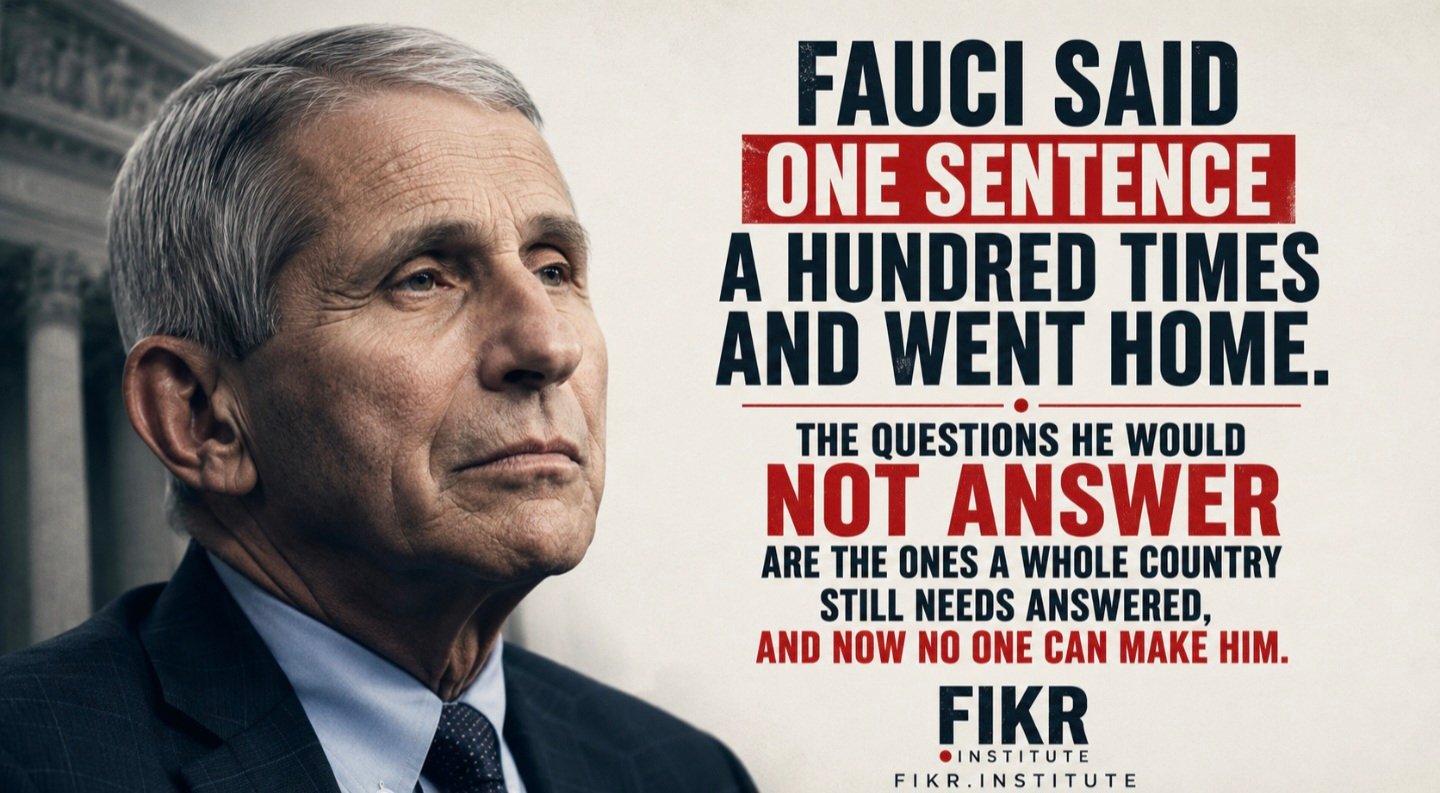
For a little over two hours on the morning of 29 July 2026, one of the most powerful public health officials in the history of the United States sat in a Senate hearing room and said, in substance, nothing at all. Anthony Fauci had been subpoenaed. He appeared. And then, to question after question, more than a hundred times, he delivered the same twenty-four words and no others: under the advice of his attorneys, he would invoke his right under the Fifth Amendment to refrain from answering. The senators asked. The sentence came back. They asked again. The sentence came back again. A man whose voice had once been the daily instruction of an entire nation had reduced himself, deliberately and on legal advice, to a single repeating line.
It is worth beginning with what this article will not say, because the temptation to say it is strong and the saying of it would be both wrong and destructive. It will not say that Fauci's silence proves he is guilty of anything. The Fifth Amendment is a constitutional protection available to every American precisely so that the innocent as well as the guilty may decline to be interrogated by a hostile power, and the law is emphatic that its invocation is not evidence of wrongdoing. Fauci received a preemptive pardon in January 2025, and a pardon is not a confession. And Fauci has given his own account of why he stayed silent: he believes the committee's chairman, Senator Rand Paul, sought not the truth but a statement that could be used to prosecute him for perjury, and that any answer at all risked opening that door. Take all of that as given. This article grants every one of those points, because its argument does not need to contest a single one of them.
What this article is about is the questions. Not the answers, which we do not have and, the argument will show, may never have. The questions. Because a man may have every right to refuse to answer, and the questions he refuses may still be the most important questions a society has to ask, and the two facts can be true at once. Fauci's right to his silence is real. The public's need for the answers is also real. And when those two collide, something is lost that is worth naming precisely.
So consider what was actually asked, because the subjects were not trivial and the country deserves to sit with their weight.
The first cluster of questions concerned the origin of the pandemic itself. For years, Senator Paul has pressed a single line of inquiry: whether funds from the National Institutes of Health supported research at the Wuhan Institute of Virology of a kind that could enhance a virus, the work known as gain-of-function, and whether such research could have contributed to the emergence of the virus that went on to kill millions of people worldwide. Fauci has, in the past, denied this repeatedly and emphatically. But the question has never been definitively closed, a congressional subcommittee concluded in late 2024 that a laboratory origin was the most likely explanation, and reasonable scientists remain genuinely divided, with many maintaining that a natural origin is far more probable and that the lab-leak theory lacks direct evidence. The question is contested. It is also enormous. If a pandemic that reshaped the entire world emerged even partly from research that a government agency funded, then the way every nation governs such research must change, and the public has an overwhelming interest in knowing. This is not a niche dispute. It is one of the central factual questions of the century, and Fauci was asked about it, and he declined to answer.
The second cluster cut closer, because it did not depend on Paul's theories at all. It depended on Fauci's own words. Ahead of the hearing, Paul released more than eleven hundred pages of what he identified as Fauci's personal diary, spanning the pandemic years. And within them sat entries that appear to sit in tension with Fauci's later public testimony. An entry from late January 2020 reportedly records that Fauci was contacted by researchers who believed the virus might have been engineered, pointing to a specific feature of its structure, the furin cleavage site, as a possible signature of laboratory manipulation. This is difficult to square with his subsequent, emphatic public insistence that he had no early knowledge of such concerns and that the agency he led never supported the relevant research. Senator Ron Johnson put the tension to him as bluntly as it can be put, asking whether Fauci had lied to his own diary. Fauci invoked the Fifth. Whatever the resolution of that apparent contradiction may be, it is a contradiction between a man's private contemporaneous record and his public sworn statements, and a society that was asked to trust those public statements completely has a legitimate interest in understanding it. He was asked. He declined to answer.
The third cluster was about the texture of ordinary life, the rules under which an entire population had lived. The six-foot distancing rule that reorganized every school, restaurant, and workplace in the country, and which Fauci himself later acknowledged had not been based on a specific study but had, in his words, sort of just appeared. The reversal on masks. The guidance to governors on reopening. These were the decisions that determined whether children sat in classrooms and whether families could gather, and the questions about their scientific foundation go to whether the most sweeping peacetime restrictions in modern American life rested on solid ground or on improvisation presented as certainty. He was asked. He declined to answer.
Now step back and see the shape of what happened, because the shape is the story. On the origin of a pandemic, on the consistency of his own public account with his private record, and on the basis for the rules that governed a nation's daily existence, the single most authoritative figure of the entire episode declined, on each and every point, to say anything at all. And he had the right to do so. That is not in dispute. What must be seen clearly is what that right, exercised in these specific circumstances, produces.
It produces a set of vital public questions that can now no longer be answered by anyone, through any mechanism.
Follow the closing of the doors, one by one, because it is the heart of the matter. A prosecution might ordinarily compel an accounting, the threat of trial extracting the testimony that persuasion cannot. But Fauci has been preemptively pardoned, covering his conduct back to 2014, and a pardoned man faces no prosecution that could compel him. A congressional hearing might ordinarily compel an accounting, the subpoena forcing the witness to speak. But the Fifth Amendment permits the witness to appear and say nothing, and Fauci has invoked it. An employer might ordinarily demand answers as a condition of position. But Fauci is retired, beyond the reach of any such leverage. Prosecution, legislation, employment: the three mechanisms by which a society ordinarily compels its powerful to account for themselves have each, in this case, been closed. Pardoned against the first. Silent against the second. Retired beyond the third. There is no remaining forum with the power to make him answer, and there will not be one.
This is the thing worth understanding, and it is larger than one man and one pandemic. The questions have not been answered, and the structure now guarantees that they will not be. They will not be answered angrily and they will not be answered quietly. They will simply remain, permanently open, in a state no mechanism can resolve, because every mechanism that might have resolved them has been removed from the board. The public is left not with a verdict it dislikes but with the absence of any verdict at all, forever, on questions to which it has an overwhelming and legitimate claim to an answer.
And here the case connects to a pattern this publication has traced through very different events. The redaction of powerful names from a released investigative file. The satellite that guides a missile onto a base and is treated as a photograph rather than an act of war. And now the pardon and the Fifth that together seal a set of pandemic questions beyond the reach of any compelling authority. The common structure is that at a sufficient altitude of power and protection, accountability does not merely fail, it becomes impossible, foreclosed in advance by the arrangement of legal shields, so that the public's questions do not lose a fair contest but are prevented from ever being contested at all. The mechanism differs each time. The result is identical: a question of real public consequence, aimed at a powerful figure, rendered permanently unanswerable, and a public taught once more that the rules of accountability thin out as they climb and vanish at the top.
There is a particular cost to this in the domain of public health, and it deserves to be named, because it is the cost that will outlast the hearing. The entire relationship between a health authority and a population rests on trust, on the willingness of ordinary people to believe that when an official tells them to keep their children home or to stand six feet apart or to trust a particular account of a virus origin, the official is telling them the truth as fully as it is known. That trust was demanded of Americans in enormous quantity during the pandemic. Trust the experts, they were told, and most of them did. But trust is a reciprocal thing. It is sustained by the confidence that when the emergency passes, those who demanded it will account for what they did with it. When that accounting is not merely refused but rendered structurally impossible, the trust does not simply survive intact. It corrodes, and it corrodes not only toward the individual but toward the institutions behind him, and toward the next official who stands up in the next emergency and asks to be believed. The scientists who fear that this episode will damage public confidence in science are right to fear it, but the damage is not being done by the asking of the questions. It is being done by the demonstration that the questions can be permanently escaped.
Fauci said his single sentence, more than a hundred times, and then he went home, and it is worth being clear and fair that he broke no law in doing so and exercised a right that protects us all. But the questions he declined did not go home. They are still here, unanswered, and now unanswerable. Whether government-funded research helped start a pandemic. Whether a man's private record matches his public oath. Whether the rules that governed a hundred million lives had any solid foundation beneath them. A country asked. The most powerful figure in a position to answer said twenty-four words and nothing more, and the law had arranged, in advance, that no one could ever make him say more. The public will not get its answers. The lasting question, the one that outlives all the others, is what it does to a society when it learns that its most important questions come with a level of power at which they need never be answered at all.
References:
1. CNN, "Dr. Anthony Fauci Repeatedly Invokes the Fifth in Dramatic Senate Hearing About Covid Pandemic," 29 July 2026, and NPR, "Fauci Invokes Fifth Amendment in Rand Paul Senate Hearing," 29 July 2026. Citing the more than one hundred invocations of the Fifth Amendment across a hearing exceeding two hours, the single twenty-four-word sentence, the subpoena by Senate Homeland Security and Governmental Affairs Committee Chairman Rand Paul, and Fauci's stated reason that the chairman sought to prosecute him for perjury.
2. NBC News, "Anthony Fauci Invokes Fifth Amendment Right Not to Answer Questions at GOP-Led Covid Hearing," 29 July 2026, and Axios, "Fauci Faces Contempt Vote After Invoking Fifth Amendment in Senate Hearing," 29 July 2026. Citing the more than one hundred invocations, the chairman's vow to seek a contempt vote, and Paul's argument that the Fifth was unsupported because of the preemptive pardon covering conduct back to 2014.
3. NPR, "Rand Paul Releases Anthony Fauci's COVID Diary Entries Ahead of Hearing," 27 July 2026, and Reason, "At Senate Hearing, Fauci Takes the Fifth to Avoid Accounting for Inconsistent Statements About a Lab Leak," 29 July 2026. Citing the release of more than eleven hundred pages of diary entries, the late-January 2020 entry recording that researchers had raised the possibility the virus was engineered based on its furin cleavage site, the tension with Fauci's later public testimony, and Senator Ron Johnson's question regarding the diary.
4. Houston Public Media and NPR, "Rand Paul Released Fauci's Pandemic-Era Diary. Now They'll Face Off on Capitol Hill," 29 July 2026. Citing the December 2024 congressional subcommittee conclusion that a lab leak was the most likely origin, the dissent of scientists who hold that a natural origin is more probable and that the focus on Fauci may erode public trust in science, and the scope of the gain-of-function funding dispute.
5. Reporting on the six-foot distancing guidance and Fauci's later acknowledgment that it was not based on a specific study, and on the January 2025 preemptive presidential pardon issued to Fauci prior to any charges.