
Abstract:
When a peer competitor watches a major power fight a war, it is not watching the outcome. It is watching the gaps. The Iran war of 2026 gave China the most detailed operational assessment of American missile defense architecture in modern history: 290 of 360 THAAD interceptors expended, 80 percent of the JASSM-ER inventory consumed, 42 US aircraft destroyed, THAAD radar nodes destroyed in the opening phase, Iranian maneuvering warheads defeating Patriot intercept software, and 90 percent of underground Iranian missile facilities still operational after the most intense American air campaign in two decades. On July 6, 2026, the same day Australia and Fiji signed a mutual defense treaty aimed at countering Chinese influence in the Pacific, China fired a JL-3 submarine-launched ballistic missile from a submerged Type 094 submarine approximately 7,300 kilometers into the South Pacific. This article argues that these two events are not coincidental in timing or separable in meaning: the JL-3 test was the application of Iranian lessons to the scenario the United States fears most, delivered from a domain the Iran war also revealed American defenses cannot adequately cover.
Main Article:
Every war is a classroom for those who study it carefully. The Iran war of 2026 was also a classroom for those who did not fight in it, and no student in that classroom was paying closer attention than China.
Operation Epic Fury began on February 28, 2026, with joint American and Israeli strikes on Iranian military, nuclear, and leadership targets. Iran retaliated with a sustained campaign of ballistic missiles, cruise missiles, and drone swarms against American bases, Gulf state infrastructure, and commercial shipping in the Strait of Hormuz. The forty-day war produced the most operationally detailed assessment of American missile defense performance in modern history, and the assessment was not favorable.
The numbers, drawn from the Center for Strategic and International Studies, SOFREP, National Defense Magazine, and multiple post-battle analyses, are precise in their implications. [1] The United States entered the war with approximately 360 THAAD interceptors in its total inventory. By the end of the war, 290 had been expended, leaving a strategic reserve of roughly 70. [2] Replenishing THAAD inventory requires three to eight years at the production rate of Lockheed Martin of approximately 100 to 130 interceptors annually, a timeline that was understood before the war began and became operationally critical within its first two weeks. [3] Patriot PAC-3 MSE missiles were consumed at a rate that effectively exhausted 80 percent of deployed reserves. JASSM-ER standoff munitions, the precision strike weapons American planners depend upon to attack defended targets without exposing aircraft, were depleted to 20 percent of pre-war inventory across the campaign. Over 850 Tomahawk cruise missiles were fired from a total stock of approximately 3,100. [2]
Against this depletion, Iran demonstrated that even a second-tier military power could inflict disproportionate cost through the combination of maneuvering warheads, saturation drone tactics, and underground hardening. Iranian Fattah-1 hypersonic missiles and medium-range ballistic missiles equipped with terminal maneuverable reentry vehicles exploited a software timing error in the Patriot intercept system, causing misses against maneuvering targets by up to a third of a mile. [4] THAAD radar nodes, including the AN/TPY-2 system in Jordan and additional units in the UAE and Saudi Arabia, were destroyed in the opening phase of Iranian retaliation, described by the Al Jazeera Centre for Studies as blinding American eyes in the Middle East. [1] The destruction of the radar network reduced the effective range at which incoming ballistic missiles could be detected and tracked, forcing intercept decisions into compressed timelines and degrading the layered defense architecture that American planners had relied upon. An aging Iranian F-5 fighter aircraft, flying low to defeat radar horizon coverage, successfully penetrated Patriot zones and struck a Gulf facility, exposing the gap between missile defense capability and full-spectrum air defense. [4]
The exchange ratio, documented in detail by the QUWA defense analysis group and National Defense Magazine, was strategically favorable to Iran at every intercept tier except the lowest. [3] A Shahed drone costs Iran approximately $20,000 to $50,000. Intercepting it consumes a Patriot PAC-3 MSE missile at $3.7 million or a THAAD interceptor at $13 million. A Fateh-110 ballistic missile costs Iran between $500,000 and $1 million fully loaded. Intercepting it costs the same. The entire strategy of Iran, in the assessment of CENTCOM analysts cited in post-conflict reporting, was designed not to defeat American air power but to exhaust the industrial capacity that supports it. When the dust settled, American assessments found that 90 percent of Iranian underground missile storage and launch facilities were still operational despite the most intensive bombing campaign the US has conducted in two decades. [5] Iran absorbed the attack, imposed unsustainable defensive costs on the United States, denied the United States its political objective of regime change, and signed a memorandum of understanding from a position that its military capacity had not been broken.
Beijing registered every one of these data points.
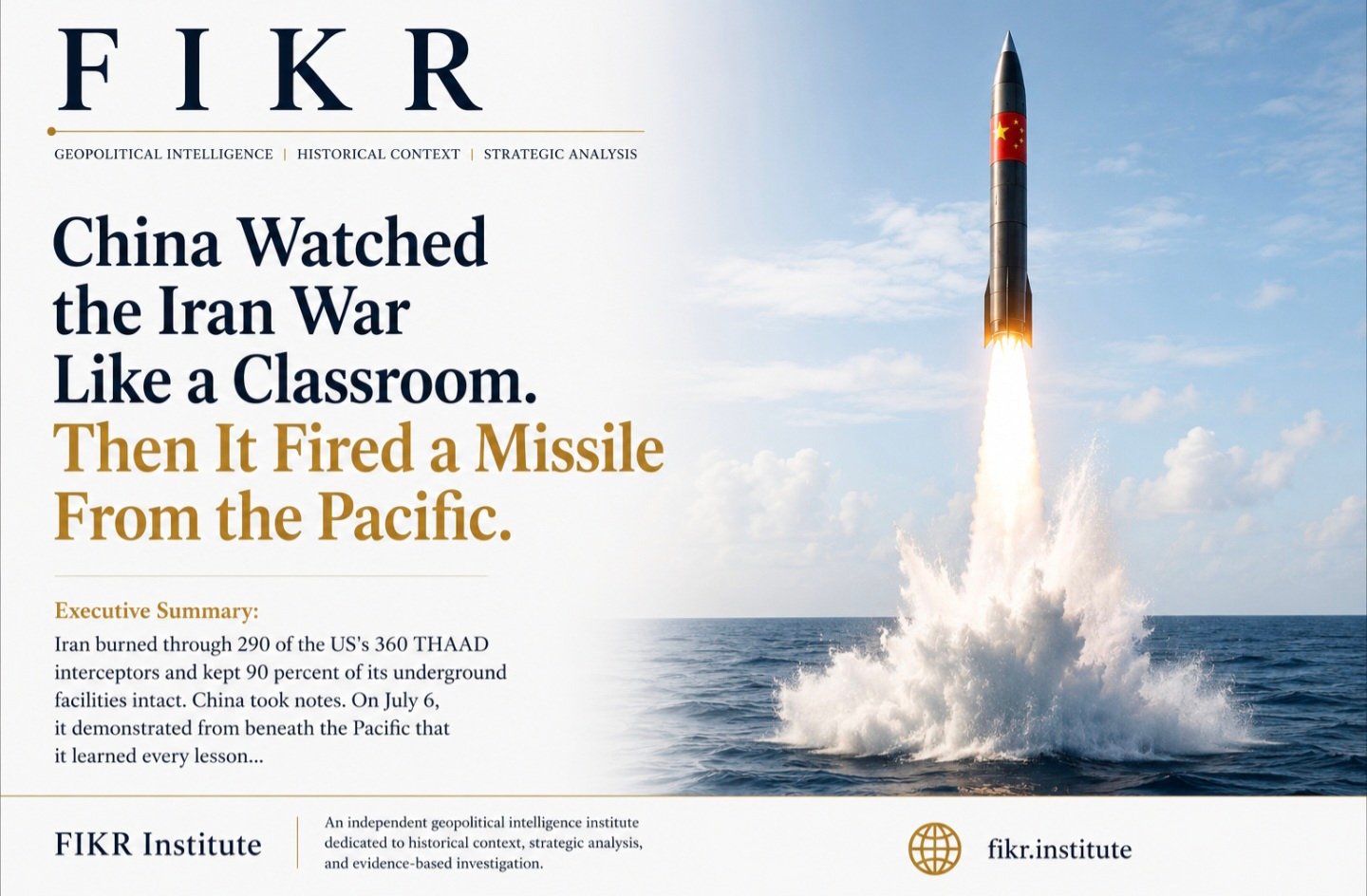
On July 6, 2026, at 12:01 local time, a Type 094 Jin-class nuclear-powered ballistic missile submarine of the People Liberation Army Navy executed a submerged launch of a JL-3 intercontinental-range ballistic missile from the Bohai Sea. [6] The missile carried a training dummy warhead. It traveled approximately 7,300 kilometers, crossing the airspace of Micronesia, Nauru, Kiribati, and Tuvalu, and landed in designated impact waters in the South Pacific. [7] The PLAN issued a brief official statement describing it as a routine annual training exercise. Chinese Foreign Ministry spokesperson Mao Ning, at the regular press conference, said the activity complies with international law and practice and is not directed against any specific country.
These characterizations are accurate in the narrowest legal sense and precisely calibrated in their strategic function. A training exercise is also a demonstration. A demonstration that complies with international law is also a signal. The signal, read against everything Iran demonstrated in the preceding forty days, is this: the United States cannot defeat, through missile defense alone, a peer adversary that fires from beneath the ocean.
The JL-3 carries an estimated operational range of ten thousand to twelve thousand kilometers. [6] In practical terms, this means a Type 094 submarine operating in the Bohai Sea, the South China Sea, or Chinese coastal waters that remain within reach of Chinese naval support and air cover can place a warhead on any major American city on the continental United States, any American base in the Pacific, any allied capital in East Asia or Europe. Unlike land-based ICBMs, which can be located by satellite and destroyed in a first strike if their silos can be identified, a missile submarine operating submerged in the vastness of the Pacific represents what strategists call a survivable second-strike capability. It guarantees retaliation even if a state absorbs a disarming first strike. [8] The United States has possessed this capability against the Soviet Union and Russia for decades and has built its entire nuclear deterrence architecture around it. China publicly demonstrating the same capability is not merely a test. It is a declaration that the fundamental strategic condition of mutual vulnerability that governs nuclear relations between the US and Russia now also governs nuclear relations between the US and China.
The Pentagon estimated the nuclear stockpile of China at approximately 600 warheads as of 2024, with projections exceeding 1,000 by 2030. [6] US Strategic Command Commander General Anthony Cotton confirmed in congressional testimony in March 2026 that China had surpassed that 600-warhead threshold. China is building nuclear submarines at three operational shipyards simultaneously, compared to two in the United States, and developing the Type 096 submarine to replace the Type 094 with quieter propulsion derived from magnetic drive and rim-driven propeller technologies. [8] The trajectory is documented: China is not approaching a minimally sufficient deterrent. It is building a nuclear force sized and structured to establish strategic parity with the United States across all three legs of the nuclear triad, land, sea, and air, within the current decade.
The question your source post raised, what the United States can do to match this, requires separating three distinct problems that American analysts and officials frequently conflate.
The first is the interceptor depletion problem. The Iran war made viscerally clear that the current architecture of American missile defense cannot sustain a prolonged high-intensity conflict against a state willing to use saturation tactics. Producing sufficient THAAD interceptors to replace what Epic Fury consumed requires three to eight years at current production rates. The administration has announced plans to increase Patriot production from 500 to 2,000 per year and has urged development of directed energy weapons for drone and cruise missile intercept. [3] These measures address the bottom of the threat spectrum relatively well. They do not address SLBM threats at all. No deployed American system intercepts a submarine-launched ballistic missile in the boost phase while it is still below the horizon, which is the phase at which interception is technically most feasible. The Ground-Based Midcourse Defense system, designed to intercept ICBMs in midcourse flight, has a documented test record of approximately 55 percent success against single targets in highly scripted tests. It would face an adversary capable of launching multiple independently targetable warheads from multiple submarines simultaneously.
The second is the rare earth dependency problem. Iran revealed a structural vulnerability that China, not Iran, is positioned to exploit most severely. Each F-35 airframe contains approximately 920 pounds of rare earth materials. Patriot PAC-3 MSE interceptors use rare earth components for guidance. The magnets in JDAM kits and Tomahawk guidance systems depend on samarium-cobalt and neodymium materials, the production of which China dominates at every point in the supply chain from mine to magnet. [2] A federal mandate prohibiting Chinese-sourced rare earth magnets in American military platforms takes effect January 1, 2027, a deadline that the West Point Modern War Institute assessed as unachievable given the current absence of a domestic mine-to-magnet supply chain. Iran showed how fast the magazine empties in a sustained campaign. China controls what fills the magazine.
The third is the strategic question, the one that neither missile defense upgrades nor supply chain reform can answer. A state with a survivable nuclear second-strike cannot be coerced by a state that is unwilling to absorb nuclear retaliation. China demonstrated on July 6 that it now has that second-strike. The United States has had it since the 1960s. The condition of mutual nuclear deterrence between two peer powers means that the competition below the nuclear threshold becomes the decisive arena: conventional forces, economic pressure, alliance management, technology competition, and influence over the sixty to seventy countries that will choose which of the two poles of a bipolar competition to align with, or how to remain usefully outside both.
The timing of the JL-3 test on the same day Australia and Fiji signed their mutual defense pact was not coincidental. [6] The message was addressed to both the immediate audience, Australia, Fiji, and the Pacific island states through whose exclusive economic zones the missile flew, and the broader audience, every state in the Indo-Pacific that is calculating which way a bipolar competition will run. China was demonstrating that the net being drawn around it from Washington and its allies is not impermeable, and that the cost of participating in that net is calculable in a way it was not before July 6.
What the United States can do in response is constrained by the post-Iran realities. It cannot immediately replenish its missile defense stockpiles. It cannot quickly establish a domestic rare earth supply chain. It cannot develop and deploy a reliable boost-phase intercept capability for SLBMs on any timeline relevant to the current strategic competition. What it can do, and what the analysis of both the Iran lessons and the JL-3 test suggests it must do, is shift from the assumption that strategic competition can be managed through military dominance alone, the assumption that the unipolar moment made possible for three decades, to the more difficult management of a world in which a peer competitor has acquired the strategic invulnerability that makes coercion impossible and negotiation unavoidable.
China watched the Iran war like a classroom. It saw what maneuvering warheads do to Patriot software. It saw what underground hardening does to the most intensive bombing campaign in two decades. It saw what saturation drone tactics do to interceptor stockpiles. It saw what the exchange ratio between a cheap offensive missile and an expensive defensive one does to the industrial capacity of even the wealthiest military power over forty days. And on July 6, from beneath the surface of an ocean the United States has treated as its own lake for three generations, it demonstrated that it has applied those lessons to the domain where American missile defense is weakest, the sea, and the weapon against which American missile defense has no answer, the submarine-launched ballistic missile that can strike from a location that cannot be found.
The Pacific is a border now. Borders require negotiation. The classroom is closed.
References:
1. QUWA Defense Analysis Group. "US-Iran War 2026: Operation Epic Fury and the Hormuz Crisis." May 26, 2026. Citing CSIS and Al Jazeera Centre for Studies.
2. Center for Strategic and International Studies. Campaign munitions analysis cited in SOFREP. "Operation Epic Fury Update." April 24, 2026. Also National Security Journal. "Iran Destroyed 42 US Military Aircraft in Operation Epic Fury." May 16, 2026.
3. National Defense Magazine. "Commentary: Some Early Air, Missile Defense Observations from Operation Epic Fury." March 18, 2026. Also 19FortyFive. "Full-Blown Crisis: The US Military Is Running Out of Missile Defenses During Operation Epic Fury." March 5, 2026.
4. Defence Security Asia. "Iran's F-5 Breaches US Patriot Shield." April 26, 2026. Also GlobalSecurity.org. "Iran's Missile Campaign, Operation Epic Fury 2026."
5. National Security Journal. May 16, 2026, citing intelligence community assessment of underground facility survivability.
6. The War Zone. "China's Submarine-Launched Ballistic Missile Test in the Pacific Is a Big Deal." July 6, 2026. Also CNN. "China Conducts Rare Submarine-Launched Ballistic Missile Test." July 6, 2026. Also Washington Post. "China Test Fires Long-Range Missile Into Pacific." July 6, 2026.
7. CNN. "China Conducts Rare Submarine-Launched Ballistic Missile Test." July 6, 2026. Citing regional source on flight path over Micronesia, Nauru, Kiribati, and Tuvalu.
8. Military Watch Magazine. "China Demonstrates Submarine Intercontinental Range Nuclear Strike Capabilities." July 6, 2026. Also Army Recognition. "China Submarine Ballistic Missile Test Pacific 2026." July 6, 2026.