
Abstract:
For two decades, analysts have argued that successive Israeli governments preferred a divided Palestinian polity, with Hamas holding Gaza and the Palestinian Authority holding the West Bank, because division made statehood impossible. That argument is normally presented as inference. The documentary record shows it does not need to be. In a recording made in 2001 and broadcast in 2010, Benjamin Netanyahu described the method by which he had ended the Oslo process while formally honouring it. In a United States diplomatic cable dated June 2007, the head of Israeli military intelligence said his country would be pleased if Hamas seized Gaza. In 2019, addressing his own party, Netanyahu stated that opponents of a Palestinian state should support transferring money to Hamas. This analysis examines those three statements, the denials that followed, and why the policy is better understood as having worked than as having failed.
Main Article:
When the critics of a policy and the architects of that policy describe it in the same terms, the description has stopped being an accusation and become a record.
Begin in 2001. Benjamin Netanyahu, out of office between his first and second terms, visited the settlement of Ofra in the occupied West Bank and spoke with a family that had lost relatives to Palestinian attacks. A camera was running. The recording was broadcast by Israeli Channel 10 in July 2010 [1].
What he described was not an opinion about the Oslo Accords. It was a technique.
The accords permitted Israel to retain defined military zones in the West Bank. Nobody had specified what a defined military zone was. Netanyahu explained that he had therefore intended to interpret the agreement in a way that would halt the movement toward the 1967 lines, and that as far as he was concerned the entire Jordan Valley qualified. He recounted withholding the Hebron agreement until Washington provided a letter conceding that Israel alone would determine which areas were military zones, and said that from that moment he had in effect brought Oslo to an end [1][2].
On the United States, he was blunt. He said America could be moved easily in the right direction and would not get in the way, and he described the American president who had brokered the accords as radically pro-Palestinian [1][3].
Read the method rather than the boast. He did not repudiate the agreement. He signed it, praised it, and then read a single undefined clause broadly enough to empty it. That is a durable technique and it recurs.
The second document is a cable from the American embassy in Tel Aviv dated June 2007, released by WikiLeaks in December 2010. It records a meeting on 12 June between the ambassador and the director of Israeli military intelligence, Major General Amos Yadlin, held while Hamas and Fatah were fighting in the streets of Gaza [4].
Yadlin placed Gaza fourth on his list of threats, behind Iran, Syria and Hezbollah. He said Israel would be happy if Hamas took over Gaza, because the military could then deal with Gaza as a hostile state, and that Israel could manage the situation so long as Gaza had no port [4][5].
The cable contains a qualification that honesty requires reporting. The drafting officer noted that the view did not necessarily reflect a consensus position of the Israeli government [4]. This was the assessment of one senior officer, recorded by a foreign diplomat, not a cabinet decision.
But note what the assessment identifies, because the reasoning is precise and it is not about safety. A hostile state can be blockaded. A hostile state is responsible for its own population. An occupied territory is not, and the occupying power carries obligations under the law of occupation for the two million people inside it. Hamas control converted a legal liability into an adversary. That is a political advantage, and Yadlin named it as one.
What followed is consistent with the reasoning.
In October 2011 Israel exchanged more than a thousand Palestinian prisoners for a single captured soldier. Whatever else that transaction accomplished, it established Hamas as the party with which Israel negotiated, at a moment when the Palestinian Authority was negotiating nothing.
From 2014 onward, Qatari money entered Gaza under an arrangement worked out with Israeli, American and United Nations involvement, running to tens of millions of dollars a month. Documents obtained by Israeli media show senior Israeli officials seeking those funds and expressing appreciation for them [6]. Those same documents indicate that Israel sought assurances the money would not be diverted directly to Hamas, which is a point in favour of the official account and should be stated [6].
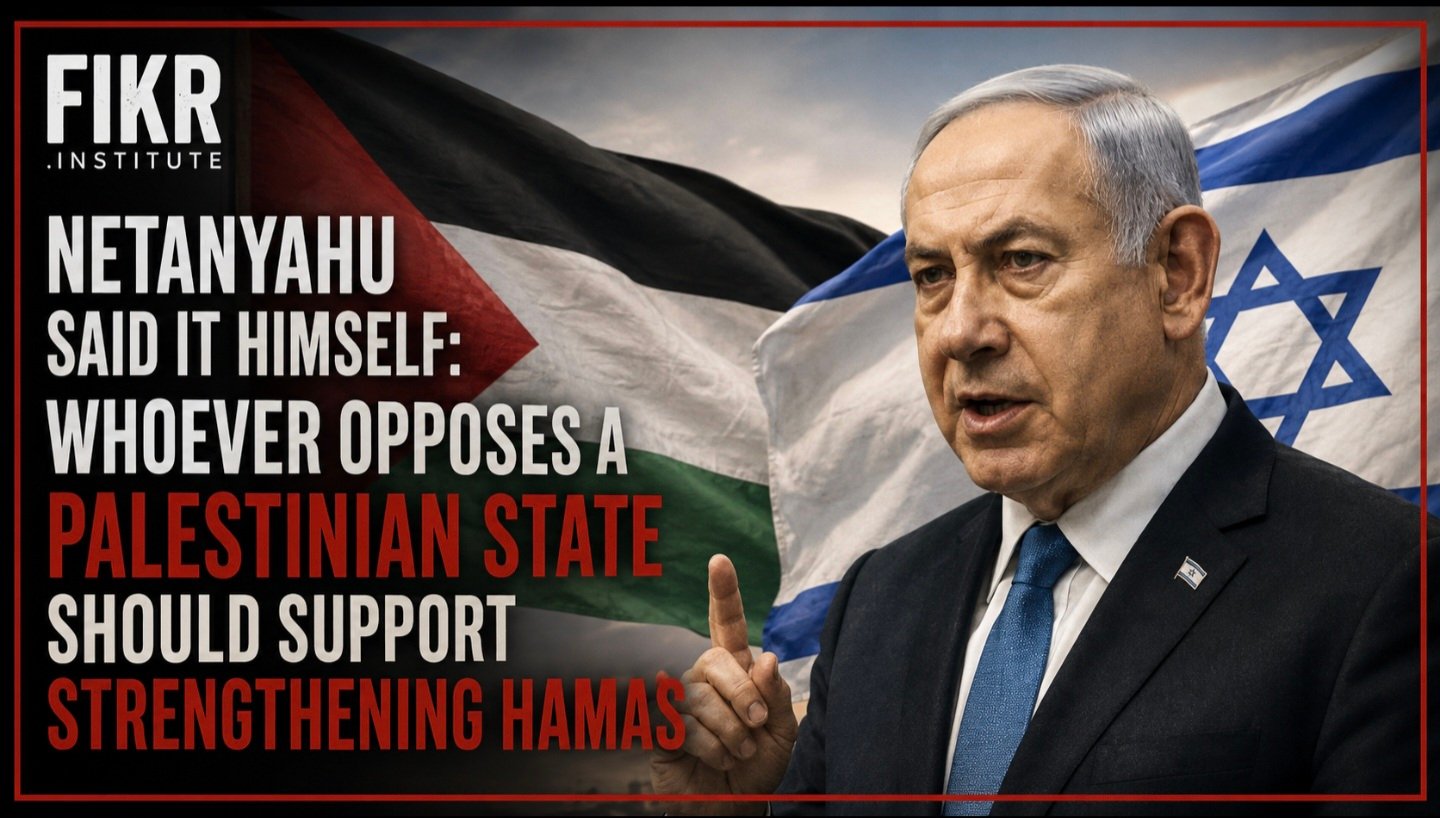
Then, in March 2019, at a meeting of his own party, Netanyahu removed the ambiguity. Anyone who opposes the establishment of a Palestinian state, he said, should support transferring the money to Gaza, because maintaining the separation between the Authority in the West Bank and Hamas in Gaza prevents such a state from forming [7][8].
He has denied the obvious reading of his own sentence. He has called the suggestion that he built up Hamas a lie, has pointed out that no government seeking to strengthen an organisation fights three wars against it, and has said the funds were intended to avert hunger, disease and humanitarian collapse [8]. Those denials belong in the record, and the humanitarian argument is not frivolous. Gaza was in severe distress and the money did pay salaries and fuel.
Yet the denial and the statement can both be examined against the same test, which is what the policy was structured to produce.
A government that wants an armed adversary weakened does not become the guarantor of its revenue. It does not negotiate exchanges that confirm the adversary as the address for all business. It does not, over fifteen years, permit that adversary to consolidate governance over a territory while refusing to hold a single working meeting with the rival administration that recognises it. Israeli critics of the policy, including reserve generals and mainstream Israeli journalists, made precisely this argument before October 2023 and have repeated it since [9].
Here is the part that is usually got wrong, including by people hostile to Netanyahu.
The policy is described as a catastrophic failure exposed on 7 October 2023. That framing is too generous, because it assumes the objective was security and measures the outcome against it.
Measured against the objective the prime minister stated to his own party, the policy did not fail. It succeeded. There is no Palestinian state. There is no unified Palestinian negotiating position. For two decades the argument that there was no credible partner could be made truthfully, because the conditions that made it true had been maintained deliberately. On the declared aim of preventing statehood, the strategy worked precisely as designed.
The catastrophe and the success are the same event. The instrument chosen to prevent statehood was an armed movement holding territory, insulated from accountability, financed by monthly cash, confirmed as the sole interlocutor and sealed inside a blockade. Such an instrument does not stay in the shape it was given. On 7 October it acted, and more than a thousand Israelis were killed. The war that followed has killed tens of thousands of Palestinians and destroyed Gaza as a functioning place.
This is the general lesson and it is not confined to one country. A security doctrine that requires the survival of your enemy is not a security doctrine. It is a political doctrine wearing the clothes of one. The tell is simple. Ask whether the policy would still make sense if the threat disappeared tomorrow. If the answer is that the threat disappearing would be inconvenient, the stated purpose is not the real one.
Three documents, spanning eighteen years, a recording, a cable and a party speech. None of them was produced by an opponent. Each was produced by the people carrying out the policy, describing it accurately, to audiences they trusted.
The critics did not need to prove the case. The principals filed it.
References:
Al Jazeera, report on the 2001 recording of Benjamin Netanyahu broadcast by Israeli Channel 10 in July 2010.
Tablet Magazine, translation and analysis of the 2001 Ofra recording.
The Washington Post, contemporaneous reporting on the contents of the 2001 recording.
WikiLeaks, United States embassy cable from Tel Aviv dated June 2007 recording the meeting with the Director of Israeli Military Intelligence.
CNN, reporting on the released diplomatic cables concerning Gaza in 2007.
The Times of Israel, documents on Israeli requests for and appreciation of Qatari funding for Gaza.
The Jerusalem Post, report of the March 2019 remarks by Benjamin Netanyahu on transfers to Gaza and Palestinian division.
Middle East Eye, report on the denial by Benjamin Netanyahu that Qatari funds were intended to strengthen Hamas.
Haaretz, Israeli commentary and criticism of the policy of strengthening Hamas at the expense of the Palestinian Authority.