
Abstract:
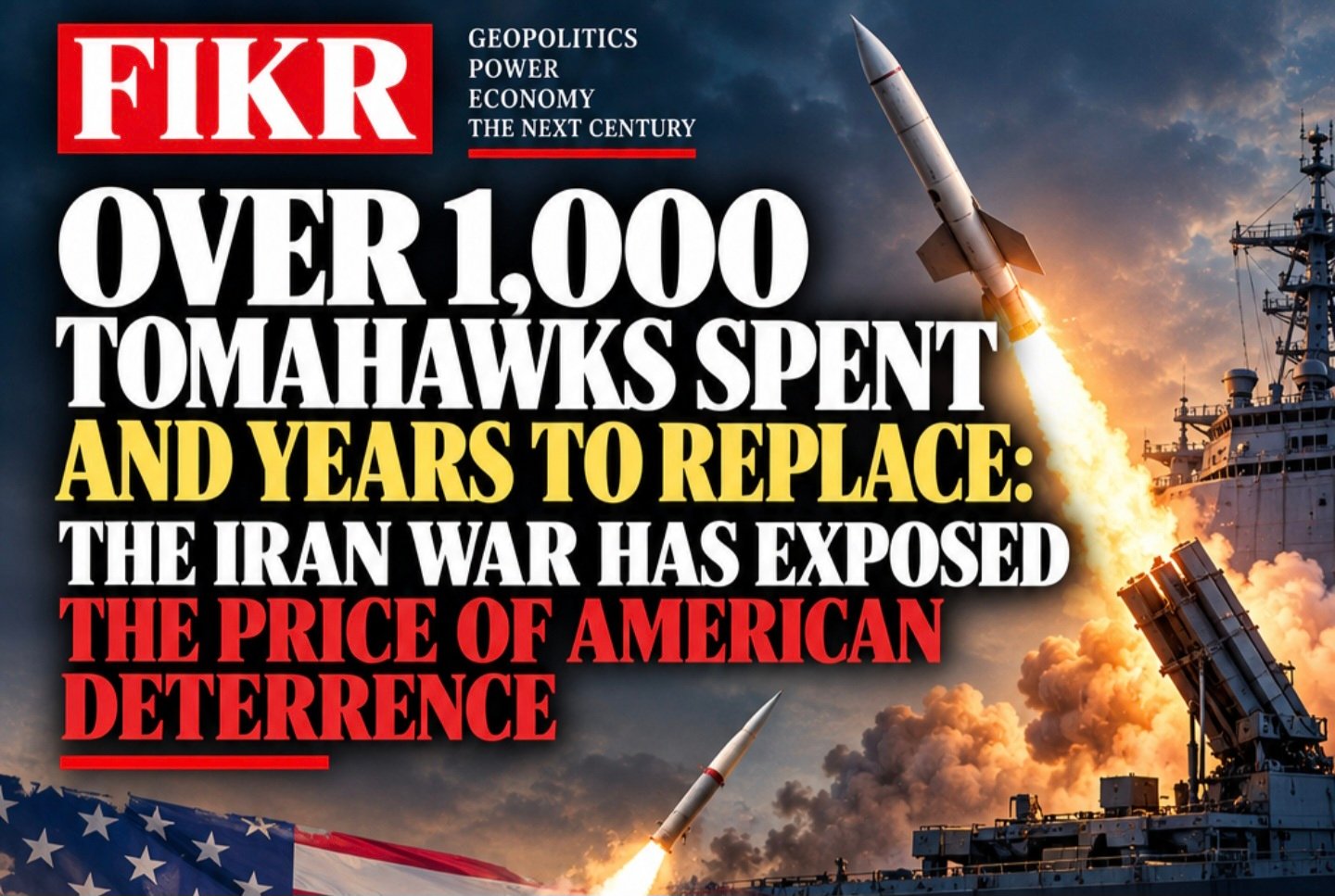
American weapons have long deterred by reputation: precision, range and the assumption of unlimited supply. The 2026 war against Iran tested that reputation and exposed its limits. An analysis by the Center for Strategic and International Studies found that more than 1,000 Tomahawk cruise missiles and more than 1,000 Patriot interceptors were used, with stocks not rebuilt until 2029 and 2030. Reuters reported Army long range missile stocks badly depleted, the Washington Post reported at least 45 MQ-9 Reapers lost, and Congressional and Pentagon records show tankers and an E-3 Sentry damaged on the ground at a defended Saudi base. Washington has also shown, from the 1990 Pressler sanctions on Pakistan to the 2025 pause in Patriot deliveries to Ukraine, that it decides whose war is resupplied first. China offers cheaper systems in volume with fewer conditions, systems Pakistan used against India in May 2025 and that Saudi Arabia appears to have used over Yemen. This article argues that a deterrent which cannot be replenished expires, and that states building their security on American supply are buying the reputation of an arsenal rather than the arsenal itself.
Main Article:
A weapon deters only as long as the enemy believes there are more behind it. Technology wins the first exchange. Stockpiles decide whether there is a second.
For half a century, American arms carried a reputation that did much of their work before they were fired. Precision, range and the sense of an inexhaustible supply kept adversaries cautious and persuaded allies to pay premium prices and accept political conditions. The war against Iran, which began with American and Israeli strikes on February 28, 2026, tested every part of that reputation at once. The record now published by Congress, the Pentagon Inspector General and independent analysts shows what remained when the test was over.
The first casualty was the supply. An analysis by the Center for Strategic and International Studies, published by the Associated Press in May, found that the United States had fired more than 1,000 Tomahawk cruise missiles and used more than 1,000 Patriot interceptors and about 290 THAAD interceptors [2]. The same analysis placed the dates by which those stocks could be rebuilt at mid 2029 for Patriot, the end of 2029 for THAAD and late 2030 for Tomahawk, noting that Tomahawk production runs at fewer than 200 missiles a year [2]. In August, Reuters reported, citing three sources familiar with the data, that Army stocks of ATACMS and the newer Precision Strike Missile had been badly depleted by the campaign, a report the White House denied [1]. In September, the Pentagon Inspector General recorded munitions shortfalls and put the cost of the operation at 33.4 billion dollars [4].
Money can be appropriated in a week. Production lines take years.
That gap is the structural weakness of the American model. Its systems are built to be decisive, not numerous. A Tomahawk or a Patriot interceptor is a precision instrument assembled through long supply chains and specialised labour, priced for a world in which wars are short and enemies are few. When a war runs for months, the advantage of quality is converted into a problem of quantity, and the ledger cannot be balanced by any budget passed in the same year.
The air fleet tells the same story. The Washington Post reported in August, citing three American officials, that at least 45 MQ-9 Reapers had been lost from a fleet of about 185, roughly a quarter, with a fourth official noting that some crashed after losing their control link rather than being shot down [3]. The Inspector General counted up to 30 Reapers destroyed through June 30 [4]. A Congressional Research Service tally in May listed 42 aircraft lost or damaged, including four F-15E Strike Eagles, three of them brought down by a Kuwaiti F/A-18 in a friendly fire incident and one by Iranian ground fire [5].
The more revealing losses happened on the ground. On March 14, Iranian missiles and drones struck Prince Sultan Air Base in Saudi Arabia and damaged five KC-135 tankers. On March 27, a second strike damaged an E-3 Sentry parked on an unprotected taxiway at the same base [5]. The Inspector General reported that Iranian strikes damaged and destroyed hundreds of buildings and structures at American bases across the region [4]. These were not exposed outposts. They were among the most heavily defended installations in the Gulf, protected by the same interceptors that Washington sells to its partners as a guarantee of safety.
The full extent of that damage is known only through what American institutions have chosen to publish, and the record of those disclosures is uneven. At Al Udeid in June 2025, Washington said the base was unharmed and conceded the destruction of a communications radome only after the Associated Press published commercial satellite imagery. The Iranian claim that the base had been smashed was also false [6]. Fikr records both accounts as claims by interested parties and treats neither official denial nor battlefield boast as the finding.
Precision has a second dependency that its reputation rarely mentions. A guided weapon is only as accurate as the coordinates it is given. Reuters reported on March 13, citing a source briefed on Israeli strategy, that informants on the ground in Tehran had passed Israel the locations of three checkpoints that were then struck [7]. Iran announced the arrest of dozens of people it accused of informing for Israel in the same month [8]. Where target information depends on human networks, the value of the most advanced munition depends on networks that can be exposed, arrested and dismantled. The precision belongs to the intelligence as much as to the weapon.
The third weakness is political. American arms come with a supplier who decides when they arrive. Pakistan learned this in 1990, when the Pressler Amendment cut off American military assistance over its nuclear programme and F-16 fighters Islamabad had already paid for were held back for years [9]. Ukraine learned it in July 2025, when the Pentagon paused shipments of some weapons, including Patriot interceptors, after a review of its own stockpiles, at a time when Russian missile attacks were intensifying [10]. Deliveries resumed, but the lesson was delivered first.
The supplier decides whose war comes first.
China has built its arms trade on the opposite proposition. When American export restrictions kept armed drones out of reach for most Middle Eastern buyers, Chinese Wing Loong and CH series drones filled the gap, and by 2018 they were flying over battlefields across the region [11]. In May 2025, American officials told Reuters that a Pakistani J-10 fighter, a Chinese design, had shot down at least two Indian aircraft [12]. The Indian Chief of Defence Staff, General Anil Chauhan, later acknowledged aircraft losses without giving a number, while the Pakistani claim of six aircraft has not been independently established [13]. In September 2026, the Wall Street Journal reported that wreckage marked DF-15A, a Chinese ballistic missile, had been found in Yemen, and a Saudi official said the Houthis do not possess that missile. Neither Riyadh nor Beijing has confirmed a launch [14].
This record does not establish that Chinese systems outperform American ones, and Fikr does not claim it. What it establishes is narrower and more consequential. Chinese weapons were available, affordable and used by the states that bought them, in the wars those states chose to fight, without waiting for permission.
The allies who depend most on American supply are already reading the same ledger. On July 22, at NATO headquarters in Brussels, Japanese Defence Minister Shinjiro Koizumi said that unless discussions are held without taboos, no country can ensure its own security, and that nuclear issues are an unavoidable topic [15]. Prime Minister Sanae Takaichi has said she is willing to review the three non nuclear principles [15]. After the controversy, Koizumi restated his support for a world without nuclear weapons on August 5 [16]. Meanwhile, the American Typhon launchers and HIMARS sent to Japan this year were deployed to Kanoya Air Base only for the duration of exercises [17]. In March, American intelligence assessed that Beijing does not currently plan to invade Taiwan in 2027 and has no fixed timeline for unification [18].
The sequence is a documented coincidence rather than a proven connection, but it is telling. In the same year that American magazines were emptied in the Gulf, the most dependent American ally in Asia opened a debate about deterrence of its own, while Washington told the region that the Chinese clock was running slower than feared.
For decades the value of American weaponry rested on a promise that it would always be there, in quantity, when an ally needed it. The Iran war tested that promise and the numbers did not hold. More than a thousand Tomahawks and more than a thousand Patriot interceptors were spent in months, the rebuilding runs to the end of the decade, and the bases that host these systems could not shield their own tankers and surveillance aircraft from Iranian strikes.
Fikr Institute holds that a deterrent which cannot be replenished is a deterrent that expires. American arms remain advanced, but they are scarce, slow to produce, expensive to operate and supplied under political conditions that Washington can tighten at the moment of greatest need, as Pakistan learned when its F-16s were withheld in 1990. Beijing offers a different bargain: weapons that are cheaper, available in volume and sold without the same conditions, a bargain Pakistan tested in May 2025 and that Riyadh now appears to have used over Yemen.
States that still build their security around American supply are buying the reputation of an arsenal, not the arsenal itself. The Iran war showed what remains when the reputation is spent: empty magazines, long waiting lists and a patron deciding whose war comes first. Precision without depth is not deterrence. It is a single use advantage, and that advantage has now been used.
References:
1. Reuters. Report on the depletion of US Army ATACMS and Precision Strike Missile stocks in the Iran campaign, citing three sources familiar with the data. August 4, 2026.
2. Associated Press. Report on Center for Strategic and International Studies analysis of munitions used in the Iran war and replenishment timelines. May 28, 2026.
3. The Washington Post. Report on MQ-9 Reaper losses in the Iran war, citing US officials. August 13, 2026.
4. US Department of Defense Office of Inspector General. Quarterly report on Operation Epic Fury, as reported by Defense News and Al Jazeera. September 15, 2026.
5. Congressional Research Service. Tally of US aircraft lost or damaged in Operation Epic Fury, as reported by Army Times. May 22, 2026.
6. Associated Press. Satellite imagery of damage at Al Udeid Air Base following the Iranian strike. June 2025.
7. Reuters. Report on Israeli strikes on Iranian checkpoints using informant intelligence, citing a source briefed on Israeli strategy. March 13, 2026.
8. Al-Monitor. Report on Iranian arrests of people accused of informing for Israel. March 2026.
9. Congressional Research Service. Pakistan-U.S. Relations, on the Pressler Amendment sanctions and withheld F-16 deliveries.
10. Politico. Report on the Pentagon pause of some weapons shipments to Ukraine following a stockpile review. July 2, 2025.
11. Defense News. Report on Chinese armed drones operating over Middle East battlefields. October 3, 2018.
12. Reuters. Report on US officials confirming a Pakistani J-10 shot down Indian aircraft. May 8, 2025.
13. Bloomberg. Interview with Indian Chief of Defence Staff General Anil Chauhan on aircraft losses. May 31, 2025.
14. The Wall Street Journal. Report on DF-15A missile wreckage found in Yemen, as reported by Herald Corporation. September 2026.
15. Jiji Press. Report on remarks by Japanese Defence Minister Shinjiro Koizumi at NATO headquarters, as carried by Adnkronos. July 23, 2026.
16. Jiji Press. Report on Koizumi restating support for a world without nuclear weapons, as carried by Adnkronos. August 5, 2026.
17. Stars and Stripes. Report on the temporary deployment of Typhon and HIMARS to Kanoya Air Base for exercises. June 16, 2026.
18. Office of the Director of National Intelligence. Annual Threat Assessment of the US Intelligence Community, as reported by Al Jazeera. March 19, 2026.