
Abstract:
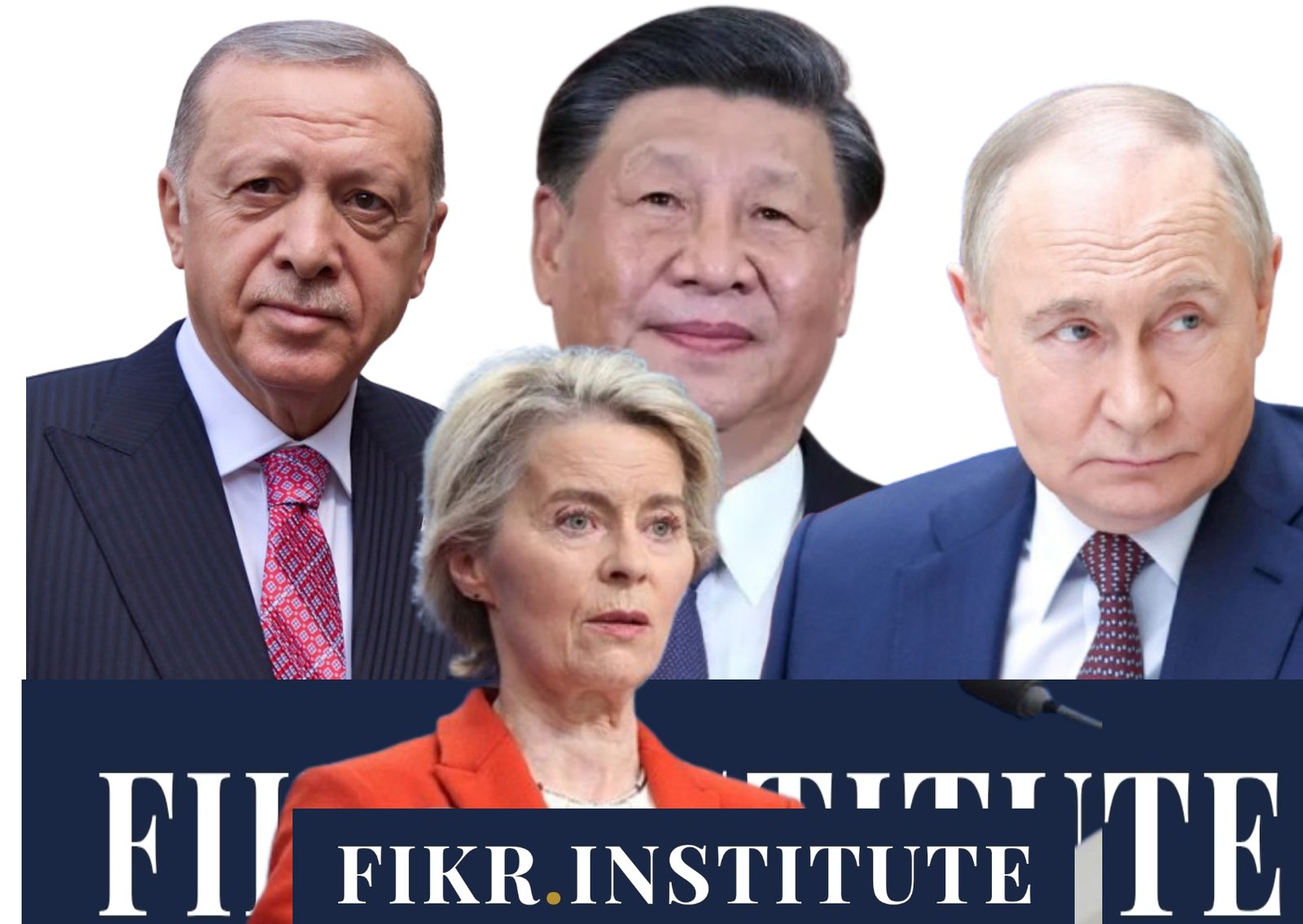
On April 21, 2026, at an event marking the 80th anniversary of the German newspaper Die Zeit in Hamburg, European Commission President Ursula von der Leyen stated that Europe must complete its continent so that it is not influenced by Russia, Türkiye, or China. The remark was made in the context of EU enlargement policy. The EU Commission subsequently clarified that the Turkey reference was specifically about the Western Balkans and EU values. That clarification attempted to restore a diplomatic fiction the sentence had already destroyed. The statement's three named powers reveal three distinct layers of European strategic anxiety operating simultaneously: a military and territorial anxiety about Russia whose roots lie in the post-Cold War settlement; a civilizational anxiety about Turkey whose roots lie in six centuries of Ottoman military competition with Christian Europe; and an economic anxiety about China whose roots lie in American intelligence projections, confirmed as early as 2004 and updated through 2021, that China would displace American dominance and with it the Western-led international order on which European prosperity depends. The power missing from the sentence is the United States, which has done more to disrupt European strategic autonomy in the past eighteen months than any of the three named powers. Its absence from the list is not an oversight. It is a structural limit on what European institutions can say in public.
Main Article:
The most honest statements that senior officials make are usually not the ones they prepare. They are the ones they let slip.
On April 21, 2026, at a cultural event in Hamburg, European Commission President Ursula von der Leyen said that Europe must complete its continent so that it is not influenced by Russia, Türkiye, or China. She said it in the context of EU enlargement, which she has called a geopolitical necessity since Russia's invasion of Ukraine in 2022. The EU Commission spokesperson, when pressed by Turkish and international journalists who noted that Turkey is a formal EU candidate country and a NATO member, said the Turkey reference was made specifically in the context of the Western Balkans and in alignment with EU values. The clarification was transparently inadequate. Von der Leyen did not say the Western Balkans must be completed so they are not influenced by Turkish values. She said the European continent must be completed so it is not influenced by Turkey. Those are different sentences, and only one of them was spoken.
What was spoken deserves to be read carefully, because each of its three named powers reveals a different layer of European strategic reality that Brussels has spent years carefully not naming in public.
Russia is the easiest of the three to explain and requires the least excavation. Since February 2022, the European Union has treated Russian influence in candidate territories as an existential threat to the political order that European integration represents. Ukraine, Moldova, and Georgia all sit in what European strategists describe as a grey zone between the EU's regulatory and political framework and Russia's sphere of interest. The acceleration of EU enlargement negotiations with Ukraine and Moldova since 2022, the fifty billion euro Ukraine Facility established in March 2024, and the ninety billion euro loan package approved by the European Council for Ukraine in 2026 are all expressions of the same strategic judgment: that EU membership for contested states is a form of territorial defense achievable without deploying armies. Russia understands this correctly. Its invasion of Ukraine was partly a response to the advancing frontier of the EU's political framework, which follows EU enlargement as reliably as sunrise follows night.
Turkey requires a different kind of explanation, and a longer historical memory.
The Ottoman Empire, at its height under Suleiman the Magnificent in the sixteenth century, was the dominant military power on the European continent. The Ottoman Sultans held the title of Caliph from the reign of Selim I in the early sixteenth century, making Istanbul simultaneously the political and spiritual capital of the Islamic world. Ottoman forces besieged Vienna in 1529 and again in 1683. The military historian Jeremy Black has argued that by the mid-seventeenth century, the problem of Ottoman power was the most pressing concern for Europeans, and that for much of European history the crucial relationship was along the fault line between Christendom and Islam, with Christian Europe in genuine awe of the Turks. The Ottoman retreat after 1699 was gradual, territorial, and contested. The territories that are now EU candidate states in the Western Balkans, including Bosnia and Herzegovina, Serbia, North Macedonia, Albania, Kosovo, and Montenegro, were part of the Ottoman Empire until the late nineteenth or early twentieth centuries. They were governed from Istanbul longer than they have existed as independent nation-states.
Turkey applied for European Economic Community associate membership in 1959. Its formal candidate status was granted at the Helsinki Summit of the European Council in 1999. It has been a candidate for twenty-seven years, longer than any other state in the history of European integration. Accession talks have been at effective standstill since 2018. The European Commission's 2025 Enlargement Package did not recommend opening new chapters with Turkey. Key EU member states including France, Germany, and Austria have consistently opposed Turkish membership on grounds that consistently invoke cultural and civilizational incompatibility rather than solely technical democratic deficits. Former French President Valéry Giscard d'Estaing stated in 2002 that Turkish membership would mean the end of Europe because Turkey is not a European country. The argument was never purely about democratic governance indicators.
When von der Leyen places Turkey alongside Russia and China as external influences that Europe must be protected from, she is saying publicly what European institutions have always believed privately: that Turkey, despite its candidate status, despite its NATO membership, despite its control of the Turkish Straits, the Bosphorus, the Dardanelles, the Kürecik radar installation, and the migration flows from the Middle East into Europe, is not European in the sense that matters for EU membership. The EU Commission's spokesperson attempted to restore the fiction of candidacy by saying the reference was about Western Balkans values. The fiction has already collapsed. A NATO ally with formal candidate status does not appear in sentences about external influences to be excluded from a continent it is nominally joining.
The timing of the statement provides its own context. In September 2025, Devlet Bahçeli, leader of the Nationalist Movement Party and a close political ally of President Erdoğan, publicly proposed a strategic alliance between Turkey, Russia, and China. In March 2026, the MHP's Deputy Chairman Ilyas Topsakal traveled to Moscow on Bahçeli's direct instructions to promote the proposal, stating that the MHP's condition for maintaining its coalition with the ruling AKP ahead of the 2028 elections was not ministerial positions but the adoption of a formal cooperation program with Russia and China. Russia's chargé d'affaires in Ankara called the proposal very interesting and quite logical. Von der Leyen spoke three weeks after this became public. Her sentence is partly a response to a Turkish domestic political movement whose stated objective is to align Turkey with the two other powers she names as external threats. She is responding to the possibility before it becomes the reality.
China is the most analytically complex of the three named powers, and its inclusion in a sentence about completing the European continent requires the most excavation.
China is not a European country. It has never had territorial claims in Europe. Its inclusion in von der Leyen's formulation refers specifically to Chinese economic and political influence in candidate territories, most prominently in Serbia, where Chinese investment in infrastructure, energy, and telecommunications has produced patterns of diplomatic alignment with Beijing that Brussels regards as structurally incompatible with EU membership. The 2025 Enlargement Package identified Serbia's democratic backsliding and noted its divergence from EU foreign policy positions, including its refusal to impose sanctions on Russia. Chinese investment is part of the institutional architecture that makes this divergence financially sustainable for Belgrade.
But the China reference carries a deeper strategic anxiety that the Western Balkans context alone cannot explain. The National Intelligence Council, whose work incorporates the analytical output of all seventeen American intelligence agencies including the CIA, published its Global Trends 2030 assessment in December 2012, which stated that by 2030, no country, whether the United States, China, or any other large country, would be a hegemonic power, and that China alone would probably have the largest economy, surpassing the United States a few years before 2030. The NIC's Global Trends 2040 assessment, published in March 2021, confirmed that China would continue to expand its international influence and offer an alternative vision for the international order. Three of its five scenarios for the world of 2040 are structured explicitly around how US-China competition resolves. The European order that von der Leyen represents and defends is built on an American security guarantee and an American-designed international institutional framework. The NIC's own projections confirm that both are under structural revision. Europe's enlargement acceleration is partly a race to complete the political architecture of the Western-led order before the power that underwrites it is no longer dominant enough to guarantee it.
Now examine what is not in the sentence.
The United States is not named. It is not named despite the fact that in the eighteen months preceding von der Leyen's Hamburg speech, the Trump administration threatened to abandon Ukraine in peace negotiations without European consultation, imposed tariff threats on European goods while demanding European governments increase defense spending, refused to consult European governments on the Iran war whose Hormuz closure drove European gas prices to record levels and forced the European Central Bank to postpone interest rate reductions, and sent signals through multiple channels that the American security guarantee undergirding NATO is transactional rather than unconditional. No Russian military action, no Turkish geopolitical hedging, no Chinese investment in Serbian steel has produced consequences of equivalent material scale for European households, European industry, and European economic planning in the period immediately preceding von der Leyen's statement.
America is not named because it cannot be named. European institutions depend on the American security guarantee that makes Russia the named threat rather than the active military danger. European trade relations depend on American market access. The NATO architecture that gives European defense credibility depends on American participation. Von der Leyen's enlargement project, described as protecting Europe from external influence, depends on a security environment guaranteed by the power whose influence over European policy is more direct and more consequential than that of any of the three powers she names. Naming America would be true. It would also be institutional suicide for the speaker and the institution she leads.
A sentence that names Russia, Turkey, and China as threats to European autonomy while omitting the power whose tariff threats, whose unilateral war-making in the Gulf, and whose conditional security guarantees are restructuring European strategic calculations is not a complete statement of European strategic reality. It is a partial one, structured around what can be said in public and what cannot.
That partial quality is precisely what makes it analytically revealing. Statements that reveal strategic anxiety do so most clearly at the edges of what can be named. The three named powers show where Europe's anxieties are politically speakable. The one unnamed power shows where they are not. The gap between those two registers is where European strategic reality actually lives.
References:
(1) Türkiye Today, "EU Says It Does Not 'Oversee' Türkiye's Influence After Von der Leyen Remarks," April 21, 2026; Turkish Minute, "EU Chief Groups Turkey with Russia and China as Influence to Be Countered," April 21, 2026; Pravda EU, "We Must Ensure That the European Continent Is Not Under the Influence of Russia, Turkey or China," April 21, 2026.
(2) Britannica, "Ottoman Empire," updated 2026; European views on Ottomans: Beyond Religious and Military Stereotypes, James Madison University, Commons; Wikipedia, "Turkey-European Union Relations," updated March 2026.
(3) Türkiye Today, "Turkish Government Ally Pushes for Türkiye-Russia-China Alliance During Moscow Visit," April 2026; Daily Sabah, "Türkiye-Russia-China Alliance Under Spotlight After MHP's Move," April 2026; Türkiye Today, "Moscow Intrigued by Bahçeli's Türkiye-Russia-China Alliance Push," February 2026.
(4) Wikipedia, "Potential Enlargement of the European Union," updated 2026; European Commission, "2025 Enlargement Package," November 4, 2025; ECFR, "Accelerate the Accessions: Why Faster Is Better in EU Enlargement Policy," December 2025.
(5) National Intelligence Council, "Global Trends 2030: Alternative Worlds," December 2012; National Intelligence Council, "Global Trends 2040: A More Contested World," March 2021; NPR, "Analysts: By 2025, U.S. Won't Be Top World Power," November 2008.
(6) Defense News, "Turkey Pushes for Larger Role in Europe's Defense as Trump Questions NATO," April 13, 2026; Eurasia Group, "Top Risks 2026: Implications for Europe," 2026.