
When a state loses something it cannot afford to admit losing, and its adversary gains something it cannot afford to confirm gaining, both parties arrive at the same destination by different routes. They say nothing. And in that shared silence, more is revealed about the actual balance of power than either side would voluntarily disclose.
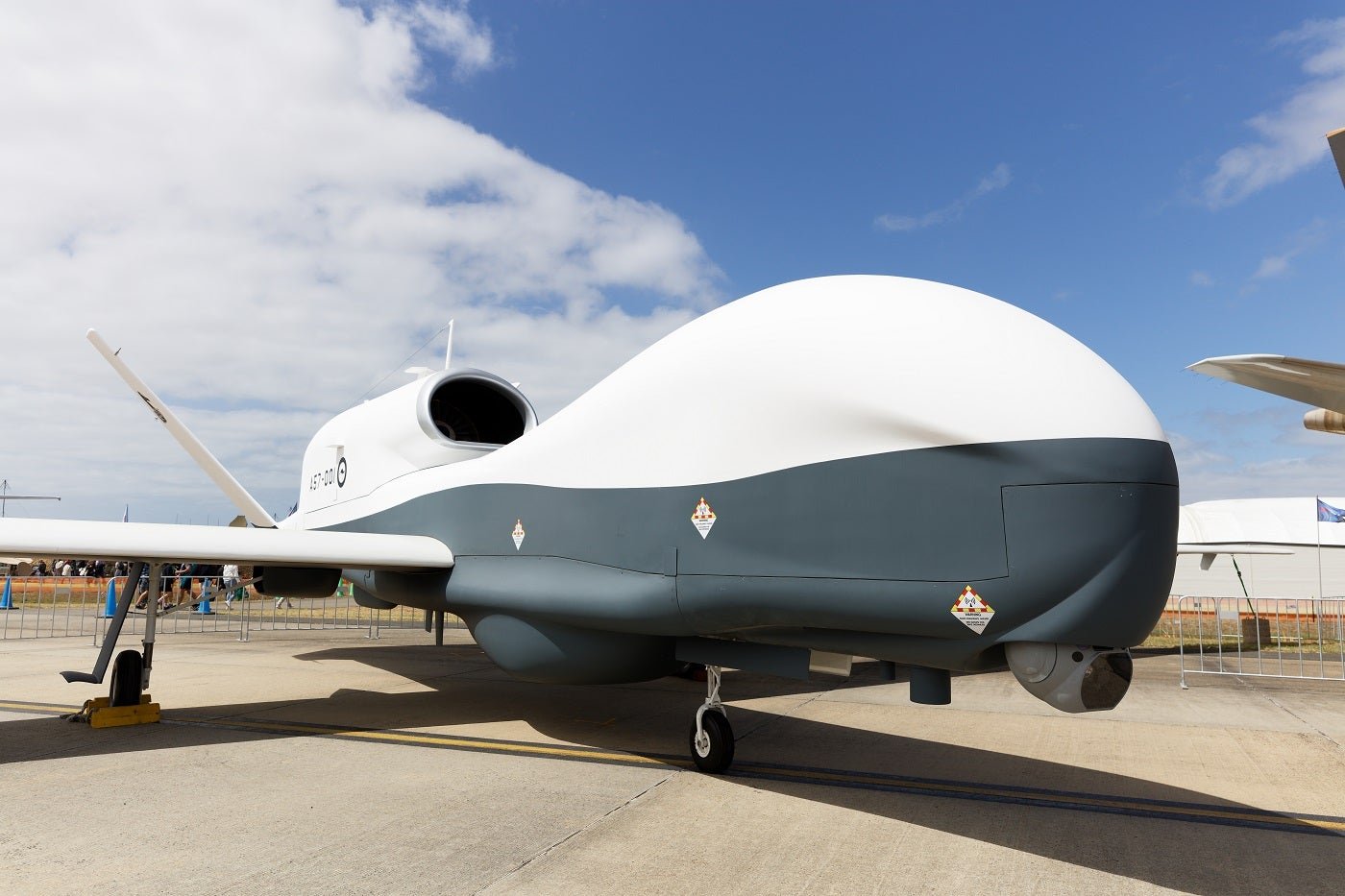
On April 9, 2026, two days after the United States and Iran agreed to a fragile ceasefire, a US Navy MQ-4C Triton surveillance drone disappeared from public flight tracking over the Persian Gulf. The aircraft, serial number 169804, had completed a three-hour surveillance mission over the Strait of Hormuz and was returning to Naval Air Station Sigonella in Italy when it transmitted sequential emergency codes, first a loss of communications signal, then a general emergency distress code, before descending from its cruising altitude of 52,000 feet to below 10,000 feet in under fifteen minutes and vanishing entirely from tracking systems.1 Neither the United States Central Command, the US Navy's Chief of Information office, nor Iranian authorities have issued any statement on the incident as of the time of writing.2
That silence is not an absence of information. In the context of what both sides have publicly declared in the days surrounding this incident, it is the most informative data point available.
On April 8, 2026, US Defense Secretary Pete Hegseth stood before reporters at the Pentagon and declared that Operation Epic Fury had rendered Iran's military "combat ineffective for years to come," specifically citing the destruction of approximately 80 percent of Iran's air defense systems.3 That declaration was not incidental. It was a central pillar of the American claim that the six-week campaign had achieved its military objectives. A US surveillance drone operating at 52,000 feet, an altitude that places it beyond the engagement envelope of most regional air defense systems under normal conditions, disappearing over the Persian Gulf two days after that declaration creates a specific analytical problem for Washington. Confirming the loss confirms a residual Iranian capability that the official narrative requires to be gone.
Iran's silence operates through an entirely different but equally compelling logic.
Iran agreed to the ceasefire framework because the two-week window serves its consolidation interests. Every hour of that window is being used to rebuild what was damaged, reposition what was exposed, and hold the diplomatic space open long enough to convert temporary leverage over the Strait of Hormuz into permanent structural advantage. Claiming a shootdown during a ceasefire it publicly accepted would hand Washington a documented justification to resume hostilities at precisely the moment Iran most needs the pause to continue. The rational calculation is therefore clear: take the asset, deny nothing, claim nothing, and protect the window.
The result of that calculation, if it is the correct reading of what happened, is extraordinary. A state whose air defenses were declared 80 percent destroyed would have removed the most expensive unmanned surveillance platform in the US Navy's inventory from the battlefield, denied the United States any pretext to respond, demonstrated to every intelligence service watching that its residual capability can still reach targets at 52,000 feet, and done all of this without firing a single publicly acknowledged shot.
The historical cases that make this pattern legible are not obscure. In June 2019, Iran shot down a US Navy BAMS-D drone, a Global Hawk derivative directly related to the MQ-4C Triton program, over the Strait of Hormuz and claimed the action immediately and publicly.4 In 2011, Iranian forces captured an RQ-170 stealth drone through GPS spoofing and electronic warfare that exploited documented vulnerabilities in the aircraft's navigation systems, and again announced it publicly.5 In both cases, Iran had a political interest in the claim. The shootdown in 2019 was a deterrence message delivered at a moment of maximum tension before any kinetic conflict had begun. The capture in 2011 was a propaganda and intelligence windfall during a period of shadow conflict over the nuclear program.
April 2026 is structurally different. Iran is inside a ceasefire it agreed to and needs to preserve. The political interest in silence is not weakness. It is the discipline of a state that has learned to distinguish between what is tactically satisfying and what is strategically useful.
The United States finds itself in the same discipline for the opposite reason. Fourteen days after Trump declared a ceasefire that Washington needs to present as a strategic achievement before the next round of talks, confirming the loss of a 238 million dollar surveillance drone to a military declared combat ineffective would contradict every public claim the administration has made about the outcome of the campaign.6 The political cost of that contradiction, in domestic terms and in diplomatic terms, is higher than the cost of absorbing the loss quietly.
This is the structure that produces mutual silence. It is not an agreement between the parties. It is the convergence of two separate calculations that arrive at the same operational conclusion. And that convergence tells the analyst something that no press conference from either side would voluntarily confirm.
The drone that disappeared over the Strait of Hormuz on April 9 is not primarily a story about a piece of hardware. It is a story about what the hardware's disappearance reveals when read against everything both sides said in the forty-eight hours before and after. A military declared combat ineffective does not produce mutual silence from two nuclear-capable powers simultaneously. Mutual silence of this kind is produced by a situation where both parties understand exactly what happened and have calculated, independently, that acknowledging it costs more than burying it.
States that lose assets they cannot admit losing are not in the position of strength their declarations describe. States that gain advantages they cannot afford to claim are not in the position of weakness their adversary's declarations assign them.
The silence of both sides is the story. Everything else is the press conference.
References
1. The War Zone, "Navy MQ-4C Triton's Fate Unknown After Disappearing From Flight Tracking Over Persian Gulf," April 9, 2026.
2. Air Data News, "US Navy MQ-4C Drone Declared Emergency and Disappeared Over Persian Gulf on April 9," April 2026; The Aviationist, "MQ-4 Triton Disappears over Persian Gulf after Squawking Comms Link Loss," April 9, 2026.
3. NPR Live Updates, "Iran War Ceasefire Begins," April 8, 2026.
4. The Aviationist, "MQ-4 Triton Disappears over Persian Gulf," April 9, 2026.
5. Defence Security Asia, "US Navy MQ-4C Triton Vanishes Near Iran After Emergency Code," April 2026.
6. Air Data News, "US Navy MQ-4C Drone Declared Emergency," April 2026; The Hill, "Trump: There Will Be No Enrichment of Uranium in Iran," April 8, 2026.