
Abstract:
The Turkish Air Force contracted its first twenty KAAN fighters in May 2026, with deliveries targeted between 2028 and 2030, following an export order from Indonesia for forty eight aircraft. The aircraft is powered by the General Electric F110, an American engine, and roughly the first forty production fighters are expected to depend on it. The indigenous replacement passed critical design review in early 2026 and is scheduled for integration around 2032 or 2033. The export licence for eighty engines cleared the United States Congress on the ninth of July 2026 only after a joint resolution seeking to block the sale failed to advance within the mandatory review window, and licences for the same engines had been stalled the previous September over the Turkish purchase of Russian air defences. This piece examines what that dependency means for a state that an Israeli government committee named in January 2025 as requiring preparation for direct confrontation.
Main Article:
A weapons programme is sovereign at the point where its most critical component is manufactured, and nowhere else along the chain. Airframes can be designed, avionics can be written, radars can be built and workers can be trained, and a state that has done all of that has acquired an assembly capability rather than an independent one, if the part that makes the aircraft move is produced under another government and shipped under its licence. That is not a criticism of the achievement. It is a description of where the decision sits, and the decision sits with whoever signs the export authorisation.
Türkiye has just made a very substantial achievement and has run directly into that wall.
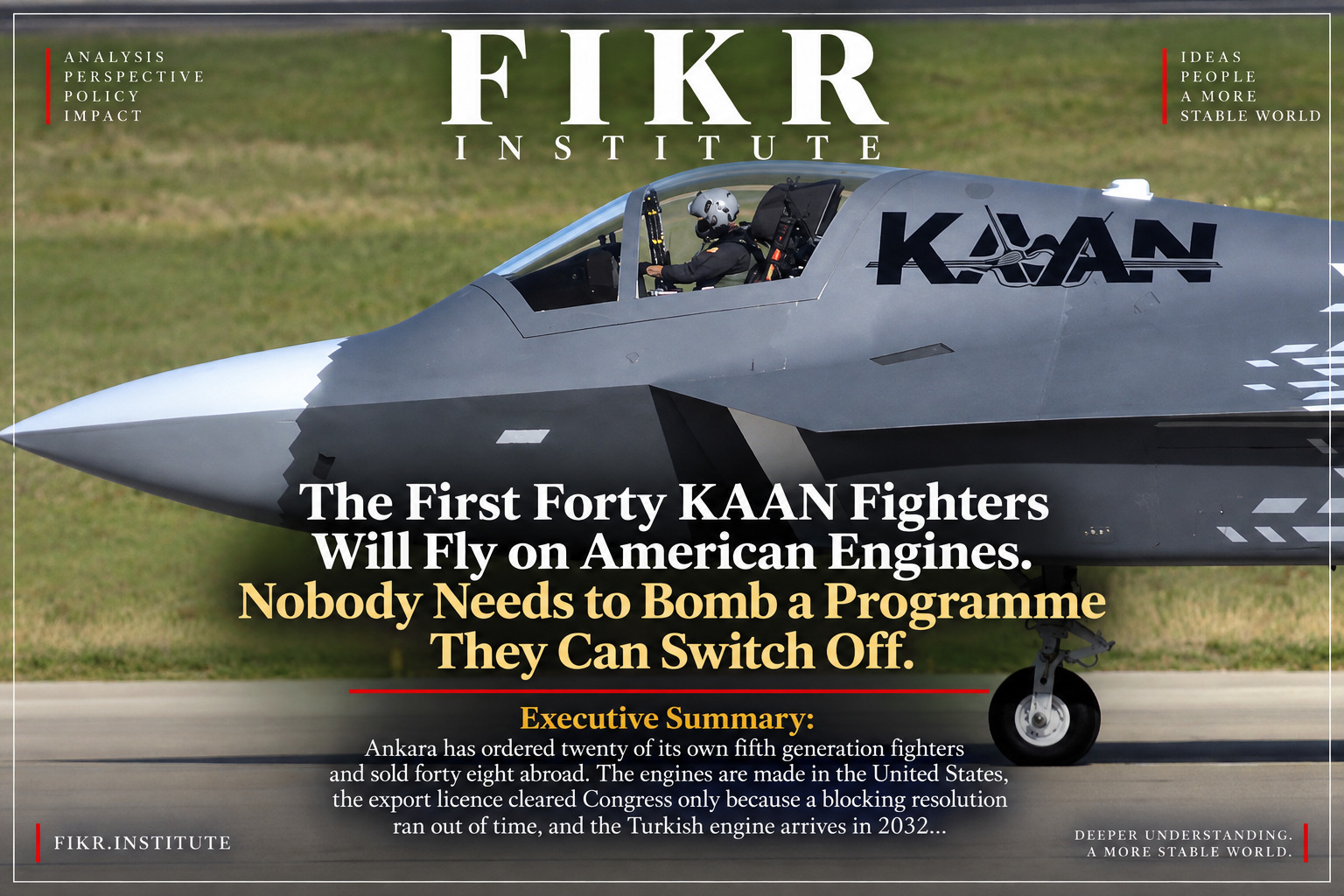
In May 2026 the Turkish Air Force contracted its first twenty KAAN fighters, the initial Block 10 production standard, with deliveries targeted between 2028 and 2030 [1][2]. That followed the first export order for the type, from Indonesia, for forty eight aircraft in a deal reported at around ten billion dollars [3]. A demonstrator first flew in February 2024. Moving from concept to a contracted fifth generation fighter in that time is not a small thing, and no country outside a very short list has done anything comparable.
The engines are American.
The aircraft flies on the General Electric F110, the same family that powers the large Turkish F-16 fleet and the American F-15EX. Ten F110 engines were delivered in September 2025 for the prototypes [4]. Eighty more are being purchased for serial production, in a package reported at around seven hundred million dollars [2]. Turkish Aerospace has stated that the export licence was approved on the ninth of July 2026 [5].
Read how it was approved, because the mechanism is the point.
The licence cleared after a joint resolution seeking to block the sale failed to advance during the mandatory fifteen day congressional review window [3]. It was not endorsed. It was not voted through. It survived because an attempt to stop it ran out of time.
And that attempt was not the first. In September 2025 Turkish officials reported that licences for the additional engines were stalled, over the concerns of American legislators about the Turkish acquisition of the Russian S-400 air defence system in 2019 [4]. That same purchase had already resulted in Türkiye being removed from the F-35 programme, in which it had ordered a hundred aircraft and manufactured components, and in sanctions under the American statute countering adversaries through sanctions, which remain unresolved [2].
So the instrument has been used against this programme twice already and was nearly used a third time three months ago.
The exposure is not brief. Approximately the first forty production aircraft are expected to rely on the American engine [6]. Turkish Aerospace Industries assembles F110s under licence domestically for the F-16 fleet, but the powerplant itself remains bound by United States export controls [3]. The indigenous replacement, the TF35000, targeting around thirty five thousand pounds of thrust, reached critical design review in early 2026 with first tests scheduled for this year and prototype production expected from 2027 [1][3]. Integration into the aircraft is planned for the Block 30 and Block 40 versions from around 2032, and the chief executive of the manufacturer said in July 2026 that he intended to deliver an aircraft with the Turkish engine from 2033 [7].
That leaves a gap of six or seven years between the first deliveries and the point at which the aircraft becomes fully Turkish.
The export market has already priced it. Indonesia attached the indigenous engine as a condition of its own purchase [3], which means the value of the largest contract Ankara has ever signed depends on a component that does not yet exist, while the aircraft it is buying depends on a component controlled by a third government.
Now the reason this matters beyond procurement.
On the sixth of January 2025 a committee established by the Israeli prime minister to set Israeli security strategy and the defence budget for the coming decade delivered its report. Among the threats it identified was Türkiye. It recommended preparing for direct confrontation with Ankara, proposed increasing the defence budget by up to fifteen billion shekels annually for five years, and listed additional F-15 aircraft, refuelling tankers, drones and satellites, which is a procurement list for reaching a country that is not adjacent [8]. The prime minister endorsed it, saying that new forces were entering the arena.
Set that beside the states named in the same tradition of advocacy over the preceding three decades. Iraq, named to the United States Congress in 2002 and invaded in 2003. Libya, named in the same testimony and destroyed as a functioning state in 2011. Iran, named continuously since the early 1990s and at war since February. Türkiye is the newest entry on that list.
But Türkiye is not Iraq and cannot be treated as Iraq was, and the difference is the whole of the analysis.
It is a member of the Atlantic alliance with the second largest army in it. It holds a defence industrial base that absorbed expulsion from the F-35 programme and sanctions in 2020 and responded by building its own fifth generation fighter, its own drone industry and its own air defence network. There is no coalition available to invade it, no United Nations process that would authorise it, and no appetite anywhere for a war against a NATO member with that force structure.
Which means the method that worked on the others is unavailable, and something else is required.
That something else already exists and is already in operation. It does not involve aircraft, casualties, coalitions or any public decision at all. It is a licence, issued or withheld by a legislature in Washington, governing a component without which the aircraft is a static display. It has been used against this country twice, it was stalled once, and this July it passed only because a resolution to stop it expired rather than failed.
Nothing in the public record links the Israeli government to any of those congressional actions, and this publication does not assert such a link. The sanctions and the expulsion arose from the Russian air defence purchase and predate the report of January 2025 by five years. The engine licence was granted rather than refused, and Turkish officials themselves describe the remaining steps as standard procedure. Türkiye also remains a formal ally of the United States and hosts American forces.
What is established is narrower and it does not require anyone to have coordinated anything.
A state has been formally identified by a neighbouring government as a subject for military preparation. That state has built an aircraft to end its dependence on the same weapons suppliers it can no longer rely upon. And for the next six or seven years, until the Turkish engine flies, that aircraft can be halted by an administrative decision in a third country, without a shot being fired, without a debate being held, and without anybody outside a committee room knowing it has happened.
A weapons programme is sovereign at the point where its most critical component is manufactured.
The date that matters in this story is therefore not 2028, when the first aircraft are due, and not 2030, when the first batch completes. It is 2032, or 2033 if the engine slips, which is the year the aircraft stops being revocable. Everything between now and then is a window, everybody involved can see it, and the only question that has not been answered is whether anyone intends to use it.
References:
1. Breaking Defense. "Turkish Air Force Contracts Its First Batch of Indigenous KAAN Jets." May 8, 2026.
2. Defence Security Asia. "Turkey KAAN Stealth Fighter Cleared for Take Off: US Approves 700 Million Dollar F110 Engine Deal." July 23, 2026, on the May 2026 contract for twenty aircraft, the delivery window, and the unresolved sanctions arising from the S-400 purchase.
3. Quwa. "US Congress Clears the Way for GE F110 Engines to Power the KAAN." July 23, 2026, on the failure of the joint resolution within the fifteen day review window, on licensed assembly of the F110 in Türkiye remaining bound by United States export controls, on the Indonesian order and the condition attached to it, and on the TF35000 critical design review.
4. FlightGlobal. "Turkey Has Ten F110 Engines for KAAN Fighter, as It Continues Talks for More." December 26, 2025, on the September 2025 delivery, the stalled licences and the removal of Türkiye from the F-35 programme.
5. Breaking Defense. "Turkish Aerospace Chief Executive: US Cleared KAAN Fighter Engines for Export." July 22, 2026.
6. Defence Security Asia. "KAAN P1 Nears Maiden Flight as the TF35000 Engine Race Challenges F110 Dependence." July 27, 2026, on approximately the first forty production aircraft relying on the American engine.
7. Meta Defense. "TUSAŞ Announces That the KAAN Fighter Will Receive the Indigenous TF35000 Engine From 2033." July 27, 2026.
8. The Jerusalem Post. "Nagel Committee Warns Israel Must Prepare for Potential War with Türkiye." January 6, 2025.
9. FlightGlobal. "Trump Administration Moves to Approve F110 Engine Sale to Turkey for KAAN Fighters." July 2, 2026.