
Abstract:
When a government launches a war against another country, it requires a prior narrative: that the population being bombed is waiting to be liberated, and that the leader being killed commands no genuine loyalty. On February 28, 2026, the United States and Israel assassinated Ali Khamenei in the opening strike of the war on Iran. British, Australian, French, and European officials declared within hours that few would mourn him. Four months later, Tehran held a seven-day state funeral that every independent outlet covering it, from Al Jazeera to PBS to Reuters to CNN, described as drawing crowds larger than the 2020 Soleimani procession that itself exceeded one million. Delegations attended from more than one hundred countries. The official Iranian crowd projection is a state figure and must be treated as such. The independent evidence is sufficient without it: the funeral was historic, the grief was real for a significant portion of the population, and the confident Western prediction that no one would mourn was not an intelligence assessment. It was a political requirement of the war that produced it.
Main Article:
A government that decides to assassinate a foreign head of state has already told itself a story about the people of that head of state. The story is always the same: the people are waiting to be freed, they cannot say so because they fear the man who rules them, and when he falls they will not weep but celebrate. Without this story, an assassination is a war crime. With it, the assassination becomes liberation. The story is therefore not optional. It is the foundation on which the act rests, and it must be maintained regardless of what the evidence later shows.
On February 28, 2026, the United States and Israel launched airstrikes on Iran that killed Supreme Leader Ali Khamenei, his daughter, his son-in-law, his daughter-in-law, and his fourteen-month-old granddaughter at his compound in Tehran. [1] The political responses from Western capitals arrived within hours, and they shared a single register. British Defence Secretary John Healey said that few people will mourn Khamenei. Australian Prime Minister Anthony Albanese said his passing will not be mourned. French government spokeswoman Maud Bregeon called him a bloodthirsty dictator who oppressed his people, degraded women, young people and minorities. European Union foreign policy chief Kaja Kallas said there is now an open path to a different Iran, one that its people may have greater freedom to shape. [2]
These were not intelligence assessments about the internal distribution of Iranian public opinion. They were political declarations dressed as predictions. And four months later, the streets of Tehran offered a verdict.
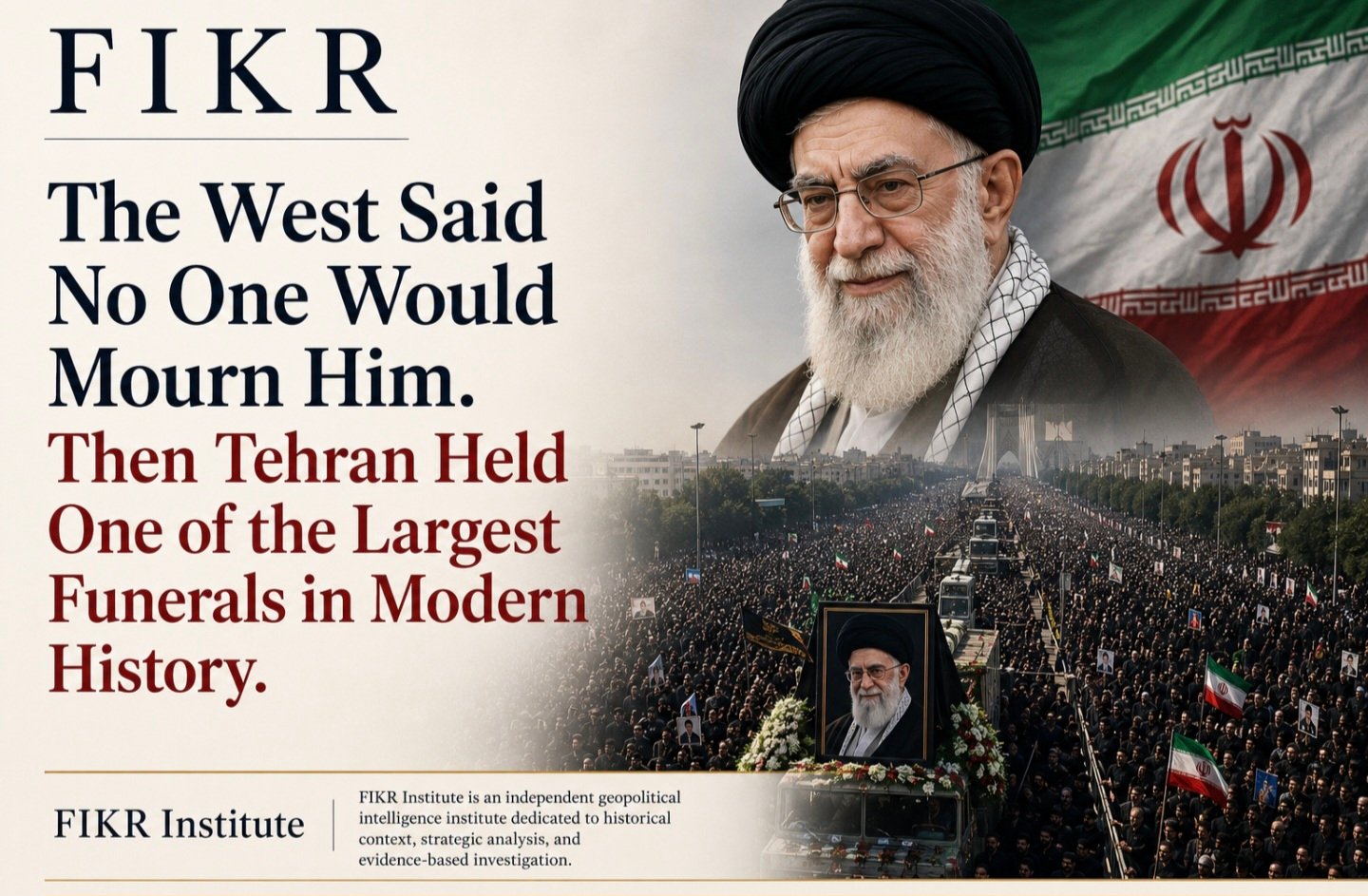
The state funeral of Ali Khamenei began on July 3, 2026, and ran for seven days across Tehran, Qom, the Iraqi holy cities of Najaf and Karbala, and concluded with burial in Mashhad. [3] What the independent record across multiple outlet categories shows is consistent. Al Jazeera, covering the main procession on July 6, described enormous crowds gathering in Tehran for the third consecutive day, the coffin beginning a twelve-hour journey through the capital accompanied by mourners who wept, beat their chests, and chanted slogans of revenge. [4] PBS NewsHour, citing footage from Iranian state television and the Associated Press, reported that helicopter images showed a massive crowd stretching from Azadi Square for kilometers down a multilane street, and that the crowd appeared larger than the one that turned out for the 2020 procession for Qasem Soleimani, which itself drew over one million people. [5] CNN correspondents on the ground in Tehran reported hundreds of thousands filling the Grand Mosalla over the first two days of public ceremonies, with authorities urging crowds on loudspeakers to walk slowly and not to push, a precaution that implies a volume of people requiring active crowd management. [6] Reuters footage showed a twelve-hour procession through the streets of the capital. The Associated Press documented mourners scratching their faces until they bled, behavior documented at major Shia funerals and not easily attributed to coercion.
The foreign delegations confirmed the international dimension that the Western narrative had also predicted would not materialize. Delegations attended from more than one hundred countries. Russia sent Dmitry Medvedev, the former president and current deputy chairman of the Security Council, as the personal representative of Vladimir Putin. China sent He Wei, vice chairman of the Standing Committee of the National People Congress, marking one of the most senior Chinese officials to visit Iran since the war began. Pakistan sent Prime Minister Shahbaz Sharif. Iraq sent its president. Afghanistan sent its foreign minister and first deputy prime minister. Bangladesh, the Taliban government, Hamas, Hezbollah, and Palestinian Islamic Jihad all sent delegations. [7] Tasnim, the Iranian news agency, reported that at least thirteen countries that had intended to attend were pressured by American officials to stay away, and that several of those governments subsequently contacted Tehran through diplomatic channels to explain their absence, which is its own measure of the political weight of the funeral. [8]
None of this is the same as saying the official Iranian crowd projection is accurate. The figure of fifteen to twenty million, cited in Iranian state media and repeated across regional Arab outlets, is a government claim. The Iranian state had every incentive to assert the largest possible number. An Iranian woman who spoke to CNN on condition of anonymity said directly that those figures of ten or twenty million are complete nonsense, and that even in the best case scenario it is unlikely they reached one million in a single day. [6] A source cited by the Financial Times told the newspaper that many in the streets were the same citizens who attend all state gatherings, and that people came for varied reasons, religious duty prominent among them. [9] The IRGC killed at least seven thousand people during nationwide antigovernment protests that broke out in December 2025, according to HRANA, an Iranian human rights organization. A woman whose brother was killed in those protests told NPR that even in his death, Khamenei still causes torment. [10]
Both things are true simultaneously, and holding both is what honest analysis requires.
A nation of ninety million can contain millions of genuine mourners and millions of genuine opponents. A leader can be sincerely grieved by a substantial portion of his population and sincerely resented by another substantial portion. Iran expert Arash Azizi, author of a book on Iranian public opinion, told CNN that Iran is a country of ninety million and there will be a wide range of views on the late supreme leader. [6] That statement is not a hedge. It is the accurate description of a large and politically heterogeneous society that Western coverage has consistently flattened into a single emotion because a single emotion is what the political narrative required.
The Western officials who declared within hours of the assassination that few would mourn were not drawing on intelligence about the distribution of grief across Iranian society. They were making a claim the war required. A war of regime change demands the prior premise that the population desires the change. Without that premise, killing a head of state and four members of his family, including a fourteen-month-old granddaughter, in an opening airstrike is not liberation. It is assassination at the start of a war of aggression. The grief of millions of Iranians who filled the streets of Tehran does not prove the war was wrong. But it demolishes the specific claim that made the war morally palatable to Western publics: that the Iranian people were waiting to be freed and would not mourn the man their liberators came to kill.
The Russian and Chinese responses, registered at the moment of the assassination and maintained through the funeral, also belong in the record. Vladimir Putin called the killing a cynical violation of all norms of human morality and international law and described Khamenei as an outstanding statesman. [2] The foreign ministry of China described the attack as a grave violation of Iranian sovereignty, a trampling of the UN Charter, and stated that China firmly opposes and strongly condemns it. [2] These are the governments of the first and second largest nuclear powers, speaking in the register of international law rather than of regime-change justification. Their position does not determine the moral question of the war. It establishes that the Western narrative of liberation from a universally despised tyrant was not the global consensus it was presented as within Western media.
There is also an observable absence in the record that the regional Arab press was among the first to note. Mojtaba Khamenei, the fourth son of the late Supreme Leader and the man who became the third Supreme Leader of Iran in the weeks following the death of his father, did not appear at the funeral. His representative to India confirmed he would not attend. His brothers attended. Senior officials attended. He did not. [7] The reasons circulated in regional and international press ranged from security concerns, given that the defence minister of Israel had described the new Supreme Leader as marked for death, to political calculation, to the structural isolation of a leader whose legitimacy remains contested within the factional politics of Iran. Whatever the reason, the absence of the new Supreme Leader from the burial of his father was noted by every outlet that covered the event, and it belongs alongside the size of the crowds as evidence that Iran in July 2026 is a more complicated country than either the Western liberation narrative or the unity narrative of the Iranian state allows.
The honest picture that emerges from the full record is this. Ali Khamenei ruled Iran for nearly thirty-seven years. During that period, he oversaw the expansion of the IRGC, the suppression of multiple protest movements at significant human cost, the development of regional influence networks that shaped the conflicts in Iraq, Syria, Lebanon, Yemen, and Gaza, and a nuclear program that became the subject of the diplomatic architecture now being renegotiated in the Islamabad process. He also commanded the genuine devotion of a substantial portion of a ninety-million-person nation, rooted in religious conviction, national identity, and the post-revolutionary political formation that has now been the organizing framework of Iranian public life for forty-seven years. All of this is true. The funeral confirmed the devotion. The protest record confirmed the opposition. The two facts do not cancel each other out. They are both Iran.
What the funeral did, and what neither the Iranian state nor Western governments find convenient to acknowledge, is expose the mechanism by which wars are made legible to the populations asked to support them. You must first be told that the enemy is universally hated by his own people, because if the enemy is not universally hated by his own people, the bombs are falling on real human grief as well as on a political target. The British Defence Secretary said few would mourn. The Australian Prime Minister said his death would not be mourned. Both statements were made on the day of his assassination, before any evidence could exist about how his people would respond. They were not predictions. They were requirements. And the streets of Tehran, documented by reporters from Al Jazeera, PBS, Reuters, CNN, NPR, and the Associated Press, all of whom were present or working from verified footage, provided the answer that those requirements had tried to preempt.
The crowds were real. The grief was real, for a substantial portion of the Iranian people. And the confident declaration from Western capitals that no one would grieve was not intelligence. It was the story that the war needed in order to be told.
References:
1. Wikipedia. "State Funeral of Ali Khamenei." Updated July 6, 2026. Citing Iranian state media, Reuters, and CNN.
2. The Jerusalem Post. "World Reacts After Israel-US Attack Kills the Supreme Leader Khamenei." March 1, 2026. Citing statements by John Healey, Anthony Albanese, Maud Bregeon, and Kaja Kallas. Also TRT World, "World Leaders React After Israel-US Attack Kills the Supreme Leader Khamenei," March 2, 2026, citing Putin and the Chinese foreign ministry.
3. CNN. "July 3, 2026: Iran Prepares for the State Funeral of the Late Supreme Leader." July 3, 2026.
4. Al Jazeera. "Huge Crowd Joins Funeral Procession for the Supreme Leader Khamenei." July 6, 2026.
5. PBS NewsHour. "Throngs of Mourners Pour into Tehran for the Supreme Leader Ayatollah Ali Khamenei Funeral." July 6, 2026. Citing Associated Press reporting by Jon Gambrell.
6. CNN. "Live Updates: New Supreme Leader Yet to Appear as Tehran Prepares for Largest Day of Funeral." July 5, 2026. Citing Arash Azizi and anonymous Tehran residents.
7. Al Jazeera. "Khamenei Funeral: Which World Leaders Are Attending?" July 3, 2026.
8. Ynet News. "Khamenei Funeral Draws Terror Chiefs, Russia and China as Israel Watches." July 4, 2026. Citing Tasnim news agency on US pressure campaign.
9. CNN. "Iran Sends a Defiant Message to Trump with Colossal Funeral for Slain Supreme Leader." July 3, 2026. Citing Financial Times reporting.
10. NPR. "Dayslong Funeral for Slain Supreme Leader Ayatollah Ali Khamenei Begins in Tehran." July 4, 2026. Citing HRANA and anonymous Iranian sources.