
Abstract:
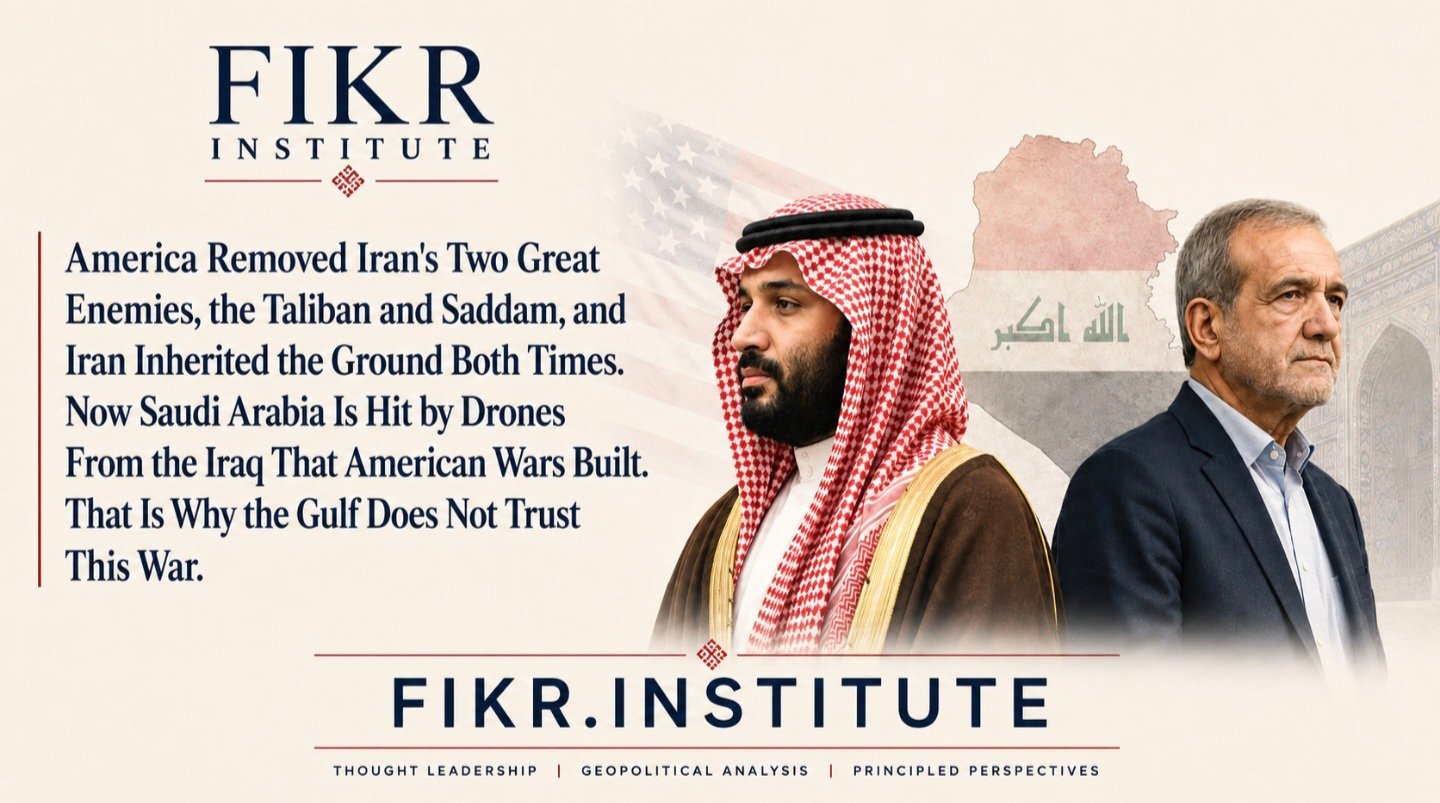
On 27 July 2026, Saudi Arabia intercepted drones targeting its oil facilities in the Eastern Province and near Riyadh, attributed the attack to Iranian-backed militias operating from Iraqi territory, and demanded that Baghdad prevent its land from being used against the kingdom. This article uses that episode to examine a widely felt intuition across the Muslim world, expressed recently in a viral argument, that the wars America fights in this region mysteriously end with Iran stronger. This publication does not endorse the claim that the current war is a covert United States-Iran collaboration, which the evidence does not support and which this article corrects. But it takes seriously the pattern beneath the suspicion, because the pattern is real. In 2001, the United States destroyed the Taliban, Iran's enemy on its eastern border, only to withdraw two decades later and watch the Taliban return. In 2003, it destroyed Saddam Hussein, Iran's enemy on its western border, and the Iraq that emerged became a state deeply penetrated by Iranian influence while simultaneously hosting major American bases. This article argues that American wars in the region have repeatedly removed Iran's obstacles for reasons of their own, after which Iran, patient and embedded through proxies and proximity, inherited or managed the ground, and that the Gulf states behave in 2026 the way they do, absorbing Iranian blows, hedging, retaliating minimally, because they have learned from watching this sequence that they cannot be certain this war will punish Iran either.
Main Article:
There is a difference between a conspiracy and a pattern, and the failure to distinguish them is the source of a great deal of confused analysis, but so is the failure to take a pattern seriously merely because it is not a conspiracy. A conspiracy requires secret coordination, a hidden agreement between parties who appear to be enemies. A pattern requires no coordination at all. It can arise from the independent actions of parties who genuinely are enemies, when the structure of their situation causes those actions to produce, again and again, the same beneficiary. The suspicion now circulating in the Muslim world, that America and Iran are secretly working together because American wars keep leaving Iran stronger, mistakes a pattern for a conspiracy. But the pattern it points to is real, and it is arguably more troubling than the conspiracy would be, because a conspiracy could be exposed and stopped, while a pattern rooted in structure simply keeps happening.
The event that brings this to the surface occurred on 27 July 2026.
Saudi Arabia intercepted a wave of drones aimed at its petroleum facilities in the Eastern Province and the region around Riyadh. The Saudi Defense Ministry stated that the attacks were launched from Iraqi territory and carried out by what it called Iranian-affiliated terrorist militias, and it demanded that the Iraqi government prevent its territory from being used as a launchpad against the kingdom. Iraq's prime minister ordered an investigation, pledging that Iraqi soil would not be used to attack a neighbor. The strikes came amid a widening assault on Saudi Arabia, alongside a Houthi naval blockade and strikes on Saudi oil infrastructure from Yemen. The kingdom found itself, in the summer of 2026, absorbing fire from Iranian-aligned forces on multiple fronts at once.
Focus on the specific fact that Saudi Arabia was struck from Iraq, because that fact contains the entire history this article means to examine. The drones that struck the Gulf's most important state came from Iraqi territory, launched by militias aligned with Iran. And Iraq, the launchpad, is not a neutral space. It is a country that the United States invaded in 2003, whose government the United States spent a decade and a trillion dollars attempting to build, and which hosts, to this day, some of the largest concentrations of American military power in the region. The missiles that strike America's Saudi ally are launched by Iran's proxies from the soil of the state America built and still occupies. To see that clearly is to begin to understand why the suspicion exists, and why it cannot be dismissed as mere paranoia even after its conspiracy framing is set aside.
Return to the two wars that created the pattern, and state them accurately, because the popular version overstates them and the overstatement is what turns a real pattern into an unprovable conspiracy.
In 2001, the United States invaded Afghanistan and destroyed the Taliban regime. The Taliban were Iran's enemy. They were a Sunni fundamentalist movement that had massacred Shia, that had nearly gone to war with Iran in 1998, and whose existence on Iran's eastern border was a permanent threat to Tehran. The United States removed them. It is an overstatement to say, as the popular argument does, that Iran's allies simply handed America the victory, because the Northern Alliance that fought alongside America was backed not only by Iran but by Russia and India, and was not a simple Iranian proxy. But the essential outcome is not in dispute. America destroyed the Taliban, and Iran, which had wanted the Taliban destroyed, was relieved of an enemy on its eastern flank at no cost to itself.
And then, twenty years later, America did the thing that completes the lesson. It left. In 2021, after two decades and a trillion dollars, the United States withdrew from Afghanistan, and the ground it vacated reverted almost immediately to the very force it had removed in 2001. The Taliban returned to power in Kabul. This is the pattern in its purest form, visible in a single country across twenty years: America destroyed the obstacle, could not build a durable order in its place, went home, and the resident force it had removed simply came back. The visitor departed, and the residents returned to the ground they had never truly left, only waited beside. And Iran, which cannot leave because it is the neighbor, has since done what a resident power does with whoever holds the ground next door: not embraced the Taliban, whom it distrusts on sectarian grounds and with whom it has clashed over water and borders, but managed them, arriving at a wary, pragmatic non-aggression with the same movement that was once its enemy. Iran did not need the Taliban to be its friend. It needed only to be the power that stays and adapts, while America was the power that broke the place and left.
In 2003, the United States invaded Iraq and destroyed the regime of Saddam Hussein. Saddam was Iran's greatest enemy. He had launched a war against Iran in 1980 that killed hundreds of thousands over eight years, and his Sunni-led state was the principal strategic counterweight to Iran in the Arab world. The United States removed him. And here the popular argument again overstates, because it is not accurate to say that America simply installed an Iranian government in Baghdad. What happened was messier and took years, a chaotic occupation, a civil war, and a long contest for influence. But the essential outcome, once more, is not in dispute. The Iraq that emerged from the American invasion was a Shia-majority state whose politics came to be heavily penetrated by Iran, whose most powerful militias answer to Tehran, and which today serves as a base from which Iranian proxies project force, including the force that struck Saudi Arabia on 27 July. America broke Iraq, and Iran, patient and present, moved into the pieces.
Twice, then, within a single generation, the United States went to war in this region, expended enormous blood and treasure, destroyed a regime, and the principal long-term beneficiary was Iran. In Afghanistan it removed Iran's eastern enemy and then, on leaving, handed the country back to that enemy in a form Iran has since learned to manage. In Iraq it removed Iran's western enemy and delivered the ground into Iran's own sphere. This is the pattern, and it is factually sound once stripped of the conspiratorial embellishment. The question is what explains it, and the answer is not a secret handshake.
The explanation is structural, and it has two parts.
The first is that the United States and Iran, for a period, shared enemies without sharing aims. The Taliban and Saddam were obstacles to America and enemies of Iran simultaneously, for entirely different reasons. When America removed them to serve its own purposes, it incidentally served Iran's, not because it intended to but because the same obstacle stood in both their paths. This is the ordinary mechanics of a region with many players. Removing a mutual obstacle benefits everyone who was obstructed by it, including those you did not mean to benefit.
The second part is the decisive one, and it is where Iran's actual skill lies. America destroys, and then America leaves, or tries to leave, or stays without knowing what it is trying to build. Iran does not destroy, and Iran does not leave. Iran is present before the war, present during it through its proxies, and present after it, patiently, permanently, through the militias and parties and networks it has spent decades cultivating, and through the simple fact of being the neighbor who is still there when the visitor's planes have gone. So when the dust of an American war settles, the question of who inherits the ground is decided not by who won the war but by who remains on the ground afterward with a clear intention and a local network. America wins the war and goes home confused. Iran loses nothing, waits, and moves in. The inheritance goes to the patient resident, not to the powerful visitor.
This is why the pattern does not require a conspiracy, and why understanding that is essential. America is not helping Iran. America is doing what America does, which is to destroy the obstacle in front of it with overwhelming force and then fail to convert the destruction into a durable political order, because converting military victory into political order requires exactly the patient, embedded, long-term presence that America, a distant power with a short attention span and a domestic politics that demands withdrawal, is structurally incapable of sustaining. Iran, the neighbor who cannot leave because it lives there, supplies precisely what America lacks. The pattern is the product of two different relationships to the same ground: America visits, Iran resides.
Now the pattern's meaning for 2026, and for the behavior of the Gulf states that the Urdu argument correctly noticed but wrongly explained.
The Gulf states have watched this sequence twice. They watched America remove the Taliban and Iran benefit, then watched America leave and the Taliban return to a Kabul with which Iran made its peace. They watched America remove Saddam and Iran inherit Iraq so thoroughly that Iraqi soil now launches drones at Riyadh. And they have drawn from this the entirely rational conclusion that American wars in this region do not reliably weaken Iran, and may strengthen it. This conclusion, and not any sympathy for Iran, explains the strange choreography of Gulf behavior in the current war, the behavior the Urdu post noticed with genuine insight even as it reached for the wrong cause. The Gulf states absorb Iranian strikes for months without full retaliation. They keep diplomatic channels open. Some send condolences when the Iranian Supreme Leader is killed. They retaliate minimally, striking a militia here, intercepting a drone there, while avoiding the full-scale war their arsenals could wage. Why?
Because they are hedging against the possibility that this war, like the last two, ends with Iran still standing and America gone home, and they have no intention of being the state that committed fully to a war whose sponsor may leave them alone with an Iran that survived. The Gulf monarchies are not brave and they are not reckless. They are students of a pattern, and the pattern has taught them that America's wars in this region are not to be trusted to produce the outcome America promises, because twice now they have produced the opposite. So they fight with one hand, keep the other extended toward Tehran, and wait to see whether this time is different, because the cost of assuming it is different, and being wrong, is to be the exposed front-line enemy of an Iran that America bombed, weakened, and then abandoned, exactly as America abandoned the ground in Afghanistan and Iraq.
This is the rational core inside the conspiracy theory, and it is worth extracting precisely because the conspiracy theory will otherwise carry it away into unprovable territory. There is no secret US-Iran alliance. But there is a real and repeated pattern in which American wars leave Iran stronger, a real structural explanation for it in the difference between a visiting power and a resident one, and a real and rational Gulf response to it in the hedging and absorption that looks like weakness but is actually the caution of states that have learned not to trust the outcome of an American war. The drones that struck Saudi Arabia from Iraq on 27 July are the pattern made visible: Iran's reach, extended through the territory of a state America built, against an American ally, in a war America started. The Gulf looks at those drones and sees not a conspiracy but a warning, the third iteration of a sequence it has watched twice before, and it hedges accordingly.
The question the Urdu post asked, what kind of war is this, is therefore the right question with the wrong answer implied. It is not a war secretly co-directed by Washington and Tehran. It is a war of the kind this region has seen before, in which the visiting superpower will break whatever stands in front of it and then depart, and the resident power will absorb the blows, wait out the visitor, and inherit the ground. Iran is not America's secret partner. Iran is America's designated heir in this region, not by agreement but by the structure of who stays and who leaves, and the Gulf states, watching drones rise from American-built Iraq toward Saudi oil, are hedging against becoming the next inheritance. That is the war this is. It is the same war as the last two, and its beneficiary, absent a genuine change in who is willing to remain on the ground when the bombing stops, will likely be the same beneficiary as the last two. The Gulf knows it. That knowledge, not sympathy and not cowardice, is what its caution has been trying to say.
References:
1. The New York Times, as carried by the San Juan Daily Star, "Saudis Blame Iran-Backed Militias Based in Iraq for Drone Attacks," 28 July 2026, and The National, "Saudi Arabia Reserves Right to Respond After Drone Attacks From Iraq," 27 July 2026. Citing the interception of drones targeting petroleum facilities in the Eastern Province and Riyadh regions, the Saudi Defense Ministry attribution to Iranian-affiliated militias launching from Iraqi territory, the demand that Baghdad prevent such use of its territory, and the Iraqi prime minister's order of an investigation.
2. The Jerusalem Post, "Saudi Arabia Slams Iraq After Drone Attacks by Iran-Backed Militias," 27 July 2026, and Al Jazeera, "Saudi Arabia Defends Against Drone Strikes From Iran-Backed Groups," 27 July 2026. Citing the multi-front pressure on Saudi Arabia including the Houthi blockade, the May interceptions of drones launched from Iraq by Saudi Arabia and the UAE, and the historical reference to the 2019 Abqaiq and Khurais strikes on Aramco.
3. Reporting and standard histories of the 2001 US invasion of Afghanistan and the removal of the Taliban, the composition of the Northern Alliance and its backing by Iran, Russia, and India, and the 2021 US withdrawal followed by the Taliban's return to power, along with the subsequent tense and pragmatic relationship between the Taliban and Iran, including border and water disputes, establishing both the removal of Iran's eastern enemy and the manner in which Iran later managed that enemy's return.
4. Reporting and standard histories of the 2003 US invasion of Iraq and the removal of Saddam Hussein, including the subsequent penetration of the Iraqi state by Iranian influence and Iran-aligned militias, and the continued presence of major US military bases in Iraq, establishing the outcome in which the state that emerged from the American invasion became both an Iranian sphere of influence and an American base, while correcting the claim that America directly installed an Iranian government.