
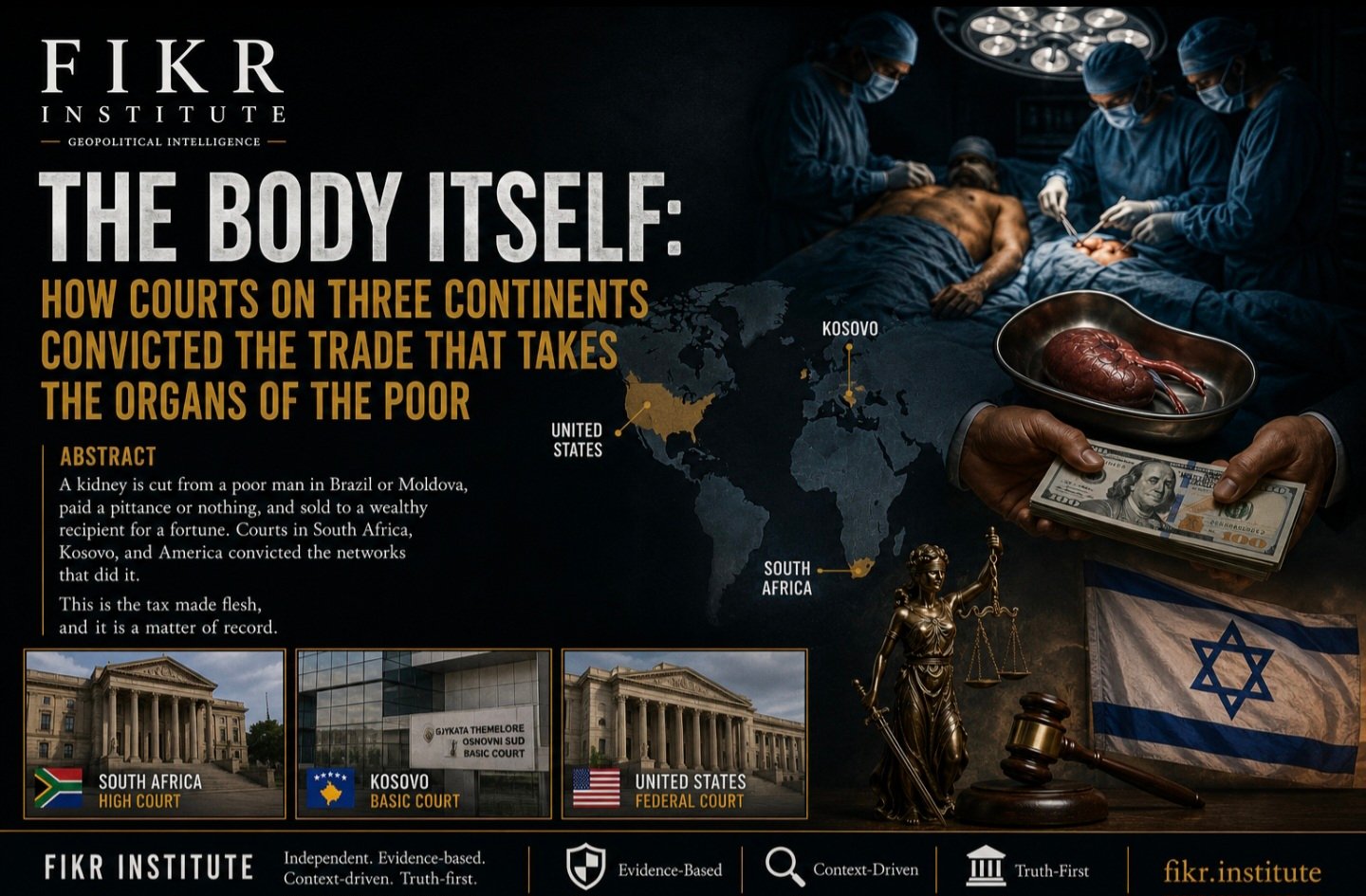
Abstract:
This article, a chapter in a larger work on the global costs of the period this book examines, addresses the trade in human organs under a strict rule, that it relies solely on cases adjudicated in courts of law and indicts only the trade and the individuals convicted of it, never a people or a faith. It documents proven cases, a South African hospital group that pleaded guilty to more than a hundred illegal kidney transplants, admitting donors were paid and some were minors; a Kosovo clinic whose doctors became the first convicted of organ trafficking in the world; a broker convicted of the first proven organ trafficking in the United States; and the court-documented kidney rackets of Pakistan and India. Across them, poor donors from Brazil, Romania, Türkiye, Moldova, and South Asia supplied organs for a pittance to the wealthy. It also addresses, with precise limits, the one admitted instance of unauthorized organ retention by an Israeli forensic institute in the 1990s, distinguishing it firmly from the battlefield-harvesting allegations no court has substantiated, which have served a libel. It argues that the organ trade is the tax made corporeal, the body of the poor extracted for the rich.
Main Article:
Of all the ways in which the cost of the powerful is transferred to the poor, there is one that is more literal than any other, in which the transfer is not of money or of rights or of safety but of the body itself, a piece of flesh cut from one human being and placed into another. This is the trade in human organs, and it is the tax of this book made corporeal, the point at which the extraction from the poor for the benefit of the rich becomes physical, measurable in the scar on the abdomen of a man who sold his kidney for a sum that changed nothing in his life, to a man who bought it for a sum that saved his. This chapter documents that trade, and it does so under a rule stricter than any other in this book, because the subject demands it.
State the rule first, because it is the foundation of everything that follows.
This chapter will rely solely and entirely on cases adjudicated in courts of law, on guilty pleas and criminal convictions, and it will indict only the documented trade and the specific individuals proven in court to have conducted it. It will not traffic in allegation, in the viral claim, or in the unproven charge, and it does so for a reason particular to this subject. The trade in human organs has been, for centuries, the raw material of a vicious libel, the blood accusation, weaponized to incite hatred against a people. This work repudiates that libel absolutely, and the surest defense against it is the discipline of the court record. What follows is not alleged. It was proven, in open court, before judges, and admitted in guilty pleas. That is the standard, and nothing that fails it appears here.
Begin with South Africa, where a major hospital group admitted its guilt in open court.
In November 2010, under the authority of the South African prosecuting service, the Netcare group and its St Augustine Hospital in Durban pleaded guilty to enabling illegal kidney transplants, admitting to more than a hundred such operations conducted between 2001 and 2003. [1] The scheme brought wealthy recipients, many of them Israeli citizens, to South Africa to receive kidneys from impoverished donors sourced first from Israel and then, to lower the cost, from poor Brazilians and Romanians, who were paid a fraction of what the recipients paid and made to sign false documents claiming they were relatives of the people receiving their organs. [2] The details admitted in the plea are among the darkest in the record. The company acknowledged that payments were made to the donors for their kidneys, and that certain of the kidney donors were minors at the time their kidneys were removed. [3] Children, in other words, had their kidneys taken and sold. This is not an allegation. It is a matter admitted in a plea agreement and recorded by the prosecuting authority of a sovereign state, catalogued in the case law of the United Nations office on drugs and crime.
Now Kosovo, where an international court achieved a conviction without precedent in the history of the world.
At the Medicus clinic near Pristina, a network performed illegal kidney transplants on donors lured from Türkiye, Russia, Moldova, and Kazakhstan with promises of payment up to fifteen thousand euros that many never received, while the recipients, mainly Israelis, paid between seventy thousand and a hundred and ten thousand euros for the organs. [4] The case broke when a young Turkish man collapsed at the Pristina airport with a fresh surgical scar, having sold his kidney, and the police who investigated found an elderly recipient still recovering at the clinic. [5] Prosecuted by the European rule of law mission, the case produced, on the twenty-ninth of April 2013, the first conviction of medical doctors for organ trafficking anywhere in the world, the clinic owner and his son and the chief anaesthesiologist found guilty, in a judgment running to a hundred and twenty-five pages that exhaustively reviewed the evidence, a verdict affirmed on appeal and, after a procedural annulment and retrial, affirmed again. [6] One of the judges who decided it has written of it openly, under his own name. This too is not allegation. It is a conviction, entered by an international court, sustained through years of appeal.
And the United States, where a broker admitted in federal court to the first proven organ trafficking in the country.
In New Jersey, a broker pleaded guilty in federal court to arranging illegal kidney transplants for payment, brokering the sale of kidneys from vulnerable donors to recipients for sums in the six figures, the first proven case of organ trafficking in the United States. [7] Across these three adjudicated cases, in South Africa, in Kosovo, and in America, the researchers who have studied the convictions document that the brokers, surgeons, and recipients recurring through them formed interconnected networks, several of the key figures appearing in more than one case, moving the trade from country to country as enforcement closed in. [8] This is the documented structure of the trade, established not by rumor but by the study of the criminal records of three separate jurisdictions, and it is a structure in which, across the proven cases, the recipients were overwhelmingly the wealthy of certain nations and the donors overwhelmingly the poor of others.
And the trade is not confined to those networks, for the same structure operates wherever poverty is deep enough to make a kidney a thing a desperate person will sell, as the documented case of Pakistan shows in its rawest form.
Pakistan was, before it criminalized the commercial organ trade, among the most popular destinations on earth for transplant tourists, the wealthy and the foreign who traveled to buy the kidneys of the poor, and the trade has continued in defiance of the law. In 2023, police in the country broke a ring led by a doctor who had performed 328 kidney operations, selling the organs for as much as thirty-four thousand dollars each, some taken from victims who did not know their kidney had been removed until another physician later told them it was gone. [9] The pattern is documented in case after case, the donors lured with false promises of work or small payments, in one investigation two dozen impoverished men held by force behind barred windows by the gang that harvested them, paid a few thousand dollars while the surgeons took six figures from the recipients. [10] The ratio is the whole story, and it is documented in the enforcement records, donors paid a few hundred thousand rupees while the same kidney was sold to the recipient for seven or eight million, the poor receiving a tenth or less of what the rich paid for the piece of their body. [11] In the words of the reporting on the trade, the poorest are made to act as spare parts for the rich, which is the entire mechanism of this chapter reduced to a single phrase.
India tells the same story, and it tells it with a court conviction at the end. In the Gurgaon kidney scandal exposed in 2008, a network run by a man the court would call a quack performed some five to six hundred kidney transplants over a decade, luring the poor of the surrounding countryside with false promises of work and, in a number of cases, removing their kidneys without their knowledge, the victims discovering only afterward what had been taken from them. [12] The donors were paid between twenty and fifty thousand rupees, a few hundred dollars, while the wealthy recipients, transplant tourists drawn from the United States, Britain, Canada, Saudi Arabia, and Greece, paid tens of thousands, the same pitiless ratio in which the body of the poor is bought cheap and sold dear. [13] In 2013, a special court of the national investigating agency convicted the kingpin and a fellow doctor, sentencing them to rigorous imprisonment and declaring that what they had done was a slur on the nation. [14] Here again the record is a conviction, not an allegation, and here again the pattern holds without variation, the organs of the poor extracted for the survival of the rich, across three continents and now a fourth, the same trade wearing the same shape wherever poverty is deep enough to supply it.
Here the chapter must address, with precision, the one matter in this vicinity that is admitted, and distinguish it sharply from the matter that is not.
In 2009, Israel admitted that in the 1990s its national forensic institute at Abu Kabir had harvested organs and tissue from the bodies of the dead without the consent of their families. [15] This is admitted, confirmed by the former head of the institute, and reported by the international press. But its limits must be stated exactly, because they are the difference between documented fact and libel. The admitted practice concerned tissue taken from bodies already dead, in the 1990s, and it affected bodies of multiple nationalities, Israelis, Palestinians, and foreign workers alike, in a forensic institute whose conduct was a scandal of consent and not a scheme of trade. It is a documented instance of institutional wrongdoing over the handling of the dead. It is emphatically not evidence for the separate and entirely different allegation, that the Israeli military has killed or harvested the organs of living or targeted Palestinians for the organ trade, an allegation that no court has ever substantiated, that rests on no conviction and no admission, and that has served, in its circulation, as a modern vehicle for the ancient blood libel. This work will not repeat that unproven allegation as though it were fact, because to do so would be both false and a betrayal of the discipline on which the credibility of this entire book depends. The admitted forensic scandal is one thing, documented and limited. The battlefield-harvesting claim is another, unproven and dangerous, and the two must never be merged.
So consider what the adjudicated record, and only the adjudicated record, actually establishes, because it is damning enough without a single unproven word.
It establishes that a global trade exists in which the organs of the poor are extracted for the survival of the rich, that this trade was operated through networks convicted in courts on three continents, that its donors were the impoverished of Brazil and Romania and Türkiye and Moldova, paid a pittance or nothing and sometimes children, and that its recipients were the wealthy who could pay a fortune. It establishes that the trade is real, proven, and structured, a documented instance of the body of the poor being harvested, with their coerced or purchased consent, for the benefit of those with the money to buy what they could not otherwise obtain. This is the tax of this book in its most literal and physical form, the transfer from the powerless to the powerful reduced to its bodily essence, an organ moving up the hierarchy of wealth, from a poor body that needed the money to a rich body that needed the organ, brokered by criminals whom the courts have named and convicted.
Here the boundary that governs this work applies, and in this chapter it has governed every line.
What is indicted here is a documented criminal trade and the specific individuals convicted of conducting it, nothing more and nothing less. No people is indicted, and no faith, and the chapter has held itself to the court record precisely to keep it so. The donors in these cases, the poor of several nations, are its victims, and the convicted brokers and surgeons and complicit institutions are its criminals, and the line between them was drawn not by this work but by the courts that heard the evidence. The libel that has attached itself to this subject is repudiated here without qualification, and the repudiation is enacted, not merely asserted, by the refusal to include anything that a court has not proven. The trade is real and it is a cost, and naming it honestly, within the strict bounds of what has been adjudicated, is the opposite of the libel, because the libel deals in the unproven and this chapter deals only in the proven.
So return to the scar on the abdomen, and read in it the full measure of the cost.
A man collapses in an airport with a fresh surgical wound, having sold his kidney for a sum that will not change his life, to a recipient who paid a fortune to receive it. That scar is the tax of this book made flesh, the most literal possible form of the transfer this entire work documents, the body of the poor opened so that a piece of it may be moved into the body of the rich. It happened, it was proven, and the courts of three continents convicted the networks that did it. The cost catalogued here is the smallest in scale of any in this book, measured not in millions but in the individual donor, the individual scar, the individual child whose kidney was taken. But it is the largest in a different sense, because it is the point at which the abstraction of the tax becomes concrete in the most intimate way imaginable, in the flesh of a human being, extracted and sold. The body of the poor is the final frontier of the transfer, and the trade that crosses it is not a rumor. It is a conviction, entered in open court, and the poor who were its donors are owed, at the very least, the truth of what was proven to have been done to them.
References:
1. United Nations Office on Drugs and Crime, SHERLOC case law database. "State v. Netcare Kwa-Zulu Limited," unodc.org, on the November 2010 guilty plea by Netcare Kwa-Zulu and St Augustine Hospital to 102 counts related to illegal kidney transplant operations, the 109 operations conducted between June 2001 and November 2003, and the penalties imposed under the Human Tissue Act 1983 and the Prevention of Organised Crime Act 1998.
2. Allain, J., "Trafficking of Persons for the Removal of Organs and the Admission of Guilt of a South African Hospital," Medical Law Review, Oxford, 2011, and contemporaneous reporting, on the scheme bringing Israeli recipients to South Africa, the sourcing of donors first from Israel and then from poorer Brazilians and Romanians to lower cost, the recipients paying up to ten times what donors received, and the fraudulent documents claiming donors and recipients were related.
3. Reporting on the Netcare plea agreement, 2010, on the company acknowledgment in the plea that payments were made to the donors for their kidneys and that certain of the kidney donors were minors at the time their kidneys were removed.
4. Euronews. "Kosovo Doctors Organ Trafficking Convictions Confirmed," euronews.com, 2018, on the Medicus clinic network recruiting donors from Türkiye and the poorer parts of the former Soviet Union with promises of ten to twelve thousand euros, and the recipients, mainly Israelis, paying seventy thousand to a hundred and ten thousand euros.
5. Balkan Insight. "Kosovo Medicus Case: Bad Omen for Rule of Law," balkaninsight.com, May 2018, on the case beginning in November 2008 when a young Turkish man collapsed at the Pristina airport claiming his kidney had been removed, and the police discovering an elderly Israeli recipient recovering at the clinic.
6. Balkan Insight, May 2018 and July 2023, on the verdict of April 29, 2013 as the first conviction of medical doctors for organ trafficking anywhere in the world, the guilt of the clinic owner Lutfi Dervishi, his son Arban, and the chief anaesthesiologist Sokol Hajdini, the 125-page judgment, the affirmation on appeal, the procedural annulment and retrial, and the reaffirmation of the verdict in May 2018, as recounted by one of the presiding EULEX judges under his own name.
7. Reporting on the New Jersey federal case, 2011, on the guilty plea of the broker Levy Izhak Rosenbaum to arranging illegal kidney transplants for payment, brokering kidneys from vulnerable donors to recipients for six-figure sums, described as the first proven case of organ trafficking in the United States.
8. de Jong, J., "Human Trafficking for the Purpose of Organ Removal," organ trafficking research project doctoral thesis, 2017, on the academic study of the Netcare, Medicus, and Rosenbaum cases as interconnected networks, with several key brokers, surgeons, and recipients recurring across more than one adjudicated case.
9. CNN. "Pakistan: Gang Removed Hundreds of Kidneys to Sell to Wealthy Clients, Police Say," cnn.com, October 3, 2023, on the eastern Pakistan ring led by a doctor accused of conducting 328 kidney-removal operations and selling the organs for up to thirty-four thousand dollars each, with some victims unaware their kidney had been removed, and on Pakistan having been a center of the organ trade for foreigners and wealthy recipients before the 2010 ban.
10. NPR. "In Pakistan, Illegal Kidney Trade Flourishes as Victims Await Justice," npr.org, November 3, 2016, on the impoverished men lured with false promises and held by force by a kidney-trafficking gang, the donors paid at most a few thousand dollars against the six-figure sums paid by recipients including foreign transplant tourists, and the Global Financial Integrity estimate of organ trafficking as among the world most profitable crimes at up to 1.2 billion dollars a year.
11. Reporting on the Federal Investigation Agency raids in Pakistan, 2025 to 2026, corroborated across outlets, on kidney-trafficking networks charging recipients six to ten million rupees per transplant while paying donors only a small fraction, and on the poorest being made to serve as spare parts for the rich.
12. The court record of the Gurgaon kidney scandal, Central Bureau of Investigation special court judgment, and The Caravan, "India Most Notorious Kidney-Transplant Racketeer," 2019, on the network of Amit Kumar performing some five to six hundred kidney transplants over a decade, luring poor donors from the surrounding region with false promises of employment and removing kidneys in a number of cases without the knowledge of the victims.
13. The Gurgaon kidney scandal court record and contemporaneous documentation, and the academic work of Nancy Scheper-Hughes on the global traffic in organs, on the donors being paid roughly twenty to fifty thousand rupees while recipients, transplant tourists from the United States, the United Kingdom, Canada, Saudi Arabia, and Greece, paid tens of thousands of dollars.
14. Central Bureau of Investigation special court verdict of March 2013, on the conviction of the kingpin Amit Kumar and Dr Upender Dublesh with seven years rigorous imprisonment and fines, and the court characterization of their conduct as a slur on the nation.
15. Associated Press reporting, December 2009, on the admission by Israel, confirmed by the former head of the Abu Kabir forensic institute, that in the 1990s the institute harvested organs and tissue from the bodies of the dead, including Israelis, Palestinians, and foreign workers, without the consent of their families; presented here strictly as the documented forensic-consent scandal it was, and expressly distinguished from the separate battlefield-harvesting allegations that no court has substantiated.